


It is no exaggeration to say that what Japan’s Rapidus Corp is trying to do requires the same kind of technical precision and government support as the Apollo missions.
The barely three-year-old state-backed venture aims to leapfrog generations of innovation, vaulting straight into mass production of bleeding-edge 2-nanometer logic chips, the most advanced engines of digital devices — a feat so complex and expensive that just a few chipmakers in the world even dare try it. Attempting the impossible, and requiring a mountain of government funding in the process, give skeptics a lot of ammunition.
If Rapidus pulls it off, however, this attempt could rewrite the history of Japan’s tech industry.
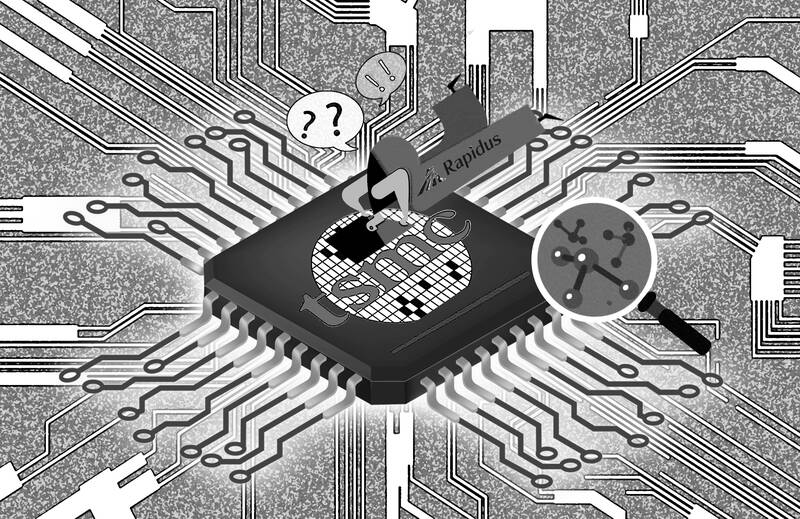
Illustration: Louise Ting
Today, the world relies on Taiwan Semiconductor Manufacturing Co (TSMC), which enjoys a virtual monopoly over the world’s most advanced chips. That dominance was not pre-ordained. When founder Morris Chang (張忠謀) reflected on his decision some 15 years ago to go all-in on what was then the cutting edge — 28-nanometer production — he quoted Shakespeare.
“There is a tide in the affairs of men which, taken at the flood, leads on to fortune,” the now 94-year-old said in a rare interview earlier this year. “I decided that 28-nanometer was going to be our tide.”
It is easy to opine in retrospect, but it was far from a clear bet at the time. The gamble required TSMC to triple its capital spending, a move that Chang said took convincing the board. Competition back then was still fierce and the fallout from the 2008 global financial crisis sowed uncertainty over demand. TSMC’s previous 40-nanometer rollout was beset with yield problems (which refers to how many usable chips come out of production) that threatened ties with one of its most important customers — Nvidia Corp.
It turned out to be one of the defining decisions of TSMC’s existence, launching it to its leadership role in the industry. It coincided with the onset of the smartphone boom and an explosion of demand for ever-smaller chips. For Taiwan, the move unlocked a new era of economic legitimacy, raising its “silicon shield.” Over the years, TSMC cleared the field of many of its rivals.
Japan’s ambitions are on a grander scale, but it faces its own version of that moment. Doing nothing would be easy. Standing still now would risk missing a fleeting opportunity.
The artificial intelligence and data-center boom has intensified global demand for ultra-advanced processors. The pandemic exposed how easily chip shortages can cripple entire industries. And a phone call from a legendary IBM Corp researcher to the now-chairman of Rapidus offered Japan critical knowledge of the making of 2-nanometer chips, giving it a partnership and intellectual jump-start money alone cannot buy.
A sliver of opportunity has opened to rebuild the domestic chip ecosystem it lost decades ago. Geopolitical winds are shifting. The diplomatic firestorm between Japan and China over Taiwan has made the government acutely aware of the risk of depending on a place China claims as its own for the world’s most strategic technology.
Rapidus still faces towering challenges. One of TSMC’s chief advantages is its local supply-chain ecosystem that took decades to build. Japanese firms already make many of the materials required for production, and TSMC’s own expansion in Kumamoto, on the southern Japanese island of Kyushu, underscores its chip manufacturing appeal. Chang himself framed the move as the start of a “renaissance of semiconductors” in the country at an opening ceremony for the TSMC plant last year, suggesting Rapidus could now jump on this bandwagon. Chang’s admiration dates back to the 1980s, when he visited a Japanese factory while at Texas Instruments Inc and found yields double those of its US plants.
Talent is one of the hardest gaps to close. Over the next decade, Japan is forecast to be short at least 40,000 semiconductor engineers — part of a global crunch that even Taiwan has not escaped. Even here there are lessons from TSMC: It has responded by creating a deep-rooted pipeline on the island, launching 57 semiconductor programs across 17 local universities, according to SemiAnalysis. Rapidus’ partnership with Hokkaido University is a start, but much more needs to be done.
Equally critical for Rapidus’ success is winning over the public. TSMC’s ascent in making the world’s most-advanced chips has become a point of national pride in Taiwan, and many believe, a deterrent against the threat of Chinese expansionism. Citizens and armies of retail investors are cheering for its success. For Rapidus to endure the public scrutiny that accompanies such vast government funding, Tokyo needs to articulate, bluntly and repeatedly, the national security stakes. Making tiny pieces of silicon might not be as glamorous as putting a man on the moon, but the geopolitical payoff is just as real. The more Tokyo can drive home the geopolitical glory of restoring chip manufacturing at home, the more likely it would drive support.
The tide is rising — whether Japan rides it or is swept aside is going to define its technological future for decades. In semiconductor production as in Shakespeare, timing is everything.
Catherine Thorbecke is a Bloomberg Opinion columnist covering Asia tech. Previously she was a tech reporter at CNN and ABC News. This column reflects the personal views of the author and does not necessarily reflect the opinion of the editorial board or Bloomberg LP and its owners.
The conflict in the Middle East has been disrupting financial markets, raising concerns about rising inflationary pressures and global economic growth. One market that some investors are particularly worried about has not been heavily covered in the news: the private credit market. Even before the joint US-Israeli attacks on Iran on Feb. 28, global capital markets had faced growing structural pressure — the deteriorating funding conditions in the private credit market. The private credit market is where companies borrow funds directly from nonbank financial institutions such as asset management companies, insurance companies and private lending platforms. Its popularity has risen since
The Donald Trump administration’s approach to China broadly, and to cross-Strait relations in particular, remains a conundrum. The 2025 US National Security Strategy prioritized the defense of Taiwan in a way that surprised some observers of the Trump administration: “Deterring a conflict over Taiwan, ideally by preserving military overmatch, is a priority.” Two months later, Taiwan went entirely unmentioned in the US National Defense Strategy, as did military overmatch vis-a-vis China, giving renewed cause for concern. How to interpret these varying statements remains an open question. In both documents, the Indo-Pacific is listed as a second priority behind homeland defense and
Every analyst watching Iran’s succession crisis is asking who would replace supreme leader Ayatollah Ali Khamenei. Yet, the real question is whether China has learned enough from the Persian Gulf to survive a war over Taiwan. Beijing purchases roughly 90 percent of Iran’s exported crude — some 1.61 million barrels per day last year — and holds a US$400 billion, 25-year cooperation agreement binding it to Tehran’s stability. However, this is not simply the story of a patron protecting an investment. China has spent years engineering a sanctions-evasion architecture that was never really about Iran — it was about Taiwan. The
In an op-ed published in Foreign Affairs on Tuesday, Chinese Nationalist Party (KMT) Chairwoman Cheng Li-wun (鄭麗文) said that Taiwan should not have to choose between aligning with Beijing or Washington, and advocated for cooperation with Beijing under the so-called “1992 consensus” as a form of “strategic ambiguity.” However, Cheng has either misunderstood the geopolitical reality and chosen appeasement, or is trying to fool an international audience with her doublespeak; nonetheless, it risks sending the wrong message to Taiwan’s democratic allies and partners. Cheng stressed that “Taiwan does not have to choose,” as while Beijing and Washington compete, Taiwan is strongest when


 RSS
RSS