


When the history of this tumultuous week in South Korean politics is written, legislators who demanded the president rescind his declaration of martial law would surely be lauded. It is also worth standing back to examine the role that economics has played in the country’s transition to democracy and why that least-worst system of government survived.
The contribution of capitalism — its constraints and opportunities — has been vital. The rhythms of global commerce have been present at key points in South Korea’s journey. It is fair to say that without the thrills and spills of money, there would not have been a mature democracy to protect. That you may not have noticed is a testament to its success and durability.
Of all the potential year-end shocks that traders had gamed out, Tuesday night’s brief, but alarming events did not come close to making the cut. Markets were braced for social media posts on outlandish cabinet picks by US president-elect Donald Trump, new tariff threats and the prospect of a French government implosion, not an attempted coup by South Korean President Yoon Suk-yeol.
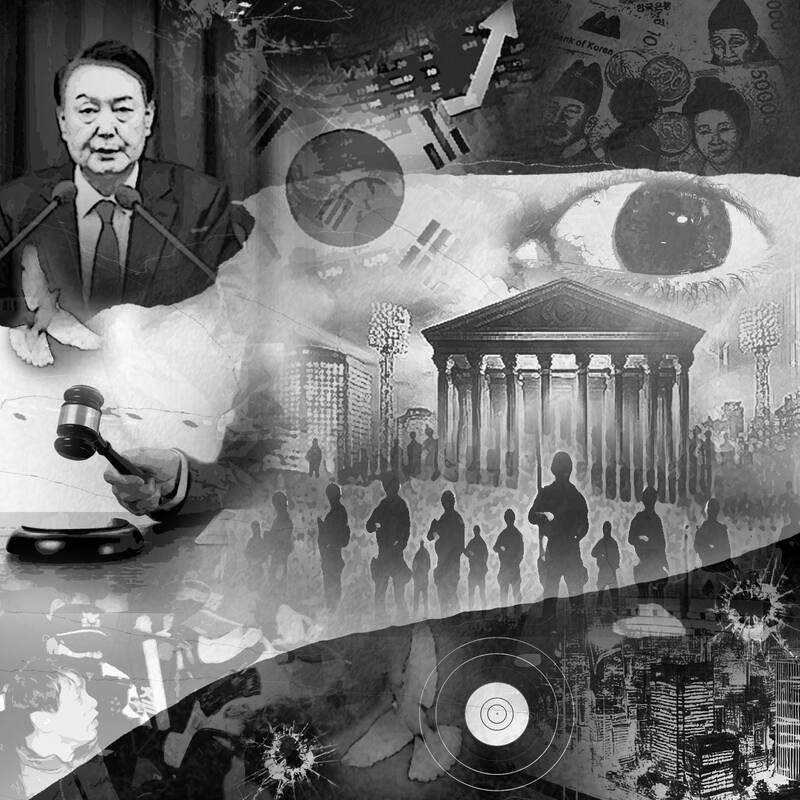
Illustration: Kevin Sheu
The reaction was swift, but contained: The currency tumbled in offshore trading, along with other assets tied to South Korea. By Wednesday morning, after lawmakers rebuked Yoon, the won had recouped losses and bonds were little changed.
Equities fell in local trading, but by no means was it a bloodbath. Regulators were ready to provide ample liquidity. Dramatic gestures such as shutting the stock exchange were eschewed, as were panicky moves such as further interest rate cuts. Officials backstopped the system without fuss.
That is the way it is supposed to work: Instill confidence, not sap it. Textbook central banking.
That does not mean the economy would sail smoothly. GDP rebounded slightly in the third quarter from a modest contraction in the previous three months. The Bank of Korea had already signaled its worries by unexpectedly reducing borrowing costs last week and making concerned noises about a resumption of trade wars. However, a cyclical downdraft is different from a shock that strikes at the heart of the administration. (When I wrote that the country was preparing for bleak days, the would-be putsch was not what I foresaw.)
The good news is that economics and political upheaval have often been strange bedfellows in South Korea — and elsewhere in Asia. As military-backed leaders in Seoul pushed rapid industrialization in the years after the 1950 to 1953 war that left the peninsula divided, it was almost inevitable that prosperity would bring with it a rising middle class that became more aspirational and demanded a greater say in how it was governed. The scrutiny that came with integration in supply chains, inbound and outbound investment, and the price demanded for access to global markets forced South Korea to clean up its act.
Booms also bring busts and Seoul came within an inch of default in the late 1990s during the Asian financial crisis. As wrenching as the meltdown was, it was also part of a big shift in the country’s politics. For the first time, a long-standing opposition politician, Kim Dae-jung, was elected president. Government figures tried to murder him during the dictatorship years, but US intervention kept Kim alive. His moment came and the transition to full democracy was complete.
As lawmakers debated the future of the now disgraced Yoon on Wednesday, former South Korean minister of trade Yeo Han-koo sat down with Bloomberg journalists in Singapore.
I asked him whether, from a historical vantage point, the ebbs and flows of capitalism were effectively the midwife to democracy in Korea.
“Absolutely,” Peterson Institute for International Economics senior fellow Yeo said. “There’s no turning back.”
Financial swings also led to a revolution and, ultimately, a freer system in Indonesia. It has not been perfect; the years after the International Monetary Fund imposed harsh conditions on loans that pushed autocratic, former Indonesian president Suharto out were marred by communal violence and efforts by far flung provinces to break away. Although Suharto’s son-in-law, Prabowo Subianto, now sits in the presidential office, he had to get there the hard way — via the ballot box. In Malaysia, former prime minister Mahathir Mohamad held on to power for a few years after the financial collapse, but the ructions it produced cemented Anwar Ibrahim as the leading alternative. Anwar became premier in 2022 and presides over a sprawling coalition that, against the odds, he has held together.
There are exceptions to these encouraging stories: China did not democratize as its economy flourished and markets took shape. If anything, it has gone in the opposite direction: Chinese President Xi Jinping (習近平) has accrued more personal authority than any leader since Mao Zedong (毛澤東). Perhaps the moral is you have to be very big to stand against the forces that thriving capitalism and an open economy unleash. Taiwan did manage the transition after decades of enviable growth.
Governance can take detours, as Koreans have found out. However, the necessities of operating within the global economic system also bring checks on the power of ambitious leaders. Let us salute the people of South Korea, but also the not-so-invisible hand of commercial priorities.
Daniel Moss is a Bloomberg Opinion columnist covering Asian economies. Previously, he was executive editor for economics at Bloomberg News.
In a summer of intense political maneuvering, Taiwanese, whose democratic vibrancy is a constant rebuke to Beijing’s authoritarianism, delivered a powerful verdict not on China, but on their own political leaders. Two high-profile recall campaigns, driven by the ruling party against its opposition, collapsed in failure. It was a clear signal that after months of bitter confrontation, the Taiwanese public is demanding a shift from perpetual campaign mode to the hard work of governing. For Washington and other world capitals, this is more than a distant political drama. The stability of Taiwan is vital, as it serves as a key player
Yesterday’s recall and referendum votes garnered mixed results for the Chinese Nationalist Party (KMT). All seven of the KMT lawmakers up for a recall survived the vote, and by a convincing margin of, on average, 35 percent agreeing versus 65 percent disagreeing. However, the referendum sponsored by the KMT and the Taiwan People’s Party (TPP) on restarting the operation of the Ma-anshan Nuclear Power Plant in Pingtung County failed. Despite three times more “yes” votes than “no,” voter turnout fell short of the threshold. The nation needs energy stability, especially with the complex international security situation and significant challenges regarding
Much like the first round on July 26, Saturday’s second wave of recall elections — this time targeting seven Chinese Nationalist Party (KMT) lawmakers — also failed. With all 31 KMT legislators who faced recall this summer secure in their posts, the mass recall campaign has come to an end. The outcome was unsurprising. Last month’s across-the-board defeats had already dealt a heavy blow to the morale of recall advocates and the ruling Democratic Progressive Party (DPP), while bolstering the confidence of the KMT and its ally the Taiwan People’s Party (TPP). It seemed a foregone conclusion that recalls would falter, as
The fallout from the mass recalls and the referendum on restarting the Ma-anshan Nuclear Power Plant continues to monopolize the news. The general consensus is that the Democratic Progressive Party (DPP) has been bloodied and found wanting, and is in need of reflection and a course correction if it is to avoid electoral defeat. The Chinese Nationalist Party (KMT) has not emerged unscathed, either, but has the opportunity of making a relatively clean break. That depends on who the party on Oct. 18 picks to replace outgoing KMT Chairman Eric Chu (朱立倫). What is certain is that, with the dust settling


 RSS
RSS