


India’s friends and partners are clearly feeling a growing sense of disquiet right now.
Relations between Canada and India reached a new low this week, when New Delhi’s ambassador to Ottawa was either recalled or expelled, depending on who you believe. That came after the Royal Canadian Mounted Police (RCMP) declared that they had evidence of “links tying agents of the Government of India to homicides and violent acts.”
The RCMP wanted to interview the ambassador about the killing in June last year of the Sikh separatist leader Hardeep Singh Nijjar. When the Indians refused, the Canadian Ministry of Foreign Affairs claimed it had no alternative but to expel him and five other diplomats.
This has set off a firestorm in New Delhi. There is a great deal of anger at what appears — from an Indian perspective — to be three irresponsible acts by Canadian authorities.
First, separatist activists that India views as dangerous extremists are allowed to thrive in Canada, and even given space within the formal political spectrum.
Second, accusations linking Indian officials to at least one murder on Canadian soil have been publicized without detailed evidence to back up those claims.
Third, Ottawa has raised the stakes by demanding to interview the ambassador, the longest-serving Indian diplomat and a man with no history of involvement in intelligence or connections to the national security establishment.
There is a stark contrast with the way the US has dealt with some very similar allegations about Indian actions on US soil.
Washington refrained from making anything public except through court submissions; ensuring there was evidence backing up each accusation. While senior US officials have largely been silent, insisting the judicial system had to be given time and space, Canadian Prime Minister Justin Trudeau has repeatedly raised the issue.
India has made “a massive mistake,” he said on Wednesday.
Meanwhile, the US briefed the press this week that India had sacked an intelligence operative who had been accused of an attempted assassination in the US.
The problem for New Delhi is that its official denials have only imperfectly distanced the nation from Nijjar’s killing. The tone and content are too much at variance. Canada might have provided no evidence of official Indian involvement, but the public’s reaction has been overwhelmingly positive, which has led to some decidedly mixed messaging. “We didn’t kill him, but we had every right to” is not very effective rhetoric.
India must recognize that the intemperate nature of its rhetoric — official and unofficial — might trouble our friends every bit as much as any as-yet-unproven accusations. Now is the time to try to stem growing disquiet about how India acts abroad, not give it reasons to grow.
For example, it is not necessary to say Trudeau has a “deliberate strategy of smearing India for political gains,” or that “India reserves the right to take further steps in response” to Canadian “support for extremism, violence and separatism against India.”
Officials would argue that, although countries from the US to Australia would pay lip service to Canadian judicial independence and the integrity of its processes, they would continue to increase cooperation with India. In their minds, India is indispensable, and everyone has to engage with us.
However, that sort of misses the point. Over the past year, I have noticed that investors who previously had no real interest in Indian politics or its geopolitical stance have begun asking careful questions of their interlocutors there. Stories like that of the Nijjar killing, and New Delhi’s response to it, tend to cut through the noise and make their way to even those who had been otherwise oblivious.
Everyone would continue to engage with India, but the quality of the engagement depends on how much it can be trusted; and that in turn depends on whether it has shown a willingness to trust others.
Countries have carried out targeted assassinations before, but they have rarely done it on friendly soil; and if so, they have not tried to make political capital out of it. If India is doing things like that, the West would think, then this is a relationship without trust. It is merely transactional.
However, it is in New Delhi’s interest for relationships in domains from intelligence sharing to high-tech investment to be less transactional. India simply does not have enough to offer at the moment. It might in the future — but today, it is asking for things on trust.
As disquiet about India grows, trust in India dies. We need to be a little less sanguine about how we are seen around the world. It might be tempting to beat up on polite Canada and throw our weight around, but it is hardly in New Delhi’s long-term interest to be seen as a bully.
Mihir Sharma is a Bloomberg Opinion columnist. A senior fellow at the Observer Research Foundation in New Delhi, he is the author of Restart: The Last Chance for the Indian Economy. This column does not necessarily reflect the opinion of the editorial board or Bloomberg LP and its owners.
A gap appears to be emerging between Washington’s foreign policy elites and the broader American public on how the United States should respond to China’s rise. From my vantage working at a think tank in Washington, DC, and through regular travel around the United States, I increasingly experience two distinct discussions. This divergence — between America’s elite hawkishness and public caution — may become one of the least appreciated and most consequential external factors influencing Taiwan’s security environment in the years ahead. Within the American policy community, the dominant view of China has grown unmistakably tough. Many members of Congress, as
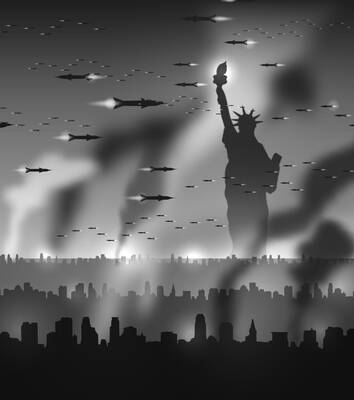
After declaring Iran’s military “gone,” US President Donald Trump appealed to the UK, France, Japan and South Korea — as well as China, Iran’s strategic partner — to send minesweepers and naval forces to reopen the Strait of Hormuz. When allies balked, the request turned into a warning: NATO would face “a very bad” future if it refused. The prevailing wisdom is that Trump faces a credibility problem: having spent years insulting allies, he finds they would not rally when he needs them. That is true, but superficial, as though a structural collapse could be caused by wounded feelings. Something
Former Taipei mayor and Taiwan People’s Party (TPP) founding chairman Ko Wen-je (柯文哲) was sentenced to 17 years in prison on Thursday, making headlines across major media. However, another case linked to the TPP — the indictment of Chinese immigrant Xu Chunying (徐春鶯) for alleged violations of the Anti-Infiltration Act (反滲透法) on Tuesday — has also stirred up heated discussions. Born in Shanghai, Xu became a resident of Taiwan through marriage in 1993. Currently the director of the Taiwan New Immigrant Development Association, she was elected to serve as legislator-at-large for the TPP in 2023, but was later charged with involvement
Out of 64 participating universities in this year’s Stars Program — through which schools directly recommend their top students to universities for admission — only 19 filled their admissions quotas. There were 922 vacancies, down more than 200 from last year; top universities had 37 unfilled places, 40 fewer than last year. The original purpose of the Stars Program was to expand admissions to a wider range of students. However, certain departments at elite universities that failed to meet their admissions quotas are not improving. Vacancies at top universities are linked to students’ program preferences on their applications, but inappropriate admission


 RSS
RSS