


We have forgotten the true virtues of money. We commonly view it in purely instrumental terms — as a device that facilitates exchange and stores value over time. Compared with bartering, coins and paper currency are profoundly convenient, but money is more than just an instrument.
As Fyodor Dostoevsky famously observed: “Money is minted freedom.” It supports our existence as autonomous individuals in a decentralized economy.
However, the situation will be very different if we someday live in a world governed by an artificial intelligence (AI) endowed with complete information and infinite processing capabilities. Under those conditions, there might no longer be any role for money.
To understand how money sets us free, consider any chain of transactions. When we receive money, we are in control. It is up to us to decide whether to hoard it or to spend it on whatever we choose. Only money gives us that capability. Money, moreover, is universal. It allows you to buy anything, anytime, from anyone — and that seller increasingly can be located anywhere. This specific freedom comes not from wealth, but from the possibility of choice.
This choice must not be taken for granted, because payment instruments have always been susceptible to paternalistic interference. In the 19th century, some firms would pay their employees with scrip that was only accepted in company-owned stores. And nowadays, technology makes it possible to issue “programmable money” with a special purpose, limited use and even a pre-emption date. Such digital tokens could be used to prohibit “non-virtuous” consumption (such as alcohol or tobacco) by recipients of public assistance.
We need money because we live in a market economy, not a preprogrammed world. Holding money protects us against uncertainty. It has an “option value,” in economic parlance.
The demand for money increases sharply during crises, because people need to be prepared for all contingencies.
Now fast-forward to a future where machines organize, decide and execute all economic activities. They transact among themselves, credit and debit reciprocal accounts, and automatically ensure discipline and the enforcement of contracts. There is no failure and no default. Do we still need money?
Such a world is already partly in view.
A decade ago, Google chief economist Hal Varian said that “there is a computer in the middle of each transaction” across our digitized economy.
Many of our daily acts are automated, algorithmic trading dominates in many securities markets and payments are increasingly programmed.
If cryptocurrency advocates’ vision of the future materializes, “smart contracts” would govern financial intermediation in a universe of decentralized finance. Some people even suggest that, in conducting monetary policy, sophisticated algorithms could replace central bankers.
For now, though, we merely use the machines. Humans still make decisions as free agents, expressing preferences and acting on them. Central banks do not blindly follow rules. They make judgements after considering difficult tradeoffs, especially in times of crisis or when facing negative supply shocks.
In fact, in an automated economy with human control, money is more necessary than ever, but it must adapt now that digitization has collapsed distance and time.
Money, too, must be digital, taking the form of tokens on our mobile phones — an e-cash that can be transferred instantly across the world without having to transit through a complex web of accounts and counterparties.
A threshold would be crossed with AI. Some scenarios project a universe where AIs do not simply process information and execute commands, but also make decisions and even determine their own objectives. They would be the “agents,” acting on preferences that might not necessarily align with those of humans.
With these capabilities, an AI could take over the allocation of resources and the distribution of income. It would assess the millions of possible economic equilibria and identify the one it considers preferable. This vision of “techno-socialism” is very far from the model of a decentralized, free society. It would be a high-tech version of old-fashioned communist central planning.
Debates about the future of AI often refer to the “singularity,” meaning a point when AIs have the ability to improve and augment themselves, thus rapidly surpassing humans in all measures of intelligence. In this scenario, humans would no longer control their own destiny.
Will it ever happen? There are huge disagreements among AI experts, but money can serve as the ideal indicator. The best sign that AI has effectively taken over would be if money becomes irrelevant in economic life.
A moneyless world might be technically feasible, but whether it would be worth living in is another matter.
Jean-Pierre Landau is an associate professor of economics at the Paris Institute of Political Studies.
Copyright: Project Syndicate
A gap appears to be emerging between Washington’s foreign policy elites and the broader American public on how the United States should respond to China’s rise. From my vantage working at a think tank in Washington, DC, and through regular travel around the United States, I increasingly experience two distinct discussions. This divergence — between America’s elite hawkishness and public caution — may become one of the least appreciated and most consequential external factors influencing Taiwan’s security environment in the years ahead. Within the American policy community, the dominant view of China has grown unmistakably tough. Many members of Congress, as
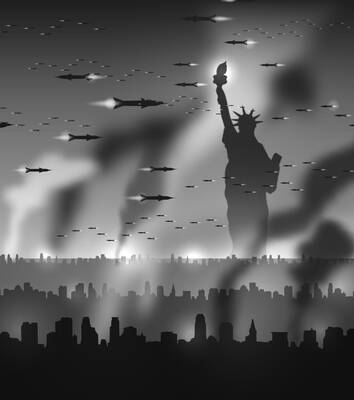
After declaring Iran’s military “gone,” US President Donald Trump appealed to the UK, France, Japan and South Korea — as well as China, Iran’s strategic partner — to send minesweepers and naval forces to reopen the Strait of Hormuz. When allies balked, the request turned into a warning: NATO would face “a very bad” future if it refused. The prevailing wisdom is that Trump faces a credibility problem: having spent years insulting allies, he finds they would not rally when he needs them. That is true, but superficial, as though a structural collapse could be caused by wounded feelings. Something
Former Taipei mayor and Taiwan People’s Party (TPP) founding chairman Ko Wen-je (柯文哲) was sentenced to 17 years in prison on Thursday, making headlines across major media. However, another case linked to the TPP — the indictment of Chinese immigrant Xu Chunying (徐春鶯) for alleged violations of the Anti-Infiltration Act (反滲透法) on Tuesday — has also stirred up heated discussions. Born in Shanghai, Xu became a resident of Taiwan through marriage in 1993. Currently the director of the Taiwan New Immigrant Development Association, she was elected to serve as legislator-at-large for the TPP in 2023, but was later charged with involvement
Out of 64 participating universities in this year’s Stars Program — through which schools directly recommend their top students to universities for admission — only 19 filled their admissions quotas. There were 922 vacancies, down more than 200 from last year; top universities had 37 unfilled places, 40 fewer than last year. The original purpose of the Stars Program was to expand admissions to a wider range of students. However, certain departments at elite universities that failed to meet their admissions quotas are not improving. Vacancies at top universities are linked to students’ program preferences on their applications, but inappropriate admission


 RSS
RSS