


Cursing, biting, blocking, kicking and grabbing... What has the Legislative Yuan become?
After the communist states in Eastern Europe collapsed at the end of the 20th century, they have walked toward liberalization. However, perhaps the difference between them and Taiwan lies in the incompleteness of the latter’s transitional justice, as the Chinese Nationalist Party (KMT) and Taiwan People’s Party (TPP) with a party-state ideology from the old political system remain, and their national identity is entangled with the People’s Republic of China (PRC) due to their pro-China sympathies.
The KMT and TPP seem to be intent on creating chaos.
The Legislative Yuan and Executive Yuan are different national governing bodies, and along with the Judicial Yuan, the Examination Yuan and the Control Yuan, they form a “separation of powers.”
The five-power system was originally established by Republic of China (ROC) founder Sun Yat-sen (孫逸仙), and is a tailor-made system for the ROC.
However, the KMT does not value the opportunity for normal democratic development after Taiwan’s democratization and is now abusing the party’s slim legislative majority.
The TPP is also failing to live up to public expectations as a young upstart party and echoes the KMT, which has been haunted by the party-state ideology and has failed to reform itself.
The TPP’s role is helping the wicked do wicked deeds.
If we look at the forms and rituals of Taiwan’s political system, the Executive Yuan and Legislative Yuan are counterparts: The Executive Yuan proposes policy and budget plans to the Legislative Yuan, while the Legislative Yuan questions the Executive Yuan’s officials and reviews the budgets, thus forming a “ritual relationship” in politics. As a result, the executive and legislative branches have their own powers and functions.
The Constitution of Taiwan adopts a “presidential system,” and our president is similar to a head of state with the status of a monarch, but the president is elected by the people to a term of office.
While the country is governed by the premier and members of the Cabinet, the president has the power to appoint the premier and is in charge of national defense and foreign affairs.
Regarding national governance, the Legislative Yuan’s counterpart is the Executive Yuan, in accordance with the constitution of the ROC since its establishment in China. After undergoing several constitutional amendments in Taiwan, the Constitution has become the current form.
The Constitution is made up of terms and conditions, while the executive and legislative branches, empowered by the Constitution, are the governing bodies in reality.
During the KMT government’s rule after it came to Taiwan in the mid-20th century, it adopted the Temporary Provisions for the Period of National Mobilization in Suppression of Communist Rebellion (動員勘亂時期臨時條款) and froze some of the people’s rights to enforce a dictatorial and authoritarian rule.
During the Martial Law period from 1949 to 1987, which lasted for 38 years, there were more “politicos” (政棍) than “politicians” (政客), and only a few “statesmen” (政治家) in Taiwan.
Today, some KMT legislators are still ignorant and incompetent, and several lawmakers are even local heavyweights with criminal backgrounds trying to “bleach” themselves through elections. These “new thieves” have been acting more recklessly than the “old thieves” of the past.
Lee Min-yung is a poet.
Translated by Eddy Chang
A gap appears to be emerging between Washington’s foreign policy elites and the broader American public on how the United States should respond to China’s rise. From my vantage working at a think tank in Washington, DC, and through regular travel around the United States, I increasingly experience two distinct discussions. This divergence — between America’s elite hawkishness and public caution — may become one of the least appreciated and most consequential external factors influencing Taiwan’s security environment in the years ahead. Within the American policy community, the dominant view of China has grown unmistakably tough. Many members of Congress, as
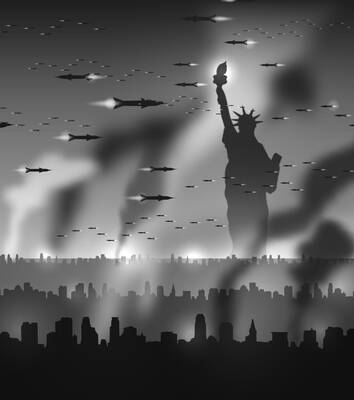
After declaring Iran’s military “gone,” US President Donald Trump appealed to the UK, France, Japan and South Korea — as well as China, Iran’s strategic partner — to send minesweepers and naval forces to reopen the Strait of Hormuz. When allies balked, the request turned into a warning: NATO would face “a very bad” future if it refused. The prevailing wisdom is that Trump faces a credibility problem: having spent years insulting allies, he finds they would not rally when he needs them. That is true, but superficial, as though a structural collapse could be caused by wounded feelings. Something
Former Taipei mayor and Taiwan People’s Party (TPP) founding chairman Ko Wen-je (柯文哲) was sentenced to 17 years in prison on Thursday, making headlines across major media. However, another case linked to the TPP — the indictment of Chinese immigrant Xu Chunying (徐春鶯) for alleged violations of the Anti-Infiltration Act (反滲透法) on Tuesday — has also stirred up heated discussions. Born in Shanghai, Xu became a resident of Taiwan through marriage in 1993. Currently the director of the Taiwan New Immigrant Development Association, she was elected to serve as legislator-at-large for the TPP in 2023, but was later charged with involvement
Out of 64 participating universities in this year’s Stars Program — through which schools directly recommend their top students to universities for admission — only 19 filled their admissions quotas. There were 922 vacancies, down more than 200 from last year; top universities had 37 unfilled places, 40 fewer than last year. The original purpose of the Stars Program was to expand admissions to a wider range of students. However, certain departments at elite universities that failed to meet their admissions quotas are not improving. Vacancies at top universities are linked to students’ program preferences on their applications, but inappropriate admission


 RSS
RSS