


It is the ultimate act of bad faith. The UN has decided to exclude women from its upcoming global conference on Afghanistan. Why? The Taliban, it seems, insisted on it.
The Islamic fundamentalist group was not invited to the first meeting in May last year, and refused to attend the next one in February because the UN would not accept the list of preconditions for its participation. “These conditions, first of all, denied us the right to talk to other representatives of the Afghan society and demanded a treatment that would, I would say, to a large extent be similar to recognition” of the Taliban as the governing authority, UN Secretary-General Antonio Guterres said at the time. So what has changed?
It is unclear what led the UN to agree to the Taliban’s demands for the talks in Doha that begin today, although the global body said: “This sort of engagement is not legitimization or normalization.” I would call it something else. An egregious breach of trust — one that places security and counterterrorism concerns above the rights of women, girls and minorities.
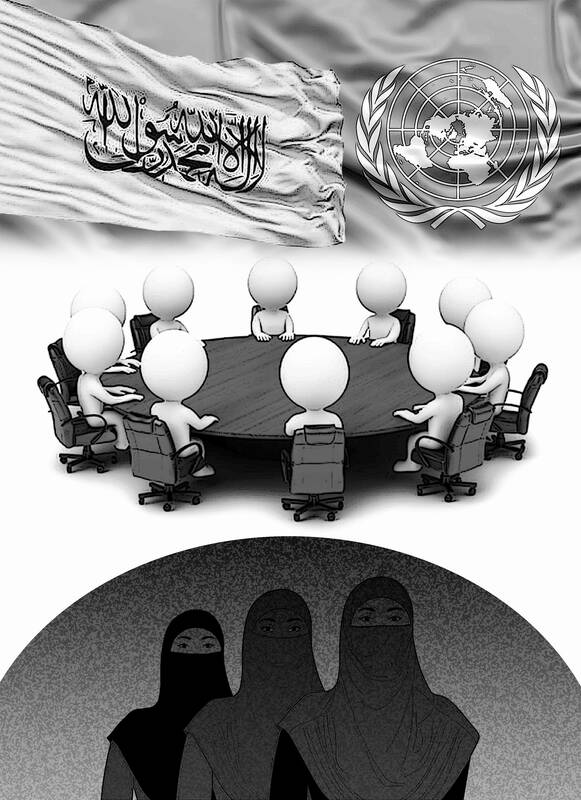
Illustration: Constance Chou
As important as the Taliban’s presence at the meeting is — the US and its allies see the Taliban’s battle against the Islamic State-Khorasan group as vital to controlling the threat of terrorism emanating from Central Asia — there were other options beyond surrendering human rights to extremists.
In November last year, the UN laid out a road map for engagement with the Taliban that required improvements in women’s rights before the UN would consider officially recognizing it as the country’s governing entity. A month later, the UN Security Council called for Afghan women to be involved in the political process and for the establishment of a special envoy for Afghanistan to coordinate international engagement. It is also considering recommendations to recognize “gender apartheid” as a crime against humanity.
In every aspect, the UN is dragging its feet. There is no special envoy, and no sign of movement on gender apartheid.
UN Special Rapporteur on Afghanistan Richard Bennett last week presented a comprehensive set of recommendations for dismantling the Taliban’s institutionalized system of gender oppression. They involve tackling the culture of impunity that has long existed in Afghanistan by punishing crimes committed by the Taliban, its agents and supporters. This can be done via “universal jurisdiction” which enables a state to prosecute perpetrators of the most serious international offenses regardless of where they were committed or the nationality of the perpetrators and the victims.
Bennett’s report makes for grim reading. It documents discrimination, segregation, disrespect for human dignity and exclusion, motivated by the Taliban’s profound rejection of women and girls’ humanity. They now have increasingly narrow roles: as bearers and rearers of children, and as objects available for exploitation, including debt bondage, domestic servitude and sexual exploitation. Women and girls are banned from education beyond sixth grade.
In March, the Taliban issued an order that women be stoned to death for so-called “moral crimes.”
There are efforts under way to initiate a case at the International Court of Justice (ICJ), and it is here that the global community could make a difference. It takes just one country that is a signatory to the Convention on the Elimination of All Forms of Discrimination Against Women to step up. Bennett also calls for better funding for a separate investigation by the International Criminal Court (ICC) into crimes against humanity and war crimes committed in Afghanistan since May 2003. He said that Afghans were frustrated with the lengthy preliminary examination and investigation. (ICJ decisions are subject to enforcement by the UN Security Council, but each of the five permanent members can veto any decision, while the ICC does not have its own enforcement body. It relies on countries to make arrests, freeze suspects’ assets and enforce sentences).
Importantly, Bennett says that nations should “avoid normalization or legitimization of the de facto authorities” until the human rights situation improves, especially for women and girls. It is hard to understand why another arm of this global body meant to defend and protect human rights would do the opposite of what its own expert is recommending.
Human Rights Watch Women’s Rights Division associate director Heather Barr said it is “enraging” that the UN has done this. “There are certain lines they shouldn’t cross,” she told me. “This is one of them.”
Not surprisingly, Afghan women and human rights defenders are calling for nations to boycott this meeting. That would present a dilemma for many countries, particularly those committed to gender justice and concerned about the rise in terrorist activities that originate in Afghanistan.
Since its inception in 2015, Islamic State-Khorasan (IS-K) — named for the historic region encompassing parts of Afghanistan, Iran and Central Asia — has expanded its international reach. The attack on a Moscow concert in March that killed more than 140 people, as well as suicide bombings in Iran that claimed 95 lives in January, were both linked to IS-K. Earlier this month, eight people from Tajikistan, some with suspected ties to the Islamic State, were arrested in the US.
However, while the Taliban might be attempting to shut down IS-K, it is still uncomfortably close to al-Qaeda — indeed the UN reported in June last year that several al-Qaeda leaders have been given key posts within the regime.
The world cannot afford to offer the Taliban some kind of clemency over its human rights abuses simply because it is resisting another terrorist group. That is the worst kind of foreign policy. International organizations and national governments must abandon the idea, once and for all, that the rights of women and girls are there to be traded off at will. They are not.
Ruth Pollard is a Bloomberg Opinion managing editor. Previously she was South and Southeast Asia government team leader at Bloomberg News and Middle East correspondent for the Sydney Morning Herald. This column does not necessarily reflect the opinion of the editorial board or Bloomberg LP and its owners.

A gap appears to be emerging between Washington’s foreign policy elites and the broader American public on how the United States should respond to China’s rise. From my vantage working at a think tank in Washington, DC, and through regular travel around the United States, I increasingly experience two distinct discussions. This divergence — between America’s elite hawkishness and public caution — may become one of the least appreciated and most consequential external factors influencing Taiwan’s security environment in the years ahead. Within the American policy community, the dominant view of China has grown unmistakably tough. Many members of Congress, as

After declaring Iran’s military “gone,” US President Donald Trump appealed to the UK, France, Japan and South Korea — as well as China, Iran’s strategic partner — to send minesweepers and naval forces to reopen the Strait of Hormuz. When allies balked, the request turned into a warning: NATO would face “a very bad” future if it refused. The prevailing wisdom is that Trump faces a credibility problem: having spent years insulting allies, he finds they would not rally when he needs them. That is true, but superficial, as though a structural collapse could be caused by wounded feelings. Something
Former Taipei mayor and Taiwan People’s Party (TPP) founding chairman Ko Wen-je (柯文哲) was sentenced to 17 years in prison on Thursday, making headlines across major media. However, another case linked to the TPP — the indictment of Chinese immigrant Xu Chunying (徐春鶯) for alleged violations of the Anti-Infiltration Act (反滲透法) on Tuesday — has also stirred up heated discussions. Born in Shanghai, Xu became a resident of Taiwan through marriage in 1993. Currently the director of the Taiwan New Immigrant Development Association, she was elected to serve as legislator-at-large for the TPP in 2023, but was later charged with involvement
Out of 64 participating universities in this year’s Stars Program — through which schools directly recommend their top students to universities for admission — only 19 filled their admissions quotas. There were 922 vacancies, down more than 200 from last year; top universities had 37 unfilled places, 40 fewer than last year. The original purpose of the Stars Program was to expand admissions to a wider range of students. However, certain departments at elite universities that failed to meet their admissions quotas are not improving. Vacancies at top universities are linked to students’ program preferences on their applications, but inappropriate admission


 RSS
RSS