


A scandal involving allegedly leaked papers and irregular scoring in a government-run Indian medical entrance exam has exposed a deeper fault line. By controlling the choice of the nation’s doctors, Indian Prime Minister Narendra Modi’s administration is pushing its hard-right Hindu agenda into the heart of the nation’s health and education systems.
The nationwide test conducted last month had 2.4 million aspirants jostling for 100,000 seats in the country’s medical colleges. The results, when they were announced this month, were nothing less than shocking. As many as 67 students had scored perfect marks, which not more than two or three candidates achieve usually.
It does not end there. As Maheshwer Peri, the founder of Careers360, an information provider on higher education, explained, the number of students who have scored enough for admission to a decent college has jumped threefold this year.
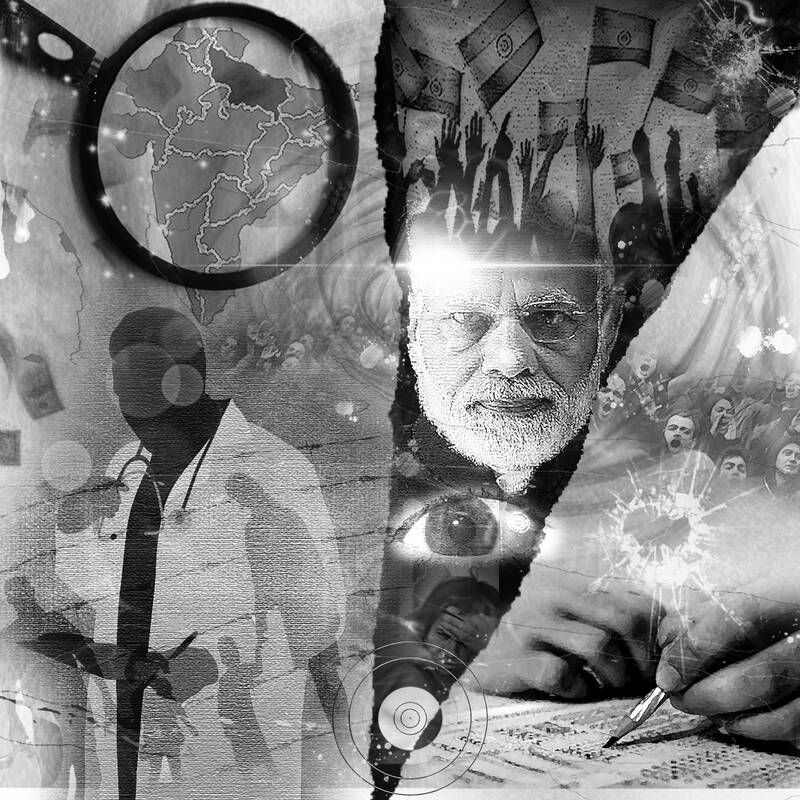
Illustration: Kevin Sheu
With this kind of grade inflation, good institutions will be out of reach of many deserving candidates.
The sanctity of the examination has been hit, says the Indian Supreme Court. “We need answers for that,” the judges told the lawyers for the National Testing Agency last week, after students and parents alleged that the paper had been leaked.
The federal government has promised to look into any malpractices, although it insists there was no scam.
Opposition parties claim that it was exactly that.
The public outrage is helping to shine a spotlight on what progressive states like Tamil Nadu have been saying since before the nationwide test was imposed on them as the sole criterion for admission into medical schools by a judicial decision in 2016. This centralized method of selecting future doctors discriminates against pupils whose parents are undereducated or cannot afford tutoring. The bias works against students from rural areas, robbing them of physicians who would want to live among them.
Tamil Nadu has 11 percent of the country’s doctors with 6 percent of its population, thanks to the medical colleges it directly funds. Why should it accept a dodgy test from New Delhi that drives its own underprivileged students to despair, or worse?
Repeated shots at the annual exam, which is how seven out of 10 seats get filled nowadays, is a 1 million rupee (US$12,000) investment in test-prep services, not counting the opportunity cost of sitting at home. Low-income families cannot compete.
The common test might have been designed to address the demand-supply mismatch caused by limited opportunities for professional education and the teeming multitudes of hopefuls wanting to get trained, but it is fundamentally a political project.
High-schoolers in India, if they go to a private or federally controlled institution, follow a national curriculum. (The very affluent are increasingly choosing the international baccalaureate course.)
However, the less well-to-do young people in state-aided schools are doing what they always have: study from books written for local students — often in the region’s language. An exam that overlooks the differences in schooling offered by the boards of 28 states emaciates local education. It does so by creating an incentive for parents to move away from state curriculums, which, in turn, helps the Modi government push its own narratives into the classroom as history.
Under his Bharatiya Janata Party (BJP), India’s Islamic rulers have almost vanished from books of the central board. As have the details around the assassination of Mahatma Gandhi in 1948 — by a Hindu nationalist.
The 1992 destruction of a 16th-century mosque, now the site of a Hindu temple, has been dropped from political science textbooks of high-school seniors.
Several states follow the lead of the central board and use these texts, while others do not.Some BJP leaders have even tried to float the trial balloon of “one nation, one syllabus.” In other words, the jostling over who should control the supply of doctors — New Delhi or individual states — is not a contest about physics, biology or chemistry, but history.
This poses a challenge to India’s south. Being in charge of local textbooks has allowed the economically more prosperous Tamil Nadu to organize its politics around a linguistic identity, shared by minorities such as Muslims and Christians, and present it as a more authentic alternative to the pro-Hindu ideology raining down from the impoverished north. So far, the experiment has been successful. The BJP did not win a single parliamentary seat from Tamil Nadu in the recently concluded elections, which brought Modi back as prime minister for a third term.
A national test is a threat to this political autonomy. Since the introduction of the competition, the graduating cohort at Tamil Nadu’s state-run schools has shrunk by 14 percent. Tamil-medium schools have also experienced a decline. Federal encroachment worries other southern states, too. Kerala’s recently introduced gender-neutral textbooks are trying to smash ingrained ideas around patriarchy. Modernization of attitudes could be stopped, even reversed, by homogenizing education.
The world view of previous generations of Indians was shaped by texts promoted by a secular republic. Competition for college was always fierce, but at least the government did not require students to gloss over Gandhi’s assassination to have a shot at a career.
Engineering amnesia about the past is what a nationwide medial entrance exam will achieve — by downgrading state education boards and nudging families toward the national curriculum. That is the reason it needs to go and not just because of allegedly leaked papers.
This year’s testing fiasco will no doubt crush many dreams, but if states regain the power to set their own entrance criteria, it might save many more others.
Andy Mukherjee is a Bloomberg Opinion columnist covering industrial companies and financial services in Asia. Previously, he worked for Reuters, the Straits Times and Bloomberg News. This column does not necessarily reflect the opinion of the editorial board or Bloomberg LP and its owners.
A gap appears to be emerging between Washington’s foreign policy elites and the broader American public on how the United States should respond to China’s rise. From my vantage working at a think tank in Washington, DC, and through regular travel around the United States, I increasingly experience two distinct discussions. This divergence — between America’s elite hawkishness and public caution — may become one of the least appreciated and most consequential external factors influencing Taiwan’s security environment in the years ahead. Within the American policy community, the dominant view of China has grown unmistakably tough. Many members of Congress, as
After declaring Iran’s military “gone,” US President Donald Trump appealed to the UK, France, Japan and South Korea — as well as China, Iran’s strategic partner — to send minesweepers and naval forces to reopen the Strait of Hormuz. When allies balked, the request turned into a warning: NATO would face “a very bad” future if it refused. The prevailing wisdom is that Trump faces a credibility problem: having spent years insulting allies, he finds they would not rally when he needs them. That is true, but superficial, as though a structural collapse could be caused by wounded feelings. Something
Former Taipei mayor and Taiwan People’s Party (TPP) founding chairman Ko Wen-je (柯文哲) was sentenced to 17 years in prison on Thursday, making headlines across major media. However, another case linked to the TPP — the indictment of Chinese immigrant Xu Chunying (徐春鶯) for alleged violations of the Anti-Infiltration Act (反滲透法) on Tuesday — has also stirred up heated discussions. Born in Shanghai, Xu became a resident of Taiwan through marriage in 1993. Currently the director of the Taiwan New Immigrant Development Association, she was elected to serve as legislator-at-large for the TPP in 2023, but was later charged with involvement
Out of 64 participating universities in this year’s Stars Program — through which schools directly recommend their top students to universities for admission — only 19 filled their admissions quotas. There were 922 vacancies, down more than 200 from last year; top universities had 37 unfilled places, 40 fewer than last year. The original purpose of the Stars Program was to expand admissions to a wider range of students. However, certain departments at elite universities that failed to meet their admissions quotas are not improving. Vacancies at top universities are linked to students’ program preferences on their applications, but inappropriate admission


 RSS
RSS