


EDITORIAL CARTOON
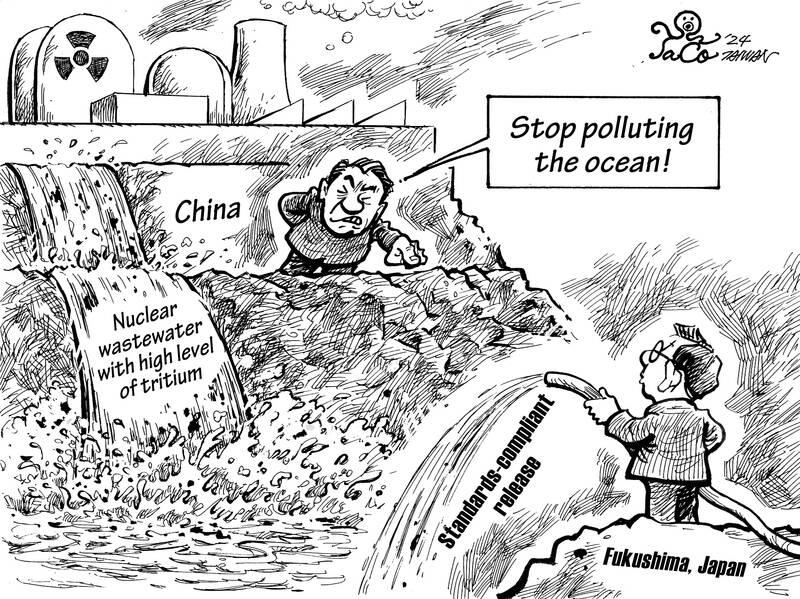

On April 19, former president Chen Shui-bian (陳水扁) gave a public speech, his first in about 17 years. During the address at the Ketagalan Institute in Taipei, Chen’s words were vague and his tone was sour. He said that democracy should not be used as an echo chamber for a single politician, that people must be tolerant of other views, that the president should not act as a dictator and that the judiciary should not get involved in politics. He then went on to say that others with different opinions should not be criticized as “XX fellow travelers,” in reference to
Chinese President and Chinese Communist Party (CCP) Chairman Xi Jinping (習近平) said in a politburo speech late last month that his party must protect the “bottom line” to prevent systemic threats. The tone of his address was grave, revealing deep anxieties about China’s current state of affairs. Essentially, what he worries most about is systemic threats to China’s normal development as a country. The US-China trade war has turned white hot: China’s export orders have plummeted, Chinese firms and enterprises are shutting up shop, and local debt risks are mounting daily, causing China’s economy to flag externally and hemorrhage internally. China’s
During the “426 rally” organized by the Chinese Nationalist Party (KMT) and the Taiwan People’s Party under the slogan “fight green communism, resist dictatorship,” leaders from the two opposition parties framed it as a battle against an allegedly authoritarian administration led by President William Lai (賴清德). While criticism of the government can be a healthy expression of a vibrant, pluralistic society, and protests are quite common in Taiwan, the discourse of the 426 rally nonetheless betrayed troubling signs of collective amnesia. Specifically, the KMT, which imposed 38 years of martial law in Taiwan from 1949 to 1987, has never fully faced its
Taiwan People’s Party Legislator-at-large Liu Shu-pin (劉書彬) asked Premier Cho Jung-tai (卓榮泰) a question on Tuesday last week about President William Lai’s (賴清德) decision in March to officially define the People’s Republic of China (PRC), as governed by the Chinese Communist Party (CCP), as a foreign hostile force. Liu objected to Lai’s decision on two grounds. First, procedurally, suggesting that Lai did not have the right to unilaterally make that decision, and that Cho should have consulted with the Executive Yuan before he endorsed it. Second, Liu objected over national security concerns, saying that the CCP and Chinese President Xi


 RSS
RSS