


In the summer of 2020, European leaders convened marathon talks over how to rescue a continent battered by the COVID-19 pandemic and a lost decade of economic stagnation. Four days of wrangling between north and south, east and west ensued.
“We were like zombies by the end,” one official said.
However, it ultimately succeeded. The 750 billion euros (US$816 billion at the current exchange rate) rescue fund was not just big, but the kind of unprecedented “Hamiltonian leap” toward unity that could only have come about in a crisis.
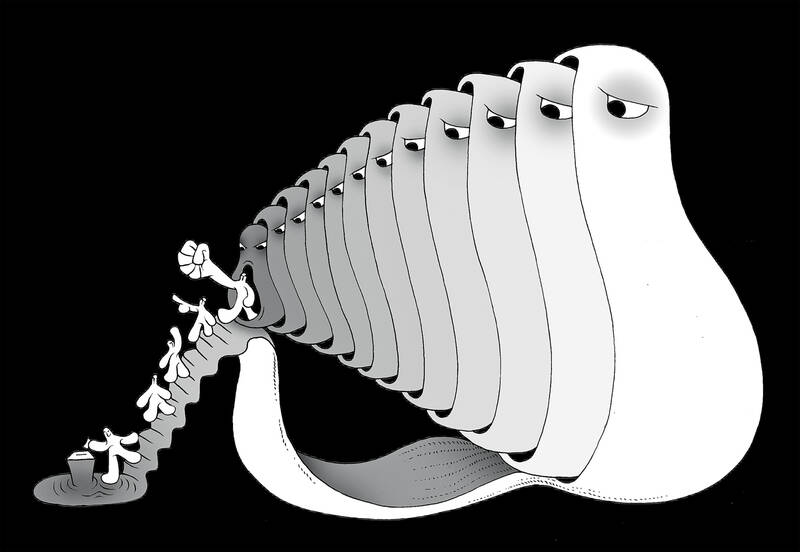
Illustration: Mountain People
Four years on, that spirit seems to have gone missing, as 450 million voters prepare to take part in EU parliamentary elections that could see a surge in support for the far right. The economy has dodged recession, but has struggled to reach the velocity needed to restore confidence at a time of stretched public finances. The scars of the inflation shock, which has undermined the social contract, are still visible. Geopolitical risks abound, with the US and China exerting economic pressure and war raging in Ukraine.
The economy is not the only driver pushing voters into the arms of National Rally leader Marine Le Pen in France or Party for Freedom leader Geert Wilders in the Netherlands; after all, eurozone unemployment is half where it was a decade ago, and no one since Brexit has talked about leaving the union. However, priorities do show rising anxiety.
Supporting the economy and job creation had risen to No. 3 on voters’ priority list, replacing climate change, a Eurobarometer survey found earlier this year.
The energy shock has probably contributed to that: 45 percent of those polled said their living standards had decreased over the past five years — especially those who already had difficulties paying bills — and 49 percent said they had stayed the same.
With old north-south divides threatening to return, as new rules on curbing debt and deficits loom, it feels like a European identity crisis — the sense of a model that is running out of road — is preying on the body politic. A posse of newly elected nationalists, while not an existential threat, would surely be a distraction. The risk of another lost decade is high if the EU spends the next few years bickering internally instead of lifting barriers to investment, innovation and regional security.
“Europe has everything it needs to win the 2020s,” investment firm TPW Advisory founder Jay Pelosky said, citing the region’s current push to ramp up in artificial intelligence, defense and green industry. “But whether it does or not will be decided in the next two years.”
Europe does indeed still have a lot going for it. It has big global companies like LVMH SE, Novo Nordisk A/S and ASML Holding NV. Life expectancy is higher than in the US and income inequality is lower; Europe’s welfare policies are also more generous. The focus on stability and cohesion as pillars of the so-called “European way of life” — a phrase that admittedly rings more hollow since the return of war on the EU’s doorstep — has been a game changer for new members joining in the east, whose per capita income has converged toward the average over the past two decades.
Those frustrating and slow-moving EU processes that demand consensus and coalition building among 27 nations — even in the heat of the pandemic — also have the advantage of boxing in political extremes. Today’s far-right firebrands, by and large, are operating within the democratic system and have dropped some of their most toxic policies (like quitting the EU).
However, stability and cohesion also need growth, and that is where things get messy. It is clear that the economic change since 2019 in the eurozone has fallen a little short of the Hamiltonian leap. GDP is only slightly above where it was going into the pandemic, and that is mainly thanks to state support; private consumption is flat, and capital expenditure below-par. Sure, jobs have boomed and wages have grown, but inflation offset those gains until only very recently.
When it comes to growth, there is no one silver bullet. Productivity and innovation were lagging well before COVID-19, especially when compared with the US, which has been a source of admiration and envy for those trying to build a more integrated, powerful EU. China’s rise as a trade competitor was also apparent well before its overperformance in electric vehicle exports, which threatens one of the traditional ventricles of European growth.
As the world deglobalizes and breaks into regions, it is no longer easy to keep faith in Europe’s single market as a reliable, German-led economic engine, converting cheap energy from Russia into manufactured goods exported to China.
Economist Andre Sapir, who in 2003 authored a report laying out how Europe should fix its innovation and growth lag, said that the problems plaguing the EU today appear much the same: Europe punches below its weight in tech companies, research spending and financing.
What has changed is the geopolitical calculus — and, unfortunately, the appeal of populist parties promising easy solutions, he said over coffee in Brussels.
Change is needed, but Sapir said he fears it would come “slowly and chaotically.”
One promising blueprint for a more dynamic EU is due to hit policymakers’ desks soon. Former Italian prime minister Mario Draghi, credited with saving the euro a decade ago as Greece teetered, is set to publish a report on improving EU competitiveness. It is likely to amplify his recent calls for more investment to reduce Europe’s dependencies in energy, tech and defense, and more spending cooperation at the EU level. It would be a return to the Hamiltonian mentality seen during that summer in 2020, rather than the austerity mindset of the 2010s.
The obvious challenge is how to push more European integration at a time when Paris and Berlin are pushing conflicting agendas and when the likes of Le Pen are promoting a less supranational “Europe of nations.” One answer would be to start with the low hanging fruit: defense. If there is one thing a more right-leaning European parliament can agree on, it is the need to invest in defense and security. A 100 billion euros pan-European defense fund looks like a no-brainer, even if this is a highly sensitive area that national governments would understandably want to keep control of.
Meanwhile, the US’ Inflation Reduction Act, which has hoovered up green investment and jobs from Europe, has yet to see a proper response in the EU — largely because the bloc’s own green subsidies are doled out at the national level. A common EU-wide funding mechanism to ramp up investment would also be a game changer. Other avenues to integration like cutting red tape, capital markets union and a more interconnected electricity market are promising, if not exactly exciting for the average voter.
Europe’s model is worth defending, and most of its problems are fixable. However, time is running out. COVID-19 recovery funding has a time limit of 2026, while new fiscal rules would be fully implemented in 2027. Politically, a lot could also change: Donald Trump could be elected US president. Germans are to vote in national elections next year; the French would vote in a presidential election in 2027 that Le Pen could very well win.
“Wake up,” embattled French President Emmanuel Macron said to voters last week.
The next time crisis leads to a four-day negotiating summit in Brussels, the outcome could be more stumble than leap.
With assistance from Elaine He
Lionel Laurent is a Bloomberg Opinion columnist writing about the future of money and the future of Europe. Previously, he was a reporter for Reuters and Forbes.

A gap appears to be emerging between Washington’s foreign policy elites and the broader American public on how the United States should respond to China’s rise. From my vantage working at a think tank in Washington, DC, and through regular travel around the United States, I increasingly experience two distinct discussions. This divergence — between America’s elite hawkishness and public caution — may become one of the least appreciated and most consequential external factors influencing Taiwan’s security environment in the years ahead. Within the American policy community, the dominant view of China has grown unmistakably tough. Many members of Congress, as

After declaring Iran’s military “gone,” US President Donald Trump appealed to the UK, France, Japan and South Korea — as well as China, Iran’s strategic partner — to send minesweepers and naval forces to reopen the Strait of Hormuz. When allies balked, the request turned into a warning: NATO would face “a very bad” future if it refused. The prevailing wisdom is that Trump faces a credibility problem: having spent years insulting allies, he finds they would not rally when he needs them. That is true, but superficial, as though a structural collapse could be caused by wounded feelings. Something
Former Taipei mayor and Taiwan People’s Party (TPP) founding chairman Ko Wen-je (柯文哲) was sentenced to 17 years in prison on Thursday, making headlines across major media. However, another case linked to the TPP — the indictment of Chinese immigrant Xu Chunying (徐春鶯) for alleged violations of the Anti-Infiltration Act (反滲透法) on Tuesday — has also stirred up heated discussions. Born in Shanghai, Xu became a resident of Taiwan through marriage in 1993. Currently the director of the Taiwan New Immigrant Development Association, she was elected to serve as legislator-at-large for the TPP in 2023, but was later charged with involvement
Out of 64 participating universities in this year’s Stars Program — through which schools directly recommend their top students to universities for admission — only 19 filled their admissions quotas. There were 922 vacancies, down more than 200 from last year; top universities had 37 unfilled places, 40 fewer than last year. The original purpose of the Stars Program was to expand admissions to a wider range of students. However, certain departments at elite universities that failed to meet their admissions quotas are not improving. Vacancies at top universities are linked to students’ program preferences on their applications, but inappropriate admission


 RSS
RSS