


The events that unfolded in Beijing’s Tiananmen Square on June 4, 1989, have become a historical footnote. China would rather obliterate the blossoming of democracy, never willing to walk along the path to democracy.
In 2021, continuing from my poems Blue China (藍中國) and Red China (紅中國), I put to paper my impressions of China’s transition from the Republic of China to the People’s Republic of China in China Dream (中國夢), one of the poems in my anthology of poems titled Yong Tan Tiao (詠嘆調).
I have also discussed Tiananmen Massacre-related poems by other poets, such as Pai Chiu’s (白萩) Engraved in Beijing (北京銘) and Tribute to an Unsung Hero (無名勇者歌讚), and Yang Mu’s (楊牧) In Front of the Tank Column (在一列坦克車前). Taiwan and the rest of the world had their eyes glued to the TV as the protests unfolded, hoping that they would lead to the democratization of China. However, due to China’s embrace of Marxism-Leninism, the hostage-holding via a dictatorship of the proletariat espoused in that ideology turned into a dictatorship of the Chinese Communist Party.
After the tanks and soldiers withdrew and mowed down democracy, protesters were swept away, liberalized capitalist powers the world over held fast to provide China with a helping hand to develop its economy. These Western nations were under the misguided impression that aiding China’s economic development could help it progress toward social and political liberalization. The reality is that this help grew out of cheap self-serving interest in China’s rock-bottom prices, mass labor, factories and markets.
The Tiananmen Massacre did not spur China toward democracy. The introduction of capitalist elements did not nudge it toward democracy — instead, China used its revitalized economy to patch up its wounds and shortcomings. The liberal democracies of Europe and the US are facing a 20th-century China that is holding economic fruits from the 21st century hostage, and using malicious national power to undermine and destroy a civilized world order.
In the waning years of the 20th century, some Taiwanese businesspeople neglected or ignored then-president Lee Tung-hui’s (李登輝) admonitions to avoid acting hastily, and his insistence that China’s appearance of so-called economic opening up was merely an illusory trap. Investment in China helped its economic development, yet Beijing never showed any gratitude in return.
Under China’s deteriorating labor conditions and the malignancy of its political forces, these business investors tasted sharp bitterness, later shifting manufacturing bases to Southeast Asia or reinvesting in Taiwan.
The ill-named “Yellow Peril” theory gave a preview of what would happen: China’s introduction of capitalism at the end of the 20th century would lead to the world’s derailment. China’s proclaiming itself to be a “land of righteousness and justice” has little truth to it when compared with how history truly played out, with China ruled by emperors who expanded imperial holdings when strong, and who flaunted power; China’s supposed humiliation in near-modern history is a matter of the late Qing Dynasty. It is a country with such a long-winded history, advanced theory of language, skilled in sophistry, possessing a record that does not conform to truth.
Tiananmen was China’s opportunity to democratize, yet the protests are little more than a footnote in history. The free world was already facing a dilemma when it stirred from its dream of allying with China to contain the then-Soviet Union. The Tiananmen Massacre is a stain on history China can never erase.
Lee Min-yung is a poet.
Translated by Tim Smith
A gap appears to be emerging between Washington’s foreign policy elites and the broader American public on how the United States should respond to China’s rise. From my vantage working at a think tank in Washington, DC, and through regular travel around the United States, I increasingly experience two distinct discussions. This divergence — between America’s elite hawkishness and public caution — may become one of the least appreciated and most consequential external factors influencing Taiwan’s security environment in the years ahead. Within the American policy community, the dominant view of China has grown unmistakably tough. Many members of Congress, as
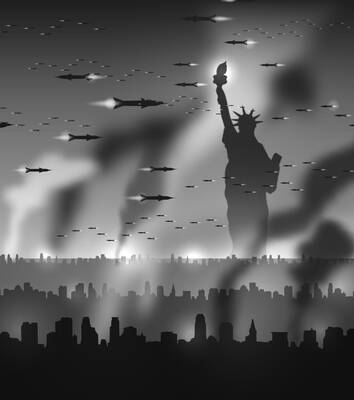
After declaring Iran’s military “gone,” US President Donald Trump appealed to the UK, France, Japan and South Korea — as well as China, Iran’s strategic partner — to send minesweepers and naval forces to reopen the Strait of Hormuz. When allies balked, the request turned into a warning: NATO would face “a very bad” future if it refused. The prevailing wisdom is that Trump faces a credibility problem: having spent years insulting allies, he finds they would not rally when he needs them. That is true, but superficial, as though a structural collapse could be caused by wounded feelings. Something
Former Taipei mayor and Taiwan People’s Party (TPP) founding chairman Ko Wen-je (柯文哲) was sentenced to 17 years in prison on Thursday, making headlines across major media. However, another case linked to the TPP — the indictment of Chinese immigrant Xu Chunying (徐春鶯) for alleged violations of the Anti-Infiltration Act (反滲透法) on Tuesday — has also stirred up heated discussions. Born in Shanghai, Xu became a resident of Taiwan through marriage in 1993. Currently the director of the Taiwan New Immigrant Development Association, she was elected to serve as legislator-at-large for the TPP in 2023, but was later charged with involvement
Out of 64 participating universities in this year’s Stars Program — through which schools directly recommend their top students to universities for admission — only 19 filled their admissions quotas. There were 922 vacancies, down more than 200 from last year; top universities had 37 unfilled places, 40 fewer than last year. The original purpose of the Stars Program was to expand admissions to a wider range of students. However, certain departments at elite universities that failed to meet their admissions quotas are not improving. Vacancies at top universities are linked to students’ program preferences on their applications, but inappropriate admission


 RSS
RSS