


Artificial intelligence (AI) has persuaded a lot of folks that we need to radically overhaul education.
Now that chatbots can speedily retrieve information and answer complex questions, why bother memorizing historical facts or quotations? Should we not instead teach kids to think critically and solve problems, and leave the grunt work to computers?
There is a problem with these arguments: Humans require knowledge to think creatively. Outsourcing our memory and cognition to Google and AI risks making us dumber and more susceptible to misinformation — including errors made by AI.
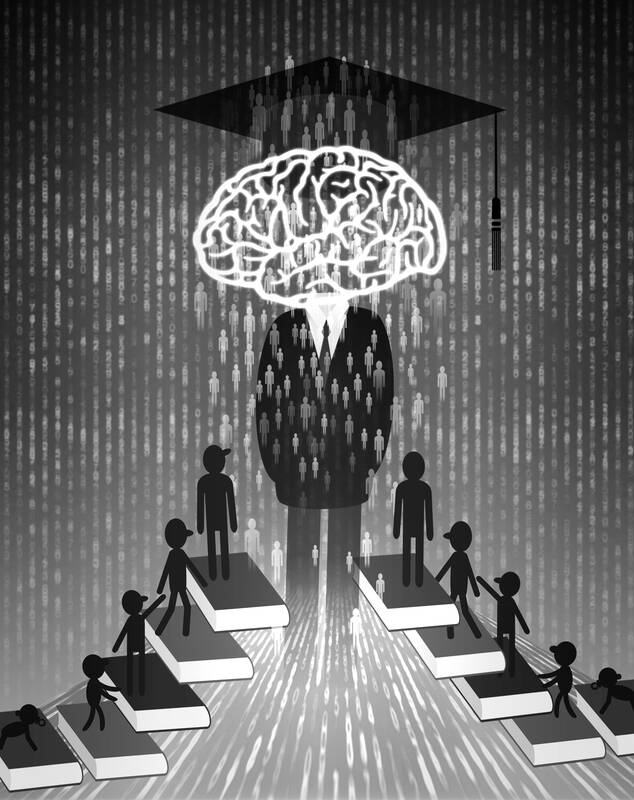
Illustration: Yusha
I am no Luddite. I think it is amazing that we have a so much information on tap thanks to the Internet, while ChatGPT and other bots can act as personal tutors, which, if used judiciously, might reinforce knowledge by answering all our questions.
I also get why people might think this has devalued the ability to recite a Shakespeare sonnet or the periodic table — or studying for the bar or Chartered Financial Analyst exam, for that matter — and the important thing is knowing where to find information.
However, being able to recall facts is indispensable in the age of search engines and large language models, and I am not alone in believing this.
In a seminal essay published in 2000, two years after Google was founded, nonagenarian US educator E. D. Hirsch demolished the argument that we can always just look things up.
“There is a consensus in cognitive psychology that it takes knowledge to gain knowledge,” he wrote. “Yes, the internet has placed a wealth of information at our fingertips. But to be able to use that information … we must already possess a storehouse of knowledge.”
Hirsch’s ideas inspired the Conservative government to overhaul English education system over the past 14 years to promote a more “knowledge-rich” curriculum: For example, by the age of nine, math pupils are now required to memorize their multiplication tables up to 12.
One cannot ignore the possibility that a Conservative government responsible for a hard Brexit might be wrongheaded about rote learning too — although England’s relative improvement in international education rankings suggests otherwise.
One can certainly debate what kinds of facts kids should have to memorize.
However, Hirsch’s essential point that general knowledge provides a kind of “mental scaffolding” and makes us smarter and better citizens seems self-evident, prior knowledge helps us absorb more of what we learn and provides the fuel for creative thinking.
“The ability to ‘just Google it’ is highly dependent on what a person has stored in their long-term memory,” the influential former British minister of state for schools Nick Gibb said in a 2021 speech.
This means literacy and numeracy remain vital even now that computers can do math and write texts faster than we can.
The suggestion we should outsource our memory to “free up” limited space for more creative thinking is based on a misconception, Nicholas Carr wrote in The Shallows: What the Internet Is Doing to Our Brains.
Thanks to its plasticity, the brain’s long-term memory center can expand, as scientists found when they studied London taxi drivers.
“When we start using the Web as a substitute for personal memory, bypassing the inner processes of consolidation, we risk emptying our minds of their riches,” Carr wrote.
Becoming reliant on the Internet or AI is a bad idea because our working memories are only capable of processing a few new items at a time, Daisy Christodoulou, the author of Seven Myths About Education, said in an essay.
So if we encounter too much new vocabulary or information, we become overwhelmed, impairing our ability to learn.
Indeed, looking stuff up on Google often results in us not being able to recall it later — either because our brains are conditioned to think we do not need to remember it, or because the Internet, mobile phones and social media scatter our attention, or both. We are also likely to overestimate our intelligence, mistaking knowledge found on the Internet for our own.
The only effective way I have found to recall academic papers and articles found online is to print them out, mark them with a highlighter and take copious notes.
Another thing to bear in mind is that so-called cognitive offloading reinforces dependency on technology, which might explain why some AI companies now want people to hand off even more information, with one even calling for humans to “embrace forgetfulness.”
Of course, Cassandras have bemoaned the deleterious impacts of technology for centuries, while techno-optimists cite the pocket calculator as just one example of equipment that made certain tasks easier but did not turn our brains to mush.
However, as this paper published in Frontiers in Psychology noted, calculators have limited functionality, while AI chatbots encompass a much broader cognitive range “from general knowledge, problem-solving, emotional support, up to creative tasks.”
If students come to rely on machines not just to retrieve facts but to think for them, it might not just be memory that suffers: Cognition and creativity could atrophy, too. A once steady rise in IQ scores known as the “Flynn effect” has begun to fade in several countries, albeit the causes are debated.
Governments are still in the early stages of thinking about AI’s role in education. I am sure there would be benefits that augment human learning, while some of the negative effects I have described can be mitigated. However, we do not need to reinvent the wheel: In an era of conspiracy theories and misinformation, it is even more vital that we humans have a firm grasp of basic facts.
Chris Bryant is a Bloomberg Opinion columnist covering industrial companies in Europe. Previously, he was a reporter for the Financial Times. This column does not necessarily reflect the opinion of the editorial board or Bloomberg LP and its owners.

A gap appears to be emerging between Washington’s foreign policy elites and the broader American public on how the United States should respond to China’s rise. From my vantage working at a think tank in Washington, DC, and through regular travel around the United States, I increasingly experience two distinct discussions. This divergence — between America’s elite hawkishness and public caution — may become one of the least appreciated and most consequential external factors influencing Taiwan’s security environment in the years ahead. Within the American policy community, the dominant view of China has grown unmistakably tough. Many members of Congress, as

After declaring Iran’s military “gone,” US President Donald Trump appealed to the UK, France, Japan and South Korea — as well as China, Iran’s strategic partner — to send minesweepers and naval forces to reopen the Strait of Hormuz. When allies balked, the request turned into a warning: NATO would face “a very bad” future if it refused. The prevailing wisdom is that Trump faces a credibility problem: having spent years insulting allies, he finds they would not rally when he needs them. That is true, but superficial, as though a structural collapse could be caused by wounded feelings. Something
Former Taipei mayor and Taiwan People’s Party (TPP) founding chairman Ko Wen-je (柯文哲) was sentenced to 17 years in prison on Thursday, making headlines across major media. However, another case linked to the TPP — the indictment of Chinese immigrant Xu Chunying (徐春鶯) for alleged violations of the Anti-Infiltration Act (反滲透法) on Tuesday — has also stirred up heated discussions. Born in Shanghai, Xu became a resident of Taiwan through marriage in 1993. Currently the director of the Taiwan New Immigrant Development Association, she was elected to serve as legislator-at-large for the TPP in 2023, but was later charged with involvement
Out of 64 participating universities in this year’s Stars Program — through which schools directly recommend their top students to universities for admission — only 19 filled their admissions quotas. There were 922 vacancies, down more than 200 from last year; top universities had 37 unfilled places, 40 fewer than last year. The original purpose of the Stars Program was to expand admissions to a wider range of students. However, certain departments at elite universities that failed to meet their admissions quotas are not improving. Vacancies at top universities are linked to students’ program preferences on their applications, but inappropriate admission


 RSS
RSS