


My wife and I spent the week in the interior of Taiwan where Shuyuan spent her childhood. In that town there is a street that functions as an open farmer’s market.
Walk along that street, as Shuyuan did yesterday, and it is next to impossible to come home empty-handed. Some mangoes that looked vaguely like others we had seen around here ended up on our table.
Shuyuan told how she had bought them from a little old farmer woman from the countryside who said the mangoes were from a very old tree she had on her property.
The big surprise came when I peeled and bit into one of them this morning. It might not have looked like anything special, but it was. The taste took me right back to my childhood on the Isle of Pines, Cuba.
A tree at the abandoned homesite on a hill behind our property had fruits that tasted exactly like that.
The fruits were broader than long and stood out for their really unique taste.
My father was a horticulturist, with a master’s degree from the University of Miami, so when he came down from Miami to visit us, I took him back up to that abandoned homestead to gather fruit from that special mango tree. He called it an “apple mango.”
On our little property we already had a whole hillside of other mango saplings of a great many superior and rarely found mango varieties that we had procured from the Agricultural Experiment Station just outside Havana.
Figuring that we might someday also have an apple mango tree of our own, I cut a sprig for my father to graft onto a wild mango rootstock that I planted next to that hillside.
Yet before that day ever came, the communist revolution happened.
We lost our little farm to a government functionary and left behind the little apple mango as well as all the other quality mango saplings and everything else we had growing on our land.
In Cuba I never encountered another apple mango. Neither did I ever come across one in Florida after the communist revolution, when I ended up living with my father in Miami.
My guess back then was that it might be a variety from long ago that no longer existed except for that lone tree up on the hill behind our property in Cuba, the last one of its kind.
Thirty-five years later I returned on a brief trip to find that the communists had bulldozed the once beautiful hilly farm so that now it looked like anywhere.
Everything that had mattered to me about it was gone, including my apple mango tree and all the other mango trees which, according to an elderly woman now living next door, had grown really big and all been bulldozed down to make way for the grapefruit groves the communists wanted to plant on the flattened land there. Mangoes grew well in that soil. It turned out grapefruit did not.
The mangoes we had planted were rare varieties that might have offered promise to the island.
The grapefruit the communists failed to grow were commonplace and commercial.
There is a blindness of dogma built into communist dictatorships, a “party line,” which renders them unable or unwilling to see what cries out to be seen.
When I told the story of the apple mango to an apple farmer in upstate New York I met many years later, he told me that so many of the most uniquely delicious apple varieties in his region were similarly vanishing, replaced by the few kinds that had gotten commercially developed but were not as tasty.
As the days went by, Shuyuan and I ate up all those mangoes she brought back from the market street. She had never before tasted mangoes like that either. She looked for the same lady next time she went to that street, but could not find her.
What makes living in Taiwan so wonderful is that this little tiny event of coming across the apple mango taste-alike is not the exception.
The unexpected and interesting is always right around the corner. There is not one philosophy -— whether it be agricultural, industrial, social or whatnot — governing this small independent, free and democratic nation, but a thousand different ones. It is the diversity here that astonishes and delights me week in and week out — that and the freedom.
I think Taiwan’s strength, and its advantage over that other Chinese country, the big pushy one next door, is that Taiwan lucked out in getting robbed and pillaged by the adversaries of the communists rather than by the communists themselves.
Though Chiang Kai-shek (蔣介石) and his Nationalists played the same game as the communists, stealing everything to enrich themselves, it eventually proved possible for Taiwanese to sweep them aside and establish a functioning democracy.
It is not just that in this Chinese country, some uniquely tasting variety of mango is still to be found.
Mangoes are the least of it. What is special about Taiwan is so much more than that. It is that in the Chinese people themselves who grow up here in Taiwan what was once most special about the people of China itself still survives.
In that big communist empire next door, this has been wiped out. Exchange students of mine from mainland China have told me that they see and appreciate this about Taiwan. Taiwan is what China used to be.
There is a flavor to the life here, a precious quality found not just in agriculture, business, and government, but in the people themselves, that they say is no longer encountered over in China.
At a conference I attended in Beijing some years back the professors were lamenting the loss in their communist country of what they called “social capital.”
Google describes this as a set of shared values or resources that allows individuals to work together in a group to effectively achieve a common purpose.
The communists are supposed to be all about that, but in fact they extinguished it, and now have no idea how to bring it back, or even what exactly it was that they destroyed in their own people.
I suspect the real reason that giant communist China has such an avid determination to forcefully invade peaceful little Taiwan and subject it to their control is that, just like they are now systematically destroying social capital in Hong Kong, they feel a need to do the same to it here, too.
In this way they would not look so bad; and no one will ever guess that there once was a free China that had what communist China has destroyed in itself and cannot get back.
Yes, tasty mangoes are the least of it.
William R. Stimson is an American writer living in Taiwan who has taught an adjunct course at several universities in the country.

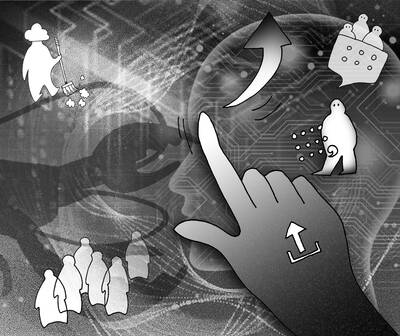
Weeks into the craze, nobody quite knows what to make of the OpenClaw mania sweeping China, marked by viral photos of retirees lining up for installation events and users gathering in red claw hats. The queues and cosplay inspired by the “raising a lobster” trend make for irresistible China clickbait. However, the West is fixating on the least important part of the story. As a consumer craze, OpenClaw — the AI agent designed to do tasks on a user’s behalf — would likely burn out. Without some developer background, it is too glitchy and technically awkward for true mainstream adoption,
A delegation of Chinese Nationalist Party (KMT) officials led by Chairwoman Cheng Li-wun (鄭麗文) is to travel to China tomorrow for a six-day visit to Jiangsu, Shanghai and Beijing, which might end with a meeting between Cheng and Chinese President Xi Jinping (習近平). The trip was announced by Xinhua news agency on Monday last week, which cited China’s Taiwan Affairs Office (TAO) Director Song Tao (宋濤) as saying that Cheng has repeatedly expressed willingness to visit China, and that the Chinese Communist Party (CCP) Central Committee and Xi have extended an invitation. Although some people have been speculating about a potential Xi-Cheng
Chinese Nationalist Party (KMT) Chairwoman Cheng Li-wun (鄭麗文) is leading a delegation to China through Sunday. She is expected to meet with Chinese President Xi Jinping (習近平) in Beijing tomorrow. That date coincides with the anniversary of the signing of the Taiwan Relations Act (TRA), which marked a cornerstone of Taiwan-US relations. Staging their meeting on this date makes it clear that the Chinese Communist Party (CCP) intends to challenge the US and demonstrate its “authority” over Taiwan. Since the US severed official diplomatic relations with Taiwan in 1979, it has relied on the TRA as a legal basis for all
The ongoing Iran conflict is putting Taiwan’s energy fragility on full display — the island of 23 million people, home to the world’s most advanced semiconductor manufacturing, is highly dependent on imported oil and gas, especially that from the Middle East. In 2025, 69.6 percent of Taiwan’s crude oil and 38.7 percent of liquified natural gas were sourced from the Middle East. In the same year, 62 percent of crude oil and 34 percent of LNG to Taiwan went through the Strait of Hormuz. Taiwan’s state-run oil company CPC Corp’s benchmark crude oil price (70 percent Dubai, 30 percent Brent)


 RSS
RSS