


US magazine Newsweek reported on Tuesday last week that the Norwegian government’s latest annual report on security challenges has also said that Chinese intelligence networks operate all over Europe and pose a security threat to the continent.
This was following warnings from Germany, the UK and several other countries about Chinese espionage activities.
Norway’s intelligence agency said that Chinese agents conceal their activities through a range of “commonly available tools and digital infrastructure.”
They do not carry out their tasks alone, but are assisted by “diplomats, travel delegations, private individuals, businesses and special interest groups,” it said.
Article 7 of People’s Republic of China’s (PRC) National Intelligence Law stipulates that “all organizations and citizens shall support, assist and cooperate with national intelligence efforts in accordance with law.”
In practice, Chinese businesses and the public are not only required to help the Chinese Communist Party (CCP) conduct its intelligence work “in accordance with law.” They might even have to serve as the party’s lackeys for threatening Chinese dissidents in other countries.
A person going by the name of Ning Ning (甯甯), who is from China and is now a postdoctoral fellow at a US research institution, posted a petition in support of Chinese dissident Peng Lifa (彭立發) on US-based Web site Change.org.
It did not take China’s cyber police very long to track down and contact Ning Ning’s family.
As Ning Ning told Radio Free Asia: “Some of my personal information on this American Web site, such as my e-mail address, should not be visible to anyone, but somehow the CCP’s cyber police found it and went to visit my family.”
Ning Ning said that China’s cyber police might have broken into Change.org’s backend, or that the US company might have CCP collaborators working inside it.
China’s cyber police hack into other countries’ governments and companies, while Chinese spies and fellow travelers carry out “silent invasions” by infiltrating other countries at all levels.
Voice of America’s Chinese section on Tuesday last week said that a report published by US-based cybersecurity firm Trellix that day showed that Taiwan received what researchers described as a “significant spike” in malicious activity during the 24 hours leading up to the presidential and legislative elections.
This was more than twice the usual level.
The damage done to the nation’s national defense and social stability by pro-China elements based in Taiwan has attracted the attention of the international community.
International media have classified the Chinese Nationalist Party (KMT) and the Taiwan People’s Party as “pro-China,” which is indeed a fair assessment.
The PRC uses its counterespionage and national security laws to suppress its citizens’ freedom of speech.
It targets managers of foreign-invested companies in China with arbitrary searches and arrests.
It forces Chinese-invested companies and individual citizens overseas to act as lackeys.
It also finds ways to coerce or persuade other countries’ citizens to betray their homelands.
The CCP regime behaves like a beast on a rampage.
The prospect of Chinese President Xi Jinping’s (習近平) regime falling from power overnight is not just possible, but probable.
Yu Kung is an entrepreneur.
Translated by Julian Clegg
On March 22, 2023, at the close of their meeting in Moscow, media microphones were allowed to record Chinese Communist Party (CCP) dictator Xi Jinping (習近平) telling Russia’s dictator Vladimir Putin, “Right now there are changes — the likes of which we haven’t seen for 100 years — and we are the ones driving these changes together.” Widely read as Xi’s oath to create a China-Russia-dominated world order, it can be considered a high point for the China-Russia-Iran-North Korea (CRINK) informal alliance, which also included the dictatorships of Venezuela and Cuba. China enables and assists Russia’s war against Ukraine and North Korea’s
After thousands of Taiwanese fans poured into the Tokyo Dome to cheer for Taiwan’s national team in the World Baseball Classic’s (WBC) Pool C games, an image of food and drink waste left at the stadium said to have been left by Taiwanese fans began spreading on social media. The image sparked wide debate, only later to be revealed as an artificially generated image. The image caption claimed that “Taiwanese left trash everywhere after watching the game in Tokyo Dome,” and said that one of the “three bad habits” of Taiwanese is littering. However, a reporter from a Japanese media outlet
Taiwanese pragmatism has long been praised when it comes to addressing Chinese attempts to erase Taiwan from the international stage. “Taipei” and the even more inaccurate and degrading “Chinese Taipei,” imposed titles required to participate in international events, are loathed by Taiwanese. That is why there was huge applause in Taiwan when Japanese public broadcaster NHK referred to the Taiwanese Olympic team as “Taiwan,” instead of “Chinese Taipei” during the opening ceremony of the Tokyo Olympics. What is standard protocol for most nations — calling a national team by the name their country is commonly known by — is impossible for
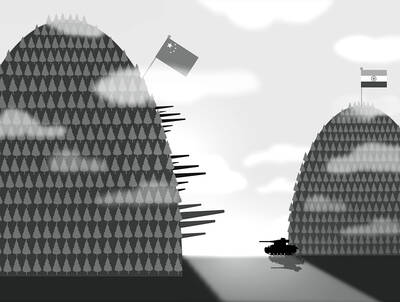
India is not China, and many of its residents fear it never will be. It is hard to imagine a future in which the subcontinent’s manufacturing dominates the world, its foreign investment shapes nations’ destinies, and the challenge of its economic system forces the West to reshape its own policies and principles. However, that is, apparently, what the US administration fears. Speaking in New Delhi last week, US Deputy Secretary of State Christopher Landau warned that “we will not make the same mistakes with India that we did with China 20 years ago.” Although he claimed the recently agreed framework


 RSS
RSS