


Newly elected legislators reported to the Legislative Yuan on Feb. 1 and held their first official meeting on Tuesday, but its disoriented state has highlighted new legislators’ inexperience.
The legislative election last month resulted in none of the major political parties holding more than half of the total 113 seats — the Chinese Nationalist Party (KMT) won 52, the Democratic Progressive Party (DPP) won 51, the Taiwan People’s Party (TPP) won eight, and two independent seats are held by KMT-friendly legislators. This means that negotiations between parties would be crucial to passing legislation.
With KMT legislator-at-large Han Kuo-yu (韓國瑜) becoming the new legislative speaker, 54 of the 113 seats are also taken by newcomers, with 34 from the KMT, leading to an unpredictable future for the legislature. Despite this, many political observers held a positive outlook, saying that new voices could bring a fresh atmosphere to the legislature.
However, the run-up to Tuesday’s meeting suggests that the KMT and TPP caucuses are unfamiliar with the Legislative Yuan’s procedural rules. KMT caucus convener Fu Kun-chi on Feb. 7 issued a press release petitioning for an extraordinary meeting for Premier Chen Chien-jen (陳建仁) to report on Feb. 17 regarding cimbuterol found in pork in Taichung — despite political parties’ agreement on Feb. 5 to have the first meeting on Tuesday.
Citing the Constitution on the holding of biannual legislative sessions between February and May and between September and December, and extraordinary sessions being called at other times, the DPP caucus questioned why the KMT would call an extraordinary session during an official session period.
The KMT caucus on Feb. 15 urged Han to hold consultations the next day regarding Chen. Han’s office refused, saying that consultations would be held a day prior to the previously agreed opening meeting. Recognizing his ignorance of the law and legislative procedure, Fu on Feb. 17 appeared to shift the blame by saying that the press release was a “typographical error” made by a party worker, who would be punished.
Confusion continued on Monday last week as the TPP caucus rejected the KMT’s proposal to have Chen’s food safety report a day later, but sent an urgent notice later the same day to the DPP and KMT caucuses asking them to attend negotiations in less than an hour. Negotiations failed as the notice was too short.
The KMT caucus’ legislators also proposed a change to the meeting agenda early on Tuesday, asking Chen to make a food safety report before his general policy address, but withdrew the proposal two hours later, saying that it supported the TPP’s proposal.
The first meeting on Tuesday opened in a chaos, as the KMT staged a boycott of Chen’s general policy address by swarming the podium. Pushing and yelling occurred when a new DPP legislator tried to snatch new KMT Legislator Lo Chih-chiang’s (羅智強) microphone.
Responding to the turmoil, Han called for a 10-minute break and urged lawmakers to “consider policies rationally” and “maintain order in the chamber” before resuming the session. The food safety report on Friday was also disrupted by Han a few times, asking for “mutual respect among legislators and government officials” to share the 15-minute Q&A time, as a few new KMT legislators refused to let Chen speak.
It is understandable that new legislators would want to prove their worth and raise their profile, but as lawmakers, legislators should first familiarize themselves with the Constitution, laws and legislative procedures.
The new legislative caucuses and legislators must also put their political stunts aside and step up their game. They should focus on more pressing issues or important bills concerning the public, such as monitoring the widespread tainted chili powder instead of the seemingly isolated case of tainted pork, rather than getting caught up in trivial political debates on basic procedural rules and letting voters’ expectations down.
On March 22, 2023, at the close of their meeting in Moscow, media microphones were allowed to record Chinese Communist Party (CCP) dictator Xi Jinping (習近平) telling Russia’s dictator Vladimir Putin, “Right now there are changes — the likes of which we haven’t seen for 100 years — and we are the ones driving these changes together.” Widely read as Xi’s oath to create a China-Russia-dominated world order, it can be considered a high point for the China-Russia-Iran-North Korea (CRINK) informal alliance, which also included the dictatorships of Venezuela and Cuba. China enables and assists Russia’s war against Ukraine and North Korea’s
After thousands of Taiwanese fans poured into the Tokyo Dome to cheer for Taiwan’s national team in the World Baseball Classic’s (WBC) Pool C games, an image of food and drink waste left at the stadium said to have been left by Taiwanese fans began spreading on social media. The image sparked wide debate, only later to be revealed as an artificially generated image. The image caption claimed that “Taiwanese left trash everywhere after watching the game in Tokyo Dome,” and said that one of the “three bad habits” of Taiwanese is littering. However, a reporter from a Japanese media outlet
Taiwanese pragmatism has long been praised when it comes to addressing Chinese attempts to erase Taiwan from the international stage. “Taipei” and the even more inaccurate and degrading “Chinese Taipei,” imposed titles required to participate in international events, are loathed by Taiwanese. That is why there was huge applause in Taiwan when Japanese public broadcaster NHK referred to the Taiwanese Olympic team as “Taiwan,” instead of “Chinese Taipei” during the opening ceremony of the Tokyo Olympics. What is standard protocol for most nations — calling a national team by the name their country is commonly known by — is impossible for
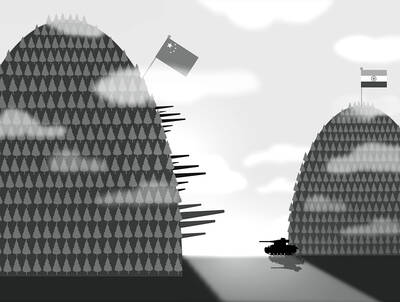
India is not China, and many of its residents fear it never will be. It is hard to imagine a future in which the subcontinent’s manufacturing dominates the world, its foreign investment shapes nations’ destinies, and the challenge of its economic system forces the West to reshape its own policies and principles. However, that is, apparently, what the US administration fears. Speaking in New Delhi last week, US Deputy Secretary of State Christopher Landau warned that “we will not make the same mistakes with India that we did with China 20 years ago.” Although he claimed the recently agreed framework


 RSS
RSS