


It has been a tough week for Ukraine. Ukrainian President Volodymyr Zelenskiy replaced the popular leader of his military, General Valeriy Zaluzhnyi, with the current army commander, General Oleksandr Syrskyi. He has watched the flailing in the US Congress over a new tranche of funding for Ukraine, while former US president Donald Trump, leading in most US presidential polls, is on the campaign trail firing shots at Ukraine and NATO.
Meanwhile, Russian President Vladimir Putin seems to have a real bounce in his step with an upcoming “election” that he would win handily and a long, propaganda-filled interview with US talk-show host Tucker Carlson.
Russian cruise missile and drone attacks hit Ukraine almost daily, and Russian ground operations around Avdiivka are grinding away with modest success in the wake of failed Ukrainian offensives last year.

Illustration: Yusha
Yes, the Ukrainians did sink another Russian warship in the Black Sea and the EU came through with a US$54 billion aid package earlier this month, but the rumblings of dissatisfaction with the Ukrainian military in major Western capitals persists. It feels like a very low point in the fortunes of Zelenskiy and his people, despite the immense courage and determination they have shown over the past two years.
The Ukrainian war effort needs a reset. What should that look like, and could it succeed?
Let us start with the shift at the top of the military. It is entirely normal to have leadership changes in prolonged campaigns. When I was the supreme allied commander of NATO, I had four different generals working successively for me in Afghanistan: retired US Army general Stanley McChrystal, retired US Army general David Petraeus, retired US Marine general John R. Allen and retired US Marine general Joseph Dunford. During the US Civil War, then-US president Abraham Lincoln went through many top generals before finding the right one in Ulysses S. Grant. Bringing in fresh thinking and rested leaders makes sense.
In Ukraine, the shift was complicated by internal disagreements, in part over the failed offensive campaign, and because Zaluzhnyi wanted to mobilize more civilians, a politically unpopular step. However, Zelenskiy managed to paper over the conflict; he awarded the general the highest state honor and it appears there has not been a blow up at the highest levels in Kyiv.
General Syrskyi would have his work cut out for him. He was born in Russia and has the benefit of a traditional Soviet-style military background, which gives him powerful insights into how Putin’s generals think. He has also proven to be an early innovator in using drones against armor and other “new war” tactics.
In terms of the reset, he is starting out emphasizing “clear and detailed planning” and trying to find a way to rest his weary troops. The latter would require increased mobilization, probably of a younger cohort of soldiers. Zelenskiy’s hesitance is understandable, but Ukraine simply has to generate more troops despite public opposition.
A second element of a reset would be coming up with more advanced warfighting technologies and integrating them into the war effort. At the top of the list would be the F-16 fighter jets provided by the West, with most of the training done in the US and Germany. These formidable multirole fighters could take on Russian planes in the air and bomb their troops on the ground. While not a total game changer, a significant number of F-16s would help Ukraine across the long battlefront, especially if coupled with Western air defense systems. The problem is that the timeline for deployment keeps lengthening, with “by the end of this year” as the vague estimate.
Drones are a better story: Improved generations would be operated by a new, dedicated branch of the Ukrainian armed forces (something the US and NATO should consider).
The war at sea, in which Kyiv has already sunk at least a third of the Russian Black Sea Fleet (including the flagship Moskva), would be enhanced by new anti-ship cruise missiles.
The third and most difficult portion of the reset is unfortunately not at all under Zelenskiy’s control: The US election, and a Republican Party that is increasingly turning against the Ukrainian cause under the sway of Trump.
About half of the Republican Party is now of the erroneous opinion that the Ukraine war is not a US problem, recent polling showed. There is a growing view on the right that if anybody helps Kyiv, it should be the Europeans. All of this is tied to a Trumpian view that NATO is not valuable.
This is a dangerous moment not just for Ukraine. If the US walks away — as it did from Europe and Asia in the 1930s — authoritarian powers would fill the void. We would likely end up, as we did in 1941, embroiled in a conflict on a far larger scale.
Zelenskiy and his supporters in Washington — not just US President Joe Biden’s administration, but also Republicans such as the 22 senators who voted in favor of the Ukrainian-Israel aid package this week — need to convince the US public that Ukraine matters and that NATO is a valuable alliance.
It commands more than 55 percent of global GDP, has 3 million active-duty troops and a combined defense budget of more than US$1 trillion. The collective European defense budget is more than US$300 billion, more than China’s and triple that of Moscow. European countries pledged more aid to Ukraine last year than the US; to characterize them as freeloaders is a bad faith argument.
Yes, any reset must include changes by the Ukrainian military command and new technologies. However, unless a real effort is made to restore the truthful narrative — that Ukraine’s fate is tied to US’ own and that the best mechanism we have to win is NATO — there is real danger ahead. Zelenskiy cannot do this by himself. It would require leadership in Washington from both sides of the aisle.
James Stavridis is a Bloomberg Opinion columnist, a retired US Navy admiral, former supreme allied commander of NATO and dean emeritus of the Fletcher School of Law and Diplomacy at Tufts University. He is also vice chairman of global affairs at the Carlyle Group. He is on the boards of Fortinet, NFP, Ankura Consulting Group and Neuberger Berman, and has advised Shield Capital, a firm that invests in the cybersecurity sector.

On March 22, 2023, at the close of their meeting in Moscow, media microphones were allowed to record Chinese Communist Party (CCP) dictator Xi Jinping (習近平) telling Russia’s dictator Vladimir Putin, “Right now there are changes — the likes of which we haven’t seen for 100 years — and we are the ones driving these changes together.” Widely read as Xi’s oath to create a China-Russia-dominated world order, it can be considered a high point for the China-Russia-Iran-North Korea (CRINK) informal alliance, which also included the dictatorships of Venezuela and Cuba. China enables and assists Russia’s war against Ukraine and North Korea’s
After thousands of Taiwanese fans poured into the Tokyo Dome to cheer for Taiwan’s national team in the World Baseball Classic’s (WBC) Pool C games, an image of food and drink waste left at the stadium said to have been left by Taiwanese fans began spreading on social media. The image sparked wide debate, only later to be revealed as an artificially generated image. The image caption claimed that “Taiwanese left trash everywhere after watching the game in Tokyo Dome,” and said that one of the “three bad habits” of Taiwanese is littering. However, a reporter from a Japanese media outlet
Taiwanese pragmatism has long been praised when it comes to addressing Chinese attempts to erase Taiwan from the international stage. “Taipei” and the even more inaccurate and degrading “Chinese Taipei,” imposed titles required to participate in international events, are loathed by Taiwanese. That is why there was huge applause in Taiwan when Japanese public broadcaster NHK referred to the Taiwanese Olympic team as “Taiwan,” instead of “Chinese Taipei” during the opening ceremony of the Tokyo Olympics. What is standard protocol for most nations — calling a national team by the name their country is commonly known by — is impossible for
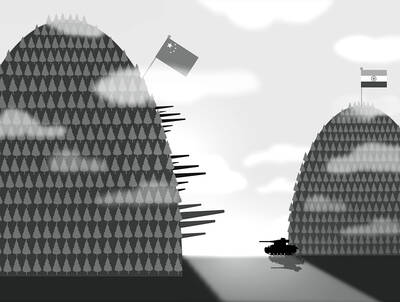
India is not China, and many of its residents fear it never will be. It is hard to imagine a future in which the subcontinent’s manufacturing dominates the world, its foreign investment shapes nations’ destinies, and the challenge of its economic system forces the West to reshape its own policies and principles. However, that is, apparently, what the US administration fears. Speaking in New Delhi last week, US Deputy Secretary of State Christopher Landau warned that “we will not make the same mistakes with India that we did with China 20 years ago.” Although he claimed the recently agreed framework


 RSS
RSS