


More than two weeks of heated discussions and speculation about which political party might win the legislative speakership ended with Chinese Nationalist Party (KMT) Legislator-at-large Han Kuo-yu (韓國瑜) elected as the new speaker on Thursday.
However, “how to recall the legislative speaker” became a hot search term that same day, while new debates arose the following day.
As neither the KMT with its 52 legislative seats, nor the Democratic Progressive Party (DPP) with its 51 seats, won more than half of the 113 legislative seats in last month’s elections, both parties’ speaker candidates visited the Taiwan People’s Party (TPP) legislative caucus, hoping to gain the support of its eight legislators.
However, the TPP on Wednesday morning announced it would field its own candidate — Legislator-at-large Vivian Huang (黃珊珊) — with the party’s eight votes all going to her, and that if a speaker was not decided in the first voting round, they would not vote in the second round.
The DPP saw the TPP’s decision as direct support for Han, while the KMT was of course glad to see the move and its caucus convener Fu Kun-chi (傅?萁) praised the TPP for standing with it in opposition to the DPP, saying that the KMT and TPP might continue to cooperate, including on assigning members to committees and selecting committee conveners.
Unsurprisingly, the KMT secured the speaker and deputy speaker roles.
However, veteran Taiwanese independence advocate Chen Yung-hsing (陳永興) on Friday published an open letter, detailing how he passed messages between TPP Chairman Ko Wen-je (柯文哲) and DPP Chairman and president-elect William Lai (賴清德) on Wednesday evening, sparking more speculation and debate.
In his letter, Chen said that on the evening of Jan. 26, he received a phone call from Ko, who asked for helpt to relay messages to Lai about the possibility of the DPP supporting Huang in the first round of voting and the TPP supporting the DPP’s deputy speaker candidate in return. Although both sides were cordial and expressed goodwill, he knew the negotiations would fail as both parties refused to concede.
Chen’s letter sparked debates among the TPP and DPP, as Ko said that DPP members approached him first and that he only called back in response to Chen’s prior inquiry, while DPP spokesperson Justin Wu (吳崢) said the DPP did not propose the idea of supporting Huang as speaker and its former deputy speaker Tsai Chi-chang (蔡其昌) as the deputy speaker candidate. Ko yesterday said he might file a defamation lawsuit against Wu over allegedly proposing the murky speakership quid pro quo.
Moreover, it sparked speculation from pan-blue camp members of whether Ko wanted to coerce the DPP into cooperating with the TPP, and only yielded to letting the KMT win after its secret negotiations with the DPP failed, and if so, the KMT might need to reconsider trusting Ko and his party.
As details of the DPP-TPP negotiations remain unclear, the incident, as well as the failure of a KMT-TPP joint presidential ticket bid, Ko’s unproven claim that a broker offered him US$200 million to quit his presidential bid and other incidents, have shown his unreliability and opportunism, often making decisions at the last moment based on political machinations and leveraging for influence by threatening to shift alliances, rather than having principles.
As a new third party that could cast decisive votes on critical issues, the TPP could have a real impact if it stays true to its claims of serving the public interest and making decisions based on rationality and professional and scientific analysis, but if it continues to engage in double-dealing for personal or partisan gains and thinks it can outsmart everyone through manipulation, it is likely to be stuck once the KMT, DPP and the public repeatedly see through its tricks and no longer trust it.
On March 22, 2023, at the close of their meeting in Moscow, media microphones were allowed to record Chinese Communist Party (CCP) dictator Xi Jinping (習近平) telling Russia’s dictator Vladimir Putin, “Right now there are changes — the likes of which we haven’t seen for 100 years — and we are the ones driving these changes together.” Widely read as Xi’s oath to create a China-Russia-dominated world order, it can be considered a high point for the China-Russia-Iran-North Korea (CRINK) informal alliance, which also included the dictatorships of Venezuela and Cuba. China enables and assists Russia’s war against Ukraine and North Korea’s
After thousands of Taiwanese fans poured into the Tokyo Dome to cheer for Taiwan’s national team in the World Baseball Classic’s (WBC) Pool C games, an image of food and drink waste left at the stadium said to have been left by Taiwanese fans began spreading on social media. The image sparked wide debate, only later to be revealed as an artificially generated image. The image caption claimed that “Taiwanese left trash everywhere after watching the game in Tokyo Dome,” and said that one of the “three bad habits” of Taiwanese is littering. However, a reporter from a Japanese media outlet
Taiwanese pragmatism has long been praised when it comes to addressing Chinese attempts to erase Taiwan from the international stage. “Taipei” and the even more inaccurate and degrading “Chinese Taipei,” imposed titles required to participate in international events, are loathed by Taiwanese. That is why there was huge applause in Taiwan when Japanese public broadcaster NHK referred to the Taiwanese Olympic team as “Taiwan,” instead of “Chinese Taipei” during the opening ceremony of the Tokyo Olympics. What is standard protocol for most nations — calling a national team by the name their country is commonly known by — is impossible for
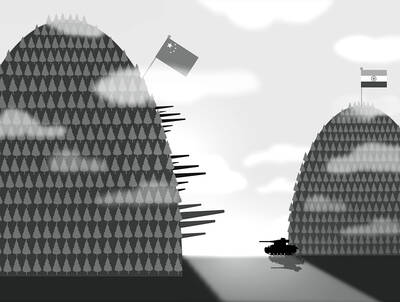
India is not China, and many of its residents fear it never will be. It is hard to imagine a future in which the subcontinent’s manufacturing dominates the world, its foreign investment shapes nations’ destinies, and the challenge of its economic system forces the West to reshape its own policies and principles. However, that is, apparently, what the US administration fears. Speaking in New Delhi last week, US Deputy Secretary of State Christopher Landau warned that “we will not make the same mistakes with India that we did with China 20 years ago.” Although he claimed the recently agreed framework


 RSS
RSS