


As the presidential election enters the final countdown, all three tickets are using every second to woo votes.
In a popular YouTube video circulating this week, an interviewer asks college students about who they would vote for, with most saying Taiwan People’s Party (TPP) Chairman Ko Wen-je (柯文哲), indicating Ko’s immense popularity among young people.
Why is he so strongly favored by young people given his many flaws?
Simply put, young people are rebels without a cause. Fed up with the long-term rivalry and conflict between the Chinese Nationalist Party (KMT) and the Democratic Progressive Party (DPP), they find Ko and his party “less detestable” than the others.
Of course, Ko is not without his charm and possesses other qualities that young people find appealing. A National Taiwan University doctor who claims to have a high IQ, Ko fires razor-sharp, off-the-cuff remarks that are often controversial, if not inappropriate. His remarks often carry a defiant undertone that resonates with young people, making him “their cup of tea.”
In terms of diplomacy and international relations, Ko seldom touches upon issues like Taiwan’s relations with the US or China, and even when he does, his pronouncements are more fantastical than realistic. Regarding China, he says he seeks a middle way of neither pushing back nor appeasing. His devil-may-care, nonchalant attitude has struck a chord with young people. After all, they do not enjoy the sounds and furies of politics, they only wish to carry on leading quiet lives, away from having to think about the quagmire of cross-strait relations.
However, young people are forgetting that their “quiet lives” are the result of the blood and toil of their forebears in fighting for freedom and democracy. Taiwan would not have the freedom it has today if not for the relentless efforts paid in blood by DPP democracy advocates. Without former president Chiang Ching-kuo’s (蔣經國) democratic reforms and former president Lee Teng-hui (李登輝) carrying the democratic baton forward, Taiwan would still be a one-party state instead of a multi-party system. Only with President Tsai Ing-wen’s (蔡英文) eight years of exceptional diplomatic and domestic leadership has Taiwan become Asia’s top democracy and economy.
Young people should remember that democracy is not something that fell from the sky. It is a fragile thing and could be easily lost if not carefully protected. They have the right to avert or despise politics, but they must remember that the quiet lives that they wish to hold on to are based on their nation’s democratic system.
It is easy to be cynical and vote for Ko to teach the KMT and the DPP a lesson. However, a ballot has never been a mere piece of paper, but a decisive tool in determining a nation’s fate and its people.
The biggest issue with Ko is neither his cunning, capriciousness nor his acting like a mommy’s boy, but his cavalier attitude toward cross-strait policy and other international relations. To Taiwan, nothing matters more than this.
Taiwan’s high-tech industry would not be able to thrive without the right allies by its side. If Taiwan and Taiwan Semiconductor Manufacturing Co (台積電) were to fall into the hands of China, Taiwan would find itself on the US sanctions list. Without the US’ chip design, there would be no need for chip manufacturing, not to mention economic and domestic issues that are closely associated with cross-strait relations.
Politics lies at the root of the workings of a nation. Young people must not choose someone who is “hip” or “cool” at an impulse over one who has a decisive vision and well-founded policies for the nation. Every ballot could become the key to changing Taiwan’s future.
Tread carefully, young people, for you might be treading on your dreams.
Taiwanese pragmatism has long been praised when it comes to addressing Chinese attempts to erase Taiwan from the international stage. “Taipei” and the even more inaccurate and degrading “Chinese Taipei,” imposed titles required to participate in international events, are loathed by Taiwanese. That is why there was huge applause in Taiwan when Japanese public broadcaster NHK referred to the Taiwanese Olympic team as “Taiwan,” instead of “Chinese Taipei” during the opening ceremony of the Tokyo Olympics. What is standard protocol for most nations — calling a national team by the name their country is commonly known by — is impossible for
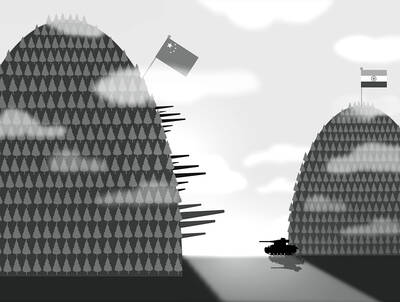
India is not China, and many of its residents fear it never will be. It is hard to imagine a future in which the subcontinent’s manufacturing dominates the world, its foreign investment shapes nations’ destinies, and the challenge of its economic system forces the West to reshape its own policies and principles. However, that is, apparently, what the US administration fears. Speaking in New Delhi last week, US Deputy Secretary of State Christopher Landau warned that “we will not make the same mistakes with India that we did with China 20 years ago.” Although he claimed the recently agreed framework
The Office of the US Trade Representative (USTR) on Wednesday last week announced it is launching investigations into 16 US trading partners, including Taiwan, under Section 301 of the Trade Act of 1974 to determine whether they have engaged in unfair trade practices, such as overproduction. A day later, the agency announced a separate Section 301 investigation into 60 economies based on the implementation of measures to prohibit the importation of goods produced with forced labor. Several of Taiwan’s main trading rivals — including China, Japan, South Korea and the EU — also made the US’ investigation list. The announcements come
Taiwan is not invited to the table. It never has been, but this year, with the Philippines holding the ASEAN chair, the question that matters is no longer who gets formally named, it is who becomes structurally indispensable. The “one China” formula continues to do its job. It sets the outer boundary of official diplomatic speech, and no one in the region has a serious interest in openly challenging it. However, beneath the surface, something is thickening. Trade corridors, digital infrastructure, artificial intelligence (AI) cooperation, supply chains, cross-border investment: The connective tissue between Taiwan and ASEAN is quietly and methodically growing


 RSS
RSS