


When I read the article “Schools should teach students about water safety” published in the Liberty Times (the Taipei Times’ sister newspaper), it reminded me of my childhood. When I was little, I used to live in a small village by the sea. As there were no computers, mobile phones and other electronic products back then, my friends and I often went to the beach for fun during the summer holiday.
As a non-swimmer, I held on to a piece of polystyrene board and joined in the fun with the others. One day, a huge wave hit me, making me let go of the board. I was engulfed by the waves and at that moment, it was as if I saw death waving at me with its scythe.
Fortunately, I was not far from the shore, and a friend quickly noticed and pulled me out of the water, saving me from drowning. From then on, I was afraid of water. Whether it was the sea, river or lakes, I always gave them a wide berth.
Before the summer holiday begins, schools always repeatedly tell students to stay away from rivers and beaches over the holiday, but children being children never heed their teacher’s words.
As a splash in the water is exciting and can cool the heat of summer, children never take safety to heart.
This is where education steps in. Schools have been promoting water safety in recent years, while the government has been introducing students to the dangers of playing water sports aside from in swimming pools via forums, videos, class meetings and discussions.
Every student should be familiar with rescue and drowning prevention skills, which can be summarized in the mantra “shouting for help, calling 119, using long objects, throwing floating objects and using floats.”
At the same time, schools should issue water safety forms to inform parents of the dangerous spots in Taiwan and to remind them to prevent children from going to those areas for fun.
Overall, as a schoolteacher, I think schools have done ample in terms of water safety education.
As many students do not attend summer holiday tutorial courses and parents do not have time to plan their children’s summer schedule, the two-month summer break can be long. After students come back after the holiday, teachers notice that many of them show a significant drop in academic performance, manners and concentration, which we call the “slippery slope” effect.
Parents and schools must share the responsibility and cooperate to ensure the emotional and intellectual growth of children.
Lin Cheng-wu is a junior-high schoolteacher.
Translated by Rita Wang
A gap appears to be emerging between Washington’s foreign policy elites and the broader American public on how the United States should respond to China’s rise. From my vantage working at a think tank in Washington, DC, and through regular travel around the United States, I increasingly experience two distinct discussions. This divergence — between America’s elite hawkishness and public caution — may become one of the least appreciated and most consequential external factors influencing Taiwan’s security environment in the years ahead. Within the American policy community, the dominant view of China has grown unmistakably tough. Many members of Congress, as
The Hong Kong government on Monday gazetted sweeping amendments to the implementation rules of Article 43 of its National Security Law. There was no legislative debate, no public consultation and no transition period. By the time the ink dried on the gazette, the new powers were already in force. This move effectively bypassed Hong Kong’s Legislative Council. The rules were enacted by the Hong Kong chief executive, in conjunction with the Committee for Safeguarding National Security — a body shielded from judicial review and accountable only to Beijing. What is presented as “procedural refinement” is, in substance, a shift away from
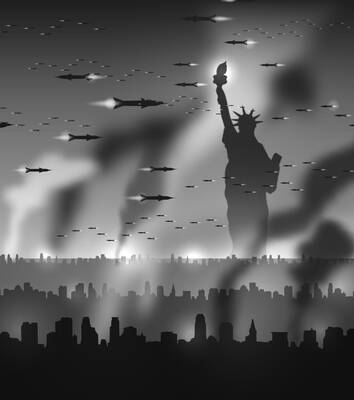
After declaring Iran’s military “gone,” US President Donald Trump appealed to the UK, France, Japan and South Korea — as well as China, Iran’s strategic partner — to send minesweepers and naval forces to reopen the Strait of Hormuz. When allies balked, the request turned into a warning: NATO would face “a very bad” future if it refused. The prevailing wisdom is that Trump faces a credibility problem: having spent years insulting allies, he finds they would not rally when he needs them. That is true, but superficial, as though a structural collapse could be caused by wounded feelings. Something
The shifting geopolitical tectonic plates of this year have placed Beijing in a profound strategic dilemma. As Chinese President Xi Jinping (習近平) prepares for a high-stakes summit with US President Donald Trump, the traditional power dynamics of the China-Japan-US triangle have been destabilized by the diplomatic success of Japanese Prime Minister Sanae Takaichi in Washington. For the Chinese leadership, the anxiety is two-fold: There is a visceral fear of being encircled by a hardened security alliance, and a secondary risk of being left in a vulnerable position by a transactional deal between Washington and Tokyo that might inadvertently empower Japan


 RSS
RSS