


Former president Ma Ying-jeou (馬英九), under the auspices of his Ma Ying-jeou Foundation, invited a group of 37 teachers and students from five universities in China to visit Taiwan for a summer exchange program that lasted from July 15 until Sunday. The foundation said that exchanges between young people from the two sides of the Taiwan Strait would influence the decisionmaking of the governments on both sides, and that the future of cross-strait relations depends on the young people of today.
Soon after arriving, some of the visitors said they were extremely impressed by the friendliness of Taiwanese, but they should pay at least as much attention to Taiwan’s democracy. The race is on for next year’s presidential and legislative elections, with parties putting forward their respective policy positions and proposals. Despite their differences, what these competing parties have in common is that they need to win support from the voters. In democratic Taiwan, elections are the only way to gain legitimate power, and there is no such thing as one-party rule.
People can judge for themselves whether the itinerary arranged by Ma for the visitors has informed or misinformed them about Taiwan. At least, in the free space that Taiwan offers, the visitors could encounter information and viewpoints that differ from those that are provided by the Chinese media or by the likes of Ma. For example, a July 16 protest on Ketagalan Boulevard calling for judicial reform and housing justice gave the visitors a taste of Taiwan’s vitality and democracy. While such rallies are commonplace in Taiwan, this one was enough to show them how transparently power is acquired and supervised in our democratic system. Provided that they were willing to keep an open mind, they could easily absorb the diversity of information and viewpoints that exists in Taiwan and learn about the true face of the free world through the unrestricted Internet.
For instance, they could find information and various interpretations about the disappearance of Chinese Minister of Foreign Affairs Qin Gang (秦剛), who has not been seen in public since the end of last month. In contrast, Chinese media have said nothing about Qin’s mysterious absence.
The Ma Ying-jeou Foundation said that interactions between young people from both sides of the Taiwan Strait can influence the policy decisions of their respective governments. The power of young people’s influence is common knowledge in Taiwan. The Sunflower movement, which arose in 2014 toward the end of Ma’s presidency, managed to block ratification of the cross-strait service trade agreement, which had been negotiated and signed behind closed doors. The main players in the Sunflower movement were university students, just like the Chinese students who have just concluded their visit to Taiwan. Raising the banner of protest, the Sunflower movement protesters occupied the floor of the Legislative Yuan, and their occupation received widespread support from the public and even from then-legislative speaker Wang Jin-pyng (王金平).
In turn, the Sunflower movement influenced the civil disobedience movement in Hong Kong. Unfortunately, the Chinese government took advantage of the COVID-19 pandemic and other troubles around the world to clamp down on Hong Kong and enforce its National Security Law. Many pro-democracy activists and members of Hong Kong’s free media were either arrested or fled abroad, leaving Hong Kong with no space for dissent. If the visitors compare Taiwan’s media with the media of Chinese-ruled Hong Kong, they would easily realize that Taiwan is not part of China.
The topic of Taiwan’s Sunflower movement also brings to mind the democracy movement that shook Beijing and other parts of China in 1989. After reform-minded former Chinese Communist Party (CCP) chairman Hu Yaobang (胡耀邦) died on April 15 of that year, mourning activities initiated by university students on Beijing’s Tiananmen Square quickly spread to other parts of China. Those students, some of whom were eventually shot dead on the square when the army moved in on June 4, were the same age as those who recently visited Taiwan. More than 30 years have gone by, and the visitors, who were born many years after those events, can neither discover the truth about what happened from China’s CCP-controlled media nor search for sensitive related keywords through Chinese search engines, while overseas search engines are blocked.
After the end of his presidency, Ma said that the attitude he had maintained when serving as mayor of Taipei had not changed, namely that there could be no talk of unification until the Chinese authorities vindicate the 1989 democracy movement. The students who took part in Ma’s summer exchange program might have used Taiwan’s freedom to learn more about the patriotic sentiments of their predecessors more than three decades ago, and perhaps they had a chance to ask Ma about how the 1989 events affect cross-strait relations.
The most important issue in Taiwan is next year’s presidential and legislative elections. It was good for the participants to experience this “carnival of democracy,” because no such thing happens under “Chinese-style democracy.” They could listen to the deeper meaning of mainstream public opinion, which cannot be voiced in China’s media. China’s leaders are always saying that “the US has US-style democracy, and China has Chinese-style democracy.” It is hard for us in Taiwan to understand what “Chinese-style democracy” is supposed to mean, because in Taiwan, as in the US, voters have the freedom to bring about a change of government. In contrast, the CCP allows no challenge to its one-party dictatorship, and such a challenge is even more unimaginable under the rule of Chinese President Xi Jinping (習近平).
On Dec. 10, 2008, a group of Chinese dissidents and human rights activists marked the 60th anniversary of the Universal Declaration of Human Rights by publishing a manifesto for reform titled Charter 08.
The following year, one of the charter’s main authors, Liu Xiaobo (劉曉波), was sentenced to 11 years in jail for “inciting subversion of state power.” Liu remained in jail even after being awarded the 2010 Nobel Peace Prize, and he died of cancer while on medical parole in July 2017. Liu, the whistle-blower of authoritarian China, and ophthalmologist Li Wenliang (李文亮), the whistle-blower of China’s COVID-19 outbreak, who died of COVID-19 in February 2020, represent the conscience of China. Whistle-blowers such as these would not have suffered such a tragic fate in democratic Taiwan, where there are regular elections, citizens are masters of the land, and politicians and political parties are there to serve the public.
Although the summer exchange participants only spent a little over a week in Taiwan, there is something that they could discover even from the most pro-unification and pro-Chinese Nationalist Party (KMT) media. Even from such sources, they could learn about democratic countries and international organizations’ condemnation of China’s attempts to forcefully change the “status quo” in the Taiwan Strait and undermine the rules-based international order. They do not shy away from calling Xi a provocateur. This stands in stark contrast to China’s official statement about the current poor state of US-China relations, which is that “the root cause is US misperceptions toward China, which has led to misguided China policies.”
Hopefully, the summer exchange participants took advantage of their visit to discover information and opinions that are shut out of China’s closed space. Such an experience would make it easier for them to learn and grow in a more balanced way after returning to China. If there is something to hope for from these visitors, it is not so much to improve cross-strait relations as to first change China. If Ma is concerned about China’s future, it would be even better if he could invite exiled Chinese and Hong Kong pro-democracy activists, as well as the Dalai Lama and World Uyghur Congress special leader Rebiya Kadeer, to visit Taiwan.
Translated by Julian Clegg
A gap appears to be emerging between Washington’s foreign policy elites and the broader American public on how the United States should respond to China’s rise. From my vantage working at a think tank in Washington, DC, and through regular travel around the United States, I increasingly experience two distinct discussions. This divergence — between America’s elite hawkishness and public caution — may become one of the least appreciated and most consequential external factors influencing Taiwan’s security environment in the years ahead. Within the American policy community, the dominant view of China has grown unmistakably tough. Many members of Congress, as
The Hong Kong government on Monday gazetted sweeping amendments to the implementation rules of Article 43 of its National Security Law. There was no legislative debate, no public consultation and no transition period. By the time the ink dried on the gazette, the new powers were already in force. This move effectively bypassed Hong Kong’s Legislative Council. The rules were enacted by the Hong Kong chief executive, in conjunction with the Committee for Safeguarding National Security — a body shielded from judicial review and accountable only to Beijing. What is presented as “procedural refinement” is, in substance, a shift away from
The shifting geopolitical tectonic plates of this year have placed Beijing in a profound strategic dilemma. As Chinese President Xi Jinping (習近平) prepares for a high-stakes summit with US President Donald Trump, the traditional power dynamics of the China-Japan-US triangle have been destabilized by the diplomatic success of Japanese Prime Minister Sanae Takaichi in Washington. For the Chinese leadership, the anxiety is two-fold: There is a visceral fear of being encircled by a hardened security alliance, and a secondary risk of being left in a vulnerable position by a transactional deal between Washington and Tokyo that might inadvertently empower Japan
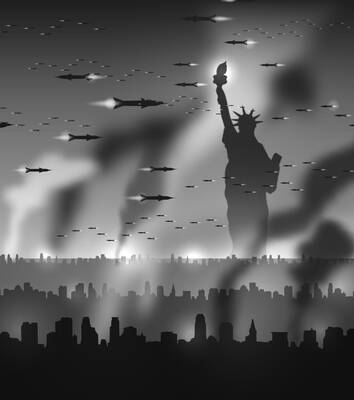
After declaring Iran’s military “gone,” US President Donald Trump appealed to the UK, France, Japan and South Korea — as well as China, Iran’s strategic partner — to send minesweepers and naval forces to reopen the Strait of Hormuz. When allies balked, the request turned into a warning: NATO would face “a very bad” future if it refused. The prevailing wisdom is that Trump faces a credibility problem: having spent years insulting allies, he finds they would not rally when he needs them. That is true, but superficial, as though a structural collapse could be caused by wounded feelings. Something


 RSS
RSS