


In an op-ed published in the Washington Post on Monday, Foxconn Technology Group founder Terry Gou (郭台銘) said the rejection of the “one China framework” by the Democratic Progressive Party (DPP) government has led to a cross-strait stalemate and increased tensions. The article was meant to be a response and challenge to the “four main pillars of peace,” a proposal spelled out in a Wall Street Journal op-ed by Vice President and DPP presidential nominee William Lai (賴清德) in his plan to preserve peace in the Taiwan Strait.
Gou was using the article to demonstrate his foreign relations vision and his negotiation skills, which Taiwan People’s Party (TPP) Chairman and presidential candidate Ko Wen-je (柯文哲) and New Taipei City Mayor Hou You-yi (侯友宜), the Chinese Nationalist Party (KMT) presidential nominee, are found to be lacking. When the three “rotten apples” of Ko, Gou and Hou are placed in the same basket, Gou probably thought that he had the upper hand and the legitimacy to run. Nonetheless, anyone who has read his op-ed would know that Gou’s article was filled with fallacies, one that is seriously out of touch with the international community and the public will.
Gou said the independence-leaning DPP’s rejection of the “one China” framework and the “1992 consensus” have “greatly aggravated the threat of war, isolated Taiwan internationally, damaged the economy, scared away investors and made Taiwan less secure.”
However, Gou glossed over the fact that more than 80 percent of Taiwanese found China’s “one China principle” and its core belief that Taiwan is an inalienable part of China unacceptable.
MYOPIA
Gou has also conveniently ignored the part that under President Tsai Ing-wen’s (蔡英文) more than seven years of leadership, Taiwan has taken the hardline stance of rejecting China and seeking out new allies, which brought forward fruitful results: Taiwan’s merchandise exports last year totaled US$479 billion, which accounted for 1.9 percent of the global exports, and ranked 17th in the world. Foreign tech giants such as Google and Microsoft are also placing their bets on Taiwan with investment. In this year’s IMD World Competitiveness Ranking, Taiwan was placed sixth out of 64 economies. This is enough to show that Gou’s proposal is way off the mark when it comes to knowing the needs of ordinary Taiwanese, and that he might not be as close to the presidential seat as he thinks.
In the article, Gou advocated the “immediate resumption of direct cross-strait negotiations between Taiwan and China as the only way to truly ease tensions and to preserve Taiwan’s democracy, freedom and rule of law.” Not only does this send the wrong message to the international community, but also plays into China’s hands by making cross-strait conflict an “internal matter,” a measure that would exclude the interference of external forces, and thereby put Taiwan’s security and future at great risk.
After more than seven years of efforts and dedication, the DPP government has finally put Taiwan in the global spotlight. With the G20 Summit, the EU, the Quadrilateral Security Dialogue and NATO have been paying close attention to cross-strait security and opposing unilateral attempts to alter the cross-strait “status quo” with acts of military intimidation, Gou’s “cross-strait negotiations” would be laying waste to these hard-earned accomplishments, and sliding back to the ignominious “one China framework” and negotiations between the Chinese Communist Party (CCP) and KMT.
However, the two policies have not only been deemed outdated long ago, but are also regarded as “toxic” to Taiwan’s identity.
OUTREACH
Current international relations favor Taiwan, allowing it to reach out and form ties with other democratic allies.
However, the foreign policies proposed by the KMT and TPP presidential candidates would go against the public will and global trends.
Ko has proposed restarting talks on the cross-strait service trade agreement, even though China has made the “one China principle” and the “1992 consensus” prerequisites. Hou still intends to follow the footsteps of former president Ma Ying-jeou (馬英九) and his “1992 consensus,” even though the CCP has made it clear that there is only one China and there are no multiple interpretations. Gou intendes to launch negotiations under the “one China” framework, which aligns with China’s hope of not allowing any external forces to interfere in cross-strait negotiations for “unification.”
All their policies fall within the political frameworks that have been established by China. They are measures to undermine Taiwan’s global and geopolitical status, and eventually serve Taiwan to China on a silver platter.
Next year’s presidential election is no doubt a choice between democracy and autocracy, the shift to democratic allies or to an authoritarian China, or the decision to move forward or to retrace one’s steps. As the presidential candidates revealed their hand, it is up to Taiwanese to make the critical choice about the nation’s future.
Jethro Wang is a former secretary at the Mainland Affairs Council.
Translated by Rita Wang
A gap appears to be emerging between Washington’s foreign policy elites and the broader American public on how the United States should respond to China’s rise. From my vantage working at a think tank in Washington, DC, and through regular travel around the United States, I increasingly experience two distinct discussions. This divergence — between America’s elite hawkishness and public caution — may become one of the least appreciated and most consequential external factors influencing Taiwan’s security environment in the years ahead. Within the American policy community, the dominant view of China has grown unmistakably tough. Many members of Congress, as
The Hong Kong government on Monday gazetted sweeping amendments to the implementation rules of Article 43 of its National Security Law. There was no legislative debate, no public consultation and no transition period. By the time the ink dried on the gazette, the new powers were already in force. This move effectively bypassed Hong Kong’s Legislative Council. The rules were enacted by the Hong Kong chief executive, in conjunction with the Committee for Safeguarding National Security — a body shielded from judicial review and accountable only to Beijing. What is presented as “procedural refinement” is, in substance, a shift away from
The shifting geopolitical tectonic plates of this year have placed Beijing in a profound strategic dilemma. As Chinese President Xi Jinping (習近平) prepares for a high-stakes summit with US President Donald Trump, the traditional power dynamics of the China-Japan-US triangle have been destabilized by the diplomatic success of Japanese Prime Minister Sanae Takaichi in Washington. For the Chinese leadership, the anxiety is two-fold: There is a visceral fear of being encircled by a hardened security alliance, and a secondary risk of being left in a vulnerable position by a transactional deal between Washington and Tokyo that might inadvertently empower Japan
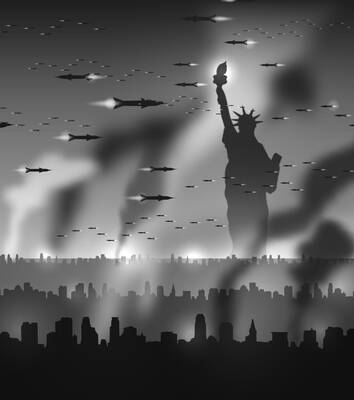
After declaring Iran’s military “gone,” US President Donald Trump appealed to the UK, France, Japan and South Korea — as well as China, Iran’s strategic partner — to send minesweepers and naval forces to reopen the Strait of Hormuz. When allies balked, the request turned into a warning: NATO would face “a very bad” future if it refused. The prevailing wisdom is that Trump faces a credibility problem: having spent years insulting allies, he finds they would not rally when he needs them. That is true, but superficial, as though a structural collapse could be caused by wounded feelings. Something


 RSS
RSS