


Convincing voters who remember the debate over the cross-strait service trade agreement a decade ago, as well as the flaws in the legislative process surrounding it at the time, will be difficult. They still remember academics and mainstream media warning of doom and gloom if the agreement were not signed.
In February 2014, Ku Ying-hua (顧瑩華), then-director of the Chung-Hua Institution for Economic Research’s (CIER) Regional Development Study Center, published an article saying that Taiwan would be “finished” within 10 years if China and South Korea signed a free-trade agreement (FTA).
South Korea had not even started negotiations until 2012, but it quickly came up with the English version of an FTA with China, and the official signing was just around the corner.
The Legislative Yuan approved the Economic Cooperation Framework Agreement (ECFA) in August 2010, and was still debating the service trade agreement and goods trade agreement. Ku believed that the day would come when South Korean products faced zero tariffs in China, when they would replace Taiwanese products. Taiwanese companies would not wait for this to happen and would relocate overseas before it did. According to this analysis, Taiwan had one or two decades before its economy was ruined.
Lin Chien-fu (林建甫) of National Taiwan University’s Department of Economics was also worried that if the China-South Korea FTA came into effect by 2015, and the cross-strait service trade agreement under the ECFA was still pending, it would be like an “atomic bomb” for Taiwan’s economy.
During an interview published in Global Views Monthly’s February 2014 issue, CIER vice president Wang Jiann-chyuan (王健全) said that if Taiwan could not ensure regional integration, salaries for young people would stagnate at NT$22,000, and the best that they could hope for would be that they would not drop within five years.
Finally, then-National Development Council minister Kuan Chung-ming (管中閔在) said the government had forecast in 2000 that South Korea’s trade volume would be about 1.3 times Taiwan’s by 2012, but that the actual ratio was 1.9 times. By extrapolation, South Korea’s trade volume could be three times higher than Taiwan’s by 2025, and that was without taking into account the Regional Comprehensive Economic Partnership and China-Japan-South Korea FTAs, Kuan said.
These forecasts are easy to test. Today, the basic monthly wage in Taiwan has exceeded NT$22,000, and has neither stagnated nor fallen in the past five years. Plus, South Korea’s trade volume reached a record high of US$1.415 trillion last year, which was almost 1.6 times Taiwan’s trade volume of US$0.9075 trillion, instead of the huge differential of 1.9 to three times predicted by Kuan — and has been shrinking.
The ECFA had been one of former president Ma Ying-jeou’s (馬英九) campaign promises, so he needed to implement it, but suspected that then-legislative speaker Wang Jin-pyng (王金平) tried to delay its passage. This is why Ma wanted to rush the service trade agreement through without review, sparking the 2014 Sunflower movement.
Taiwan People’s Party Chairman and presidential candidate Ko Wen-je (柯文哲) is revisiting the issue to attract deep-blue supporters, and also to show young voters too young to remember the Chinese Nationalist Party’s (KMT) egregious handling of the legislative process.
As the Democratic Progressive Party is not talking about the issue, Ko can portray himself as being no slave to ideology, while also expressing his goodwill to China. He is essentially killing four birds with one stone.
Wu Hai-ruei is a manager at a listed company.
Translated by Eddy Chang
A gap appears to be emerging between Washington’s foreign policy elites and the broader American public on how the United States should respond to China’s rise. From my vantage working at a think tank in Washington, DC, and through regular travel around the United States, I increasingly experience two distinct discussions. This divergence — between America’s elite hawkishness and public caution — may become one of the least appreciated and most consequential external factors influencing Taiwan’s security environment in the years ahead. Within the American policy community, the dominant view of China has grown unmistakably tough. Many members of Congress, as
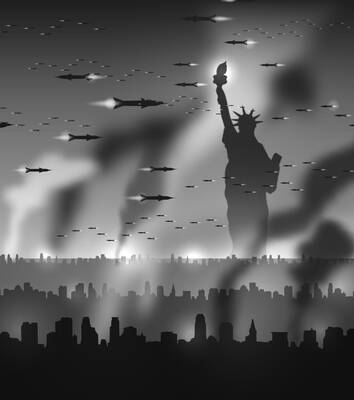
After declaring Iran’s military “gone,” US President Donald Trump appealed to the UK, France, Japan and South Korea — as well as China, Iran’s strategic partner — to send minesweepers and naval forces to reopen the Strait of Hormuz. When allies balked, the request turned into a warning: NATO would face “a very bad” future if it refused. The prevailing wisdom is that Trump faces a credibility problem: having spent years insulting allies, he finds they would not rally when he needs them. That is true, but superficial, as though a structural collapse could be caused by wounded feelings. Something
Former Taipei mayor and Taiwan People’s Party (TPP) founding chairman Ko Wen-je (柯文哲) was sentenced to 17 years in prison on Thursday, making headlines across major media. However, another case linked to the TPP — the indictment of Chinese immigrant Xu Chunying (徐春鶯) for alleged violations of the Anti-Infiltration Act (反滲透法) on Tuesday — has also stirred up heated discussions. Born in Shanghai, Xu became a resident of Taiwan through marriage in 1993. Currently the director of the Taiwan New Immigrant Development Association, she was elected to serve as legislator-at-large for the TPP in 2023, but was later charged with involvement
Out of 64 participating universities in this year’s Stars Program — through which schools directly recommend their top students to universities for admission — only 19 filled their admissions quotas. There were 922 vacancies, down more than 200 from last year; top universities had 37 unfilled places, 40 fewer than last year. The original purpose of the Stars Program was to expand admissions to a wider range of students. However, certain departments at elite universities that failed to meet their admissions quotas are not improving. Vacancies at top universities are linked to students’ program preferences on their applications, but inappropriate admission


 RSS
RSS