


Looking at this year’s presidential and legislative nomination process, the national development planning of the candidates and their pan-blue, green and white camps can be seen.
Within the Chinese Nationalist Party (KMT), there has been a dispute over its nomination mechanism, as Hon Hai Group founder Terry Gou (郭台銘) again sought the party’s presidential nomination. With a basic consensus that the party must select the most suitable candidate, KMT Chairman Eric Chu (朱立倫) nominated New Taipei City Mayor Hou You-yi (侯友宜), a decision based on opinion polls.
Although the Taiwan People’s Party (TPP), the main party in the pan-white camp, was expected to ally with the KMT, the rise of pan-blue camp support was seen as unfavorable to the TPP, which has gradually been marginalized. A TVBS poll released last month said that support for the KMT, the Democratic Progressive Party (DPP) and the TPP was 23, 22 and 12 percent respectively.
The DPP, even with great resources, has its burdens. Since Vice President and DPP Chairman William Lai (賴清德) launched his presidential campaign without challenge, he has used traditional media, social media and YouTube to interact with young people on issues concerning them, such as their livelihoods, education, the economy and transportation, while also proposing possible solutions. This has obviously had a positive effect on Lai’s campaign.
A Taiwanese Public Opinion Foundation poll released this month showed the DPP leading with a 24.6 percent approval rating, while the TPP’s rating rose greatly to 22.2 percent, overtaking the KMT, which fell to 20.4 percent.
Another TVBS poll, also conducted this month, showed that support for TPP Chairman and presidential candidate Ko Wen-je (柯文哲) surged 10 percent to 33 percent, followed by Lai at 30 percent, while Hou dropped to third at 23 percent. A surprise surge such as that by the TPP and its candidate is rarely seen, and the phenomenon deserves attention.
The TPP’s strategy is to uphold the banner of a “coalition government” after standing firmly in second place, in an attempt to stimulate a “dump-save effect,” in which voters ditch their preferred candidate to strategically cast their ballot for another to prevent a disliked party from winning.
The TPP believes that since there is a “ceiling” to the DPP’s growth, if the opposition camp can integrate light-green voters as well as medium to dark-blue voters, it might be able to achieve its ultimate goal of gaining power. This strategy has become the focus of many political watchers.
To achieve this, the TPP has been adopting a “two-handed strategy,” attacking the KMT to split the pan-blue camp, while attracting votes from the pan-green camp. The strategy has already yielded short-term results.
However, smart voters are also likely to be watching the TPP’s internal conflicts and Ko’s leadership style. Many problems occurred during his terms as Taipei mayor, such as administrative flaws by political appointees and corruption scandals, his autocratic leadership style and even sexual harassment allegations coming to light amid Taiwan’s #MeToo movement. Such problems are still fresh in the electorate’s mind.
Through direct elections, Taiwanese can be aware of facts and values that they are used to, but easily ignore, and such values of an open and diverse democratic society are exactly what China should learn.
Pan Wei-yiu is the secretary-general of the Northern Taiwan Society.
Translated by Eddy Chang
A gap appears to be emerging between Washington’s foreign policy elites and the broader American public on how the United States should respond to China’s rise. From my vantage working at a think tank in Washington, DC, and through regular travel around the United States, I increasingly experience two distinct discussions. This divergence — between America’s elite hawkishness and public caution — may become one of the least appreciated and most consequential external factors influencing Taiwan’s security environment in the years ahead. Within the American policy community, the dominant view of China has grown unmistakably tough. Many members of Congress, as
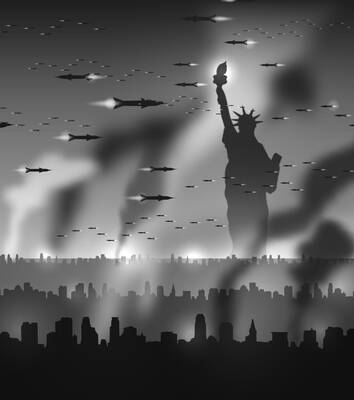
After declaring Iran’s military “gone,” US President Donald Trump appealed to the UK, France, Japan and South Korea — as well as China, Iran’s strategic partner — to send minesweepers and naval forces to reopen the Strait of Hormuz. When allies balked, the request turned into a warning: NATO would face “a very bad” future if it refused. The prevailing wisdom is that Trump faces a credibility problem: having spent years insulting allies, he finds they would not rally when he needs them. That is true, but superficial, as though a structural collapse could be caused by wounded feelings. Something
Former Taipei mayor and Taiwan People’s Party (TPP) founding chairman Ko Wen-je (柯文哲) was sentenced to 17 years in prison on Thursday, making headlines across major media. However, another case linked to the TPP — the indictment of Chinese immigrant Xu Chunying (徐春鶯) for alleged violations of the Anti-Infiltration Act (反滲透法) on Tuesday — has also stirred up heated discussions. Born in Shanghai, Xu became a resident of Taiwan through marriage in 1993. Currently the director of the Taiwan New Immigrant Development Association, she was elected to serve as legislator-at-large for the TPP in 2023, but was later charged with involvement
Out of 64 participating universities in this year’s Stars Program — through which schools directly recommend their top students to universities for admission — only 19 filled their admissions quotas. There were 922 vacancies, down more than 200 from last year; top universities had 37 unfilled places, 40 fewer than last year. The original purpose of the Stars Program was to expand admissions to a wider range of students. However, certain departments at elite universities that failed to meet their admissions quotas are not improving. Vacancies at top universities are linked to students’ program preferences on their applications, but inappropriate admission


 RSS
RSS