


Ahead of May 20, the anniversary of the presidential inauguration, the performance of the New Southbound Policy has again come under scrutiny. To defend its policy, the government released official figures showing that two-way trade last year with the target countries hit a record-high US$180.3 billion. Specifically, exports to those countries reached US$96.9 billion. The government is evidently hoping to counter some of the criticism of the policy with these glowing figures.
However, these data represent only part of the picture and do not truly reflect the trend of Taiwanese trade with these countries. Interestingly, the announcement did not include data about imports from these countries and the resultant trade surplus. The trade balance, a component of GDP, is a better indicator of its economic contribution to a country than the value of exports alone.
Taiwan’s trade surplus with the New Southbound countries dropped from US$22.6 billion in 2016 to US$13.4 billion last year, plunging about 40 percent. The ratio of the trade surplus to the nation’s GDP dipped from 4.17 percent of 2016 to 1.77 percent last year — falling below 2 percent for the first time — a decline of 60 percent.
In other words, as Taiwanese exports increased, its imports also increased. With the two offsetting each other, the policy’s contribution to the nation’s economy, as the trade surplus showed, was historically the worst. Ignoring this trend, the government chose to focus on the overall trade value as an indication of the policy’s achievements.
In fairness, the New Southbound Policy is not without merit. In particular, the quality and quantity of personnel exchanges between Taiwan and the New Southbound countries have grown significantly. In the 2006 academic year, the number of students from New Southbound countries who came to Taiwan to study for a degree was 25,268. In 2010, it jumped 1.6 times to 41,177; it could have increased even more if not for the impact of the COVID-19 pandemic.
The government has also established the Taiwan-Asia Exchange Foundation to bolster academic research with a national think tank, and organized track two dialogue mechanisms such as the Yushan Forum. Externally, the National Science and Technology Council set up overseas scientific research centers in the New Southbound countries, and domestically subsidizes the establishment of “Taiwan-India academic chains” and other projects. All these are the undeniable contributions of the New Southbound Policy.
However, there have been signs of a decline since the policy was implemented. For example, for its first budget allocation, the government set aside NT$2.11 billion (US$68.8 million). The following year represented its peak budget, with the government allocating NT$3.78 billion, but since then it has remained at about NT$3 billion.
Despite a record-high government budget for next year, the money allocated for the New Southbound Policy covering 18 countries is only NT$3.11 billion, which is lower than the period from 2018 to 2020; while the budget solely for supporting Ukraine is NT$1.8 billion.
Some administrative details also show that the government does not attach as much importance to the New Southbound Policy as before. For example, the Directorate-General of Budget, Accounting and Statistics has slashed daily expenses for business trips to Southeast Asia and South Asia this year, and the budget for business travel expenses to New Delhi have shrunk by 40 percent, while those for travel to Japan and South Korea have increased.
In 2017, the Ministry of Foreign Affairs listed the New Southbound Policy as one of the main research topics of the overseas stationing program for academics; the following year, it was listed as one of the subtopics. After that, New Southbound Policy was never included in the list, which is regrettable.
The New Southbound Policy was highly anticipated when it was first proposed, and armed with hindsight, considering the events that have happened since — the tense cross-strait relations, the US-China trade war, the spread of the COVID-19 pandemic — its importance is all the more apparent.
To put it bluntly, the New Southbound Policy is Taiwan’s risk-avoidance strategy. The idea is not problematic, and its key lies in the strength and sustainability of its implementation.
With the presidential election approaching, aside from cross-strait and US policies, candidates should propose a more innovative 2.0 version of the New Southbound strategy.
Fang Tien-sze is associate professor at National Tsing Hua University’s Center for General Education and deputy director of the Center for India Studies.
Translated by Lin Lee-kai
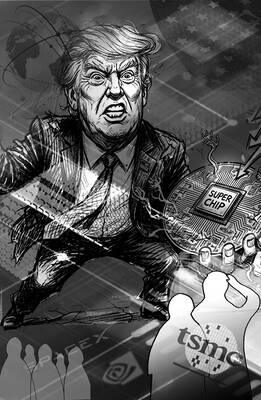
The White House’s decision to take a 9.9 percent stake in Intel Corp is looking like very shrewd business indeed. Since the government bought in at US$20.47 a share last August, the US chipmaker’s surging stock price has delivered the US a US$43 billion return. One of the reasons the investment has so far proved so sound is that the White House has made sure of it. According to The Wall Street Journal, Howard personally pushed deals on Intel’s behalf with some of the most lucrative clients imaginable. They include Nvidia Corp, the company at the heart of the AI
A single photograph can cut through a lot of noise, but it can also be used to misrepresent the truth. At the very least, it can concentrate the mind on something that requires further investigation. On Monday last week, Ma Ying-jeou Foundation CEO Tai Hsia-ling (戴遐齡) and former National Security Council secretary-general King Pu-tsung (金溥聰) held a news conference in which they showed a photograph of former foundation CEO Hsiao Hsu-tsen (蕭旭岑), now Chinese Nationalist Party (KMT) deputy chairman. In the image Hsiao is seated next to Xiamen Taiwan Businessmen Association chairman Han Ying-huan (韓螢煥). The two men were holding
I first met Professor Ray Jiing (井迎瑞) as a film and documentary student at Shih Hsin University’s (SHU) Department of Radio Television and Film in 1988. The following year, he went on to become the director of the Chinese Taipei Film Archive — forerunner of the Taiwan Film and Audiovisual Institute (TFAI). Over his eight-year tenure, Jiing rescued and restored over 200 classic Taiwanese films. In 1997, he established the Graduate Institute of Studies in Documentary and Film Archiving at Tainan National University of the Arts (TNNUA), and I joined the program in his third cohort of students. Beyond a
President William Lai Ching-te’s (賴清德) May 20 second-anniversary address was not just a routine policy review; it was damage control. US President Donald Trump’s remarks — that he did not want to see anyone move toward independence and that the delivery of a major Taiwan arms package could depend on the progress of US-China relations — unsettled Taiwan’s public and created an opening for opposition parties to question whether Taiwan was being treated as a bargaining chip in Washington’s dealings with Beijing. Lai’s speech was designed to close that opening. The address covered the expected ground: sovereignty, cross-strait relations, defense spending,


 RSS
RSS