


To intervene or not to intervene. That has been a central debate about the state’s role in the economy at least since the 18th century. Over the past 40 years, the US and other Western liberal democracies have championed free markets, free trade and a limited role for government — a stance known as neoliberalism or “market fundamentalism.”
To some commentators, the recent passage of the US’ Creating Helpful Incentives to Produce Semiconductors and Science Act and its Inflation Reduction Act — US President Joe Biden’s two signature industrial policies — marks the end of neoliberalism and the reemergence of interventionism as the dominant paradigm.
However, this is a false dichotomy. Governments are not limited to a binary choice between laissez-faire and top-down planning.
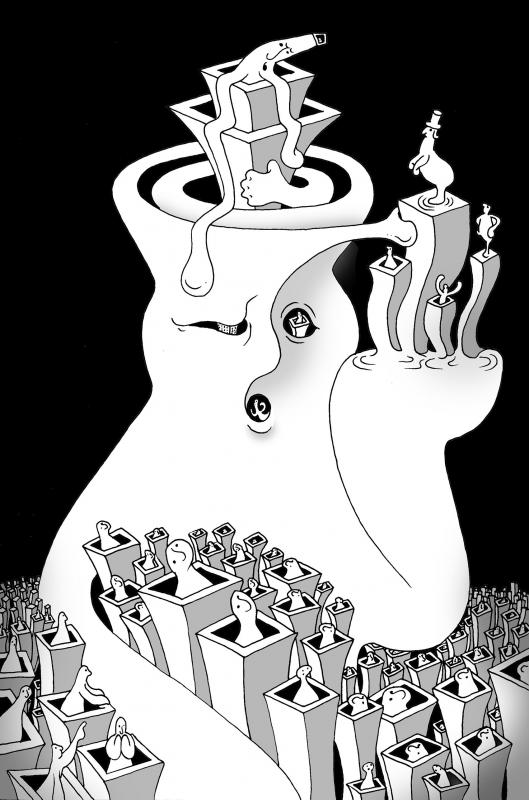
Illustration: Mountain People
A third option, long-neglected by policymakers and economists, is for governments to direct bottom-up processes of improvisation and creativity, akin to the role of an orchestra conductor. One can find plenty of examples of this in China and the US.
Neoliberalism emerged as the dominant policymaking paradigm in the West in the 1980s. Under then-US president Ronald Reagan, the US pursued deregulation, cut taxes and slashed welfare programs. Government intervention, the thinking went, inevitably leads to policy distortions, dependence on state handouts and corruption.
As Reagan famously put it in his first inaugural address, “government is not the solution to our problem. Government is the problem.”
Soon after, neoliberalism turned global. Under the “Washington Consensus,” a term coined by economist John Williamson in 1989, the US-dominated IMF and World Bank pressured developing countries to embrace deregulation, privatization and free trade.
One policy prescription favored by policymakers and economists was “secure property rights,” which spawned a cottage industry of studies showing the link between such rights and economic growth.
The implication was that all it took for countries to prosper was to leave markets to private entrepreneurs. State intervention was unnecessary, if not downright harmful.
However, not all developing countries went along. In defiance of Western prescriptions, Japan and the four “Asian Tigers” — Taiwan, Hong Kong, Singapore and South Korea — opted for massive government intervention.
By crafting long-term plans, investing in public infrastructure, and selecting and promoting potentially successful industries with favorable policies, they all achieved extraordinary economic growth from the 1960s to the 1990s.
Proponents of the model underlying the East Asian “miracle” criticized the Washington Consensus for ignoring the indispensable role of governments in late-developing economies.
The ideological pendulum has swung back and forth ever since.
Neoliberals briefly had the upper hand following the 1997 Asian financial crisis, which was widely blamed on state intervention.
However, the tide began to turn after the 2008 financial crisis. In the face of rising inequality, the COVID-19 pandemic and competition from China, a growing number of politicians and advisers argue that the West should follow in Asia’s footsteps and enact industrial policies.
What is missing from the debate is the third path, which I call “directed improvisation.”
As I chronicle in my book How China Escaped the Poverty Trap, China’s economic reforms from the 1980s to 2012 illustrate this hybrid role.
Directing involves coordinating and motivating a decentralized network of creative actors, discovering — but not predetermining — successful outcomes, and making ample use of experimentation and bottom-up feedback.
China’s economic boom is often credited to top-down planning by a strong government.
If authoritarianism and central planning were the answer, China would have prospered under former Chinese leader Mao Zedong (毛澤東).
When former Chinese leader Deng Xiaoping (鄧小平) succeeded Mao in 1978, he quietly revolutionized China.
The central government switched from dictator to director, articulating clear national goals and establishing appropriate incentives and rules, but also empowering subnational governments to improvise development strategies according to local conditions and needs.
Reflecting Deng’s pragmatism, the Chinese system was a melange of multiple — sometimes contradictory — elements, including Asian-style developmentalism and Western-style liberalization.
The underlying order was the seemingly paradoxical combination of direction and improvisation.
As a Chinese saying puts it, the central government sets the stage and local governments perform the play.
The result has been a diversity of regional “China models” operating simultaneously within the larger Chinese system.
For example, while Zhejiang and Jiangsu provinces are industrial powerhouses, the private sector plays a stronger role in Zhejiang’s economy, whereas Jiangsu relies on a more interventionist model.
The US government’s role in supporting innovation, which sociologists Fred Block and Matthew Keller called “coordinated decentralization,” is another example of directed improvisation.
In the mid-20th century, the US fostered a decentralized network of inventors, companies, universities and labs engaged in cutting-edge scientific research. It neither left them to their own devices nor told them what to do.
Instead, it coordinated knowledge sharing, helped identify opportunities to commercialize discoveries and provided seed funding, which created the conditions for the information and communication technology revolution.
However, this success is barely known to the public, because — as Block and Keller explained — it “does not fit with the claims of market fundamentalism.”
Governments’ ability to direct creative processes is more critical at the innovation-driven stages of development than at the early stages of mass industrialization.
As an economy becomes more complex and technologically advanced, it becomes harder — perhaps even impossible — for governments to pick winners.
Innovation is inherently uncertain. In the 1990s, for example, few would have thought that an online bookseller would one day become a dominant global retailer.
Policymakers are reluctant to talk about creativity. They would rather talk about markets or plans than acknowledge that innovation is necessarily a creative process with uncertain outcomes.
However, while governments cannot control this process, they can direct and influence it.
To do so, policymakers must first abandon the false dichotomy of neoliberalism versus interventionism.
Yuen Yuen Ang is chair of Political Economy at Johns Hopkins University.
Copyright: Project Syndicate
In the US’ National Security Strategy (NSS) report released last month, US President Donald Trump offered his interpretation of the Monroe Doctrine. The “Trump Corollary,” presented on page 15, is a distinctly aggressive rebranding of the more than 200-year-old foreign policy position. Beyond reasserting the sovereignty of the western hemisphere against foreign intervention, the document centers on energy and strategic assets, and attempts to redraw the map of the geopolitical landscape more broadly. It is clear that Trump no longer sees the western hemisphere as a peaceful backyard, but rather as the frontier of a new Cold War. In particular,
When it became clear that the world was entering a new era with a radical change in the US’ global stance in US President Donald Trump’s second term, many in Taiwan were concerned about what this meant for the nation’s defense against China. Instability and disruption are dangerous. Chaos introduces unknowns. There was a sense that the Chinese Nationalist Party (KMT) might have a point with its tendency not to trust the US. The world order is certainly changing, but concerns about the implications for Taiwan of this disruption left many blind to how the same forces might also weaken
As the Chinese People’s Liberation Army (PLA) races toward its 2027 modernization goals, most analysts fixate on ship counts, missile ranges and artificial intelligence. Those metrics matter — but they obscure a deeper vulnerability. The true future of the PLA, and by extension Taiwan’s security, might hinge less on hardware than on whether the Chinese Communist Party (CCP) can preserve ideological loyalty inside its own armed forces. Iran’s 1979 revolution demonstrated how even a technologically advanced military can collapse when the social environment surrounding it shifts. That lesson has renewed relevance as fresh unrest shakes Iran today — and it should
As the new year dawns, Taiwan faces a range of external uncertainties that could impact the safety and prosperity of its people and reverberate in its politics. Here are a few key questions that could spill over into Taiwan in the year ahead. WILL THE AI BUBBLE POP? The global AI boom supported Taiwan’s significant economic expansion in 2025. Taiwan’s economy grew over 7 percent and set records for exports, imports, and trade surplus. There is a brewing debate among investors about whether the AI boom will carry forward into 2026. Skeptics warn that AI-led global equity markets are overvalued and overleveraged


 RSS
RSS