


At the end of last year, New York state banned pet stores from selling cats, dogs or rabbits. The state wants to encourage pet stores to work with shelters, rather than puppy mills, to get animals adopted.
With any luck, other US states will follow suit.
In her story The Ones Who Walk Away From Omelas, Ursula Le Guin described a society where the joy of its citizens depended upon the “abominable misery” of a single child immured in a dungeon. Le Guin asked the reader if even great happiness could justify suffering.
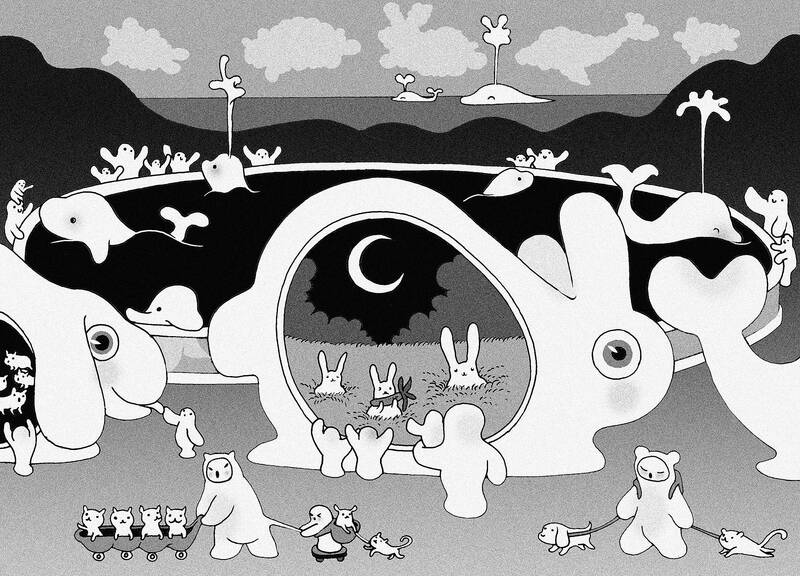
Illustration: Mountain People
Humanity’s relationship to animals is predicated on a similar utilitarian calculus. Like the town of Omelas, we have made a silent pact to dominate pets for our benefit, despite the cost to the pets themselves, to wild and farmed animals, and to our own morality.
Pets’ popularity has turned these humble animals into an economic and ecological force on a global scale. There are 900 million dogs and 700 million cats (both owned and feral) worldwide. Half of US households own an animal, while the number of pets in China has grown from virtually nil — dogs were once banned in Beijing — to 251 million.
At US$260 billion, the global pet market is worth more than the solar and wind energy sectors combined.
Pet ownership is bad for pets. The animals are harmed from the outset, regardless of whether they are sourced from puppy mills, the wild or artisanal inbreeders. Often African gray parrots and other “exotics” are captured from their habitats, and many die en route to the market.
Puppy mills are plagued by high mortality rates for the young, while mothers are kept perpetually pregnant until they are discarded.
Pedigreed animals, whose genetics are equivalent to the offspring of siblings, are often plagued by health problems during their truncated lives.
Other harms may similarly cut a pet’s life short. Dogs are often hit by vehicles, fall out of them or bake in them. The equivalent to 6 percent of the US cat and dog population (8 million animals) are abandoned at shelters every year — half of whom are then killed. In some cities, the number of new shelter animals has soared as people give up their “pandemic pets.”
Many animals survive this war of attrition, but lead lives of loneliness. Recently, the German government mandated one-hour daily walks for dogs because many were not getting enough attention or exercise. Two in five African gray parrots pluck themselves (“feather destruction”) out of boredom, and most die years earlier than their natural lifespan. It is hard to fathom the boredom of pet fish.
Although millions of animals are brought into this world solely for our pleasure, this dependence induces little reciprocity.
Pets suffer under the yoke of our affection, and they in turn harm wild and farmed animals. If US pets were a nation, they would rank fifth globally in terms of meat consumption — greater than Germany. Carnage at this scale is unnecessary because dogs can be vegan, yet only 1.6 percent are. (As obligate carnivores, cats are trickier.) Similarly, pet fish often could eat plants rather than the congealed remains of their pelagic cousins.
Pets are not always passive participants in the butchery of other animals. Cats have extinguished 63 species worldwide. The average feral cat in Australia kills 390 mammals, 225 reptiles and 130 birds per year.
Dogs are almost as ecologically destructive, presently endangering 200 species worldwide. In ecologically sensitive areas, dogs are banned or must be leashed, yet owners often defy such rules.
Furthermore, pets’ “pathogen pollution” sickens wild animals — the fungus B dendrobatidis has decimated wild amphibian populations and canine distemper threatens the rare Ethiopian wolf.
Pet ownership causes physical and psychic wounds to humanity, too.
Dogs kill about 25,000 people worldwide every year (mostly through rabies). By comparison, fewer than a dozen people are killed by sharks. Pets make us sick, too, by spreading monkeypox, brain parasites, ringworm and Lyme.
Australian horses were the disease vector for the deadly Hendra virus, which emerged in 1994. Epidemiologists note that dog feces are the “dominant source of aerosolized bacteria” in US cities because owners stoop and scoop only half the time.
Pet ownership’s more insidious injury is the hardening of our hearts for the sake of a selfish, possessive happiness. Rather than seeing other animals as autonomous beings with their own lives, desires and cultures, they are reduced to mere dolls. Living creatures become commodities that can be perfectly calibrated to one’s tastes — see the many “dog breed selectors” online.
People crave the unconditional love pets offer, but such supplication requires mastery at the level of individual animals broken by “training,” control of a species’ genetic inheritance through inbreeding and the dominance of whole ecosystems to feed hundreds of millions of animals.
If pet owners were animal lovers, as they profess, more would care about mass death in shelters and vanishing wild species. Far more pet owners would swear off meat. If people love cats, why are there 3 million domesticated cats (Felis catus) in the Netherlands, but only 14 European wildcats (Felis silvestris silvestris)?
A study found that compared with peers without pets, Slovak bird owners showed more interest in birds, but less empathy. They had learned to unsee the cruelty inherent in the pet-relation.
Like the imprisoned child of Omelas, it is not possible to free pets. They are too numerous or too ruined by their subjugation to live in the wild. Nor is it enough to walk away from pet ownership individually.
To create a world without pets, we must collectively decide to shut down puppy mills, to spay and neuter pets, and to support conservation programs that humanely capture feral animals.
In a post-pets era, we could still enjoy the company and beauty of animals, but from afar as naturalists in a wilder world. We can only speculate what this new era might look like, but its realization begins once we accept that true happiness cannot be predicated on the suffering of others.
Troy Vettese is an environmental historian at the European University Institute and coauthor of Half-Earth Socialism.
A 50-year-old on Wednesday last week died while under anesthesia at a Taipei cosmetic clinic shortly after undergoing a penis enlargement procedure. The surgeon was arrested for suspected medical malpractice, again bringing to the surface shortcomings in the regulation of cosmetic medicine. Media reports said the clinic owner and surgeon, surnamed Ting (丁), was previously convicted of negligent homicide for a postsurgical death and had been charged with coercion and aggravated assault after allegedly stopping a patient from calling for an ambulance. He had also been fined for failing inspections and had allegedly permitted people without medical licenses to assist
It was most annoying last week to read Chairman Xi Jinping’s (習近平) fulsome encomium to the People’s Liberation Army during the Eightieth Anniversary celebrations of victory over Japan in World War II. Comrade Xi’s soaring rhetoric was stuffed with “martyrs, sacrifice, solemnity and unwavering resolve” in praise of the “Chinese People’s War of Resistance Against Japanese Aggression and the World Anti-Fascist War.” His aspirations overflowed with “world peace” and love of the United Nations, of which China is a founding member. The Liberation Army Daily said that every word from General Secretary Xi Jinping “resounded in his powerful voice, illuminating the
An American Institute in Taiwan (AIT) spokesperson on Saturday rebuked a Chinese official for mischaracterizing World War II-era agreements as proving that Taiwan was ceded to China. The US Department of State later affirmed that the AIT remarks reflect Washington’s long-standing position: Taiwan’s political status remains undetermined and should only be resolved peacefully. The US would continue supporting Taiwan against military, economic, legal and diplomatic pressure from China, and opposes any unilateral attempt to alter the “status quo,” particularly through coercion or force, the United Daily News cited the department as saying. The remarks followed Chinese Minister of Foreign Affairs
OpenAI CEO Sam Altman recently sat down for an interview with former Fox News host Tucker Carlson in which he openly acknowledged that ChatGPT’s model behavior is indeed influencing the entire world, and that he himself is responsible for the decisions related to the bot’s moral framework. He said that he has not had a good night of sleep since its launch, as the technology could bring about unpredictable consequences. Although the discussion took place in the US, it is closely related to Taiwan. While Altman worries about the concentration of power, the Chinese Communist Party (CCP) has already weaponized artificial


 RSS
RSS