


Nothing much is rotten in the state of Denmark. Quite the contrary. And that is worth contemplating in bigger and dysfunctional — if not yet irredeemably rotten — democracies such as the US and the UK, so let us look to Copenhagen for lessons in self-governance for grown-ups.
Denmark, like several other places, just had an election. The outcome was a cliffhanger and nail-biter — and yet the aftermath is turning out so orderly, consensual and sensible as to look deceptively boring from the outside. In that paradox lies the inspiration, for the Danes do democracy properly.
If the description above sounds familiar, it probably means you have spent a good part of the past decade binging on the four seasons of Borgen, a sophisticated Danish drama series that makes House of Cards look amateurish.
Borgen is the nickname of the Christiansborg Palace that houses Denmark’s legislative, executive and judicial branches. As such, it is the eponym of the fictional series and also the venue for this week’s real-life action. As they say, life imitates art, art imitates life.
In the real Borgen, Danish Prime Minister Mette Frederiksen appears odds-on to stay in power, defying earlier predictions that her multiparty “red bloc” would lose to a different coalition, the “blue bloc.” Having won by a hair, she is stepping down nonetheless to form a new and even wider alliance to govern the country. No change at the top, in other words, but plenty of change underneath.
Such lack of outward drama might seem odd to Americans, Brits, Brazilians, Israelis and other cantankerous democrats out there. How do the Danes do it?
The answer starts with their system. Denmark has the type of governance typical of continental Europe, but often incomprehensible to Anglo-Americans — a combination of proportional representation with parliamentary democracy. In this system, many parties are represented in any given legislature. In Borgen, there are 17.
In such motley parliaments, executive power invariably gets filtered through arduous coalition negotiations. That process in turn presumes and requires a willingness by all sides to accept certain ground rules: to respect facts and truth; to bow to decorum; and ultimately to compromise for the sake of a new consensus.
Lest you think that I am about to draw halos around Danish politicians, think back to the fictional Borgen. Its suspense is based on the clash between human nature — which is the same everywhere — and the surrounding cultural and systemic constraints.
The series’ main character is Birgitte Nyborg. She is a politician and mother who excels at coalition maneuvers, forms a new party, becomes prime minister, goes back into opposition, becomes foreign minister, craves power, is insecure, struggles in her marriage, gets menopausal hot flashes at the worst possible moments, makes mistakes and almost sells out, but ultimately stays true to herself. She is human — all-too-human.
In more ways than one, that character thus anticipated Helle Thorning-Schmidt, Denmark’s first female prime minister, or indeed Mette Frederiksen. However, her sex — while it nods to the country’s generally progressive vibe — is incidental.
What makes the show so riveting is the way Nyborg and all the other pols, pollsters and hacks get things done and undone in and around Borgen.
To Americans, who are used to two parties slamming into each other like hostile armies, these plotlines initially appear chaotic, because they involve a dozen or more blocs and shifting alliances, not to mention a queen somewhere in the background. Gradually, however, a theme emerges.
It is the sanctity of institutions in democracy. Chief among those — listen up, MAGA Republicans — is the concept of a loyal opposition. Equal to that is a free and pesky press corps — embodied memorably in Borgen by the news anchor Katrine Fonsmark, the editor Torben Friis and others. Like the politicians, the show’s journalists feel the incessant tug into the moral swamp, but ultimately remember the idealism that made them choose their careers in the first place.
On all sides, taboos keep being broken, in private and in public. But eventually, all involved remember why they erected those taboos in the first place and patriotically reaffirm the rules of engagement.
One of those is mutual respect, and a rejection of thuggishness. Another is the stipulation that the truth is above any individual’s vanity. Every time this ethos is defended, all the antagonists remember their common bond, and compromise becomes thinkable.
You might object: Denmark is a small and simple country; the US and the UK are not. True, the nation has roughly the population of Wisconsin, and pigs outnumber people by two to one. The scandal that led to this week’s election did not involve people, but mink (in an overreaction during the COVID-19 pandemic, the government had culled them).
However, the Borgen on and off screen has long been buffeted by all the other gales of geopolitics. Denmark was the first Nordic country to throttle the entry of migrants —which is one reason why the Danes, unlike the Swedes, have largely relegated the far right to the political fringes. And with its frontiers stretching from the Baltic to the Arctic, the country is constantly gasping for breath between Russia, China and the US — Frederiksen once had to remind then-US president Donald Trump that Greenland is not for sale.
Many countries — Hungary springs to mind — might react to such tension by turning toward populists and authoritarians. This is why authors like Steven Levitsky and Daniel Ziblatt have recently been pondering How Democracies Die, as they gradually sacrifice their liberties on the bonfires of personal vanities and tribal hatreds.
The Borgen in fiction and reality shows us instead how democracies live. Individually, all the people in it are as childish and brittle as the rest of us. Collectively, they constitute a polity that is mature and resilient. Congratulations Mette Frederiksen. But above all, skal Birgitte Nyborg, skal Borgen, skal democracy.
Andreas Kluth is a Bloomberg Opinion columnist covering European politics. A former editor-in-chief of Handelsblatt Global and a writer for The Economist, he is author of Hannibal and Me. This column does not necessarily reflect the opinion of the editorial board or Bloomberg LP and its owners.
A series of strong earthquakes in Hualien County not only caused severe damage in Taiwan, but also revealed that China’s power has permeated everywhere. A Taiwanese woman posted on the Internet that she found clips of the earthquake — which were recorded by the security camera in her home — on the Chinese social media platform Xiaohongshu. It is spine-chilling that the problem might be because the security camera was manufactured in China. China has widely collected information, infringed upon public privacy and raised information security threats through various social media platforms, as well as telecommunication and security equipment. Several former TikTok employees revealed
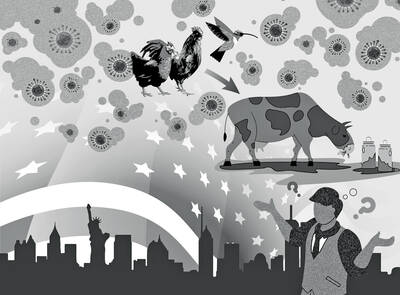
The bird flu outbreak at US dairy farms keeps finding alarming new ways to surprise scientists. Last week, the US Department of Agriculture (USDA) confirmed that H5N1 is spreading not just from birds to herds, but among cows. Meanwhile, media reports say that an unknown number of cows are asymptomatic. Although the risk to humans is still low, it is clear that far more work needs to be done to get a handle on the reach of the virus and how it is being transmitted. That would require the USDA and the Centers for Disease Control and Prevention (CDC) to get

For the incoming Administration of President-elect William Lai (賴清德), successfully deterring a Chinese Communist Party (CCP) attack or invasion of democratic Taiwan over his four-year term would be a clear victory. But it could also be a curse, because during those four years the CCP’s People’s Liberation Army (PLA) will grow far stronger. As such, increased vigilance in Washington and Taipei will be needed to ensure that already multiplying CCP threat trends don’t overwhelm Taiwan, the United States, and their democratic allies. One CCP attempt to overwhelm was announced on April 19, 2024, namely that the PLA had erred in combining major missions
On April 11, Japanese Prime Minister Fumio Kishida delivered a speech at a joint meeting of the US Congress in Washington, in which he said that “China’s current external stance and military actions present an unprecedented and the greatest strategic challenge … to the peace and stability of the international community.” Kishida emphasized Japan’s role as “the US’ closest ally.” “The international order that the US worked for generations to build is facing new challenges,” Kishida said. “I understand it is a heavy burden to carry such hopes on your shoulders,” he said. “Japan is already standing shoulder to shoulder


 RSS
RSS