


German Chancellor Olaf Scholz, accompanied by 12 top executives, on Friday visited China, hoping to deepen economic ties to reinvigorate the German economy, which is on the brink of a recession. However, the 11-hour trip shows the excessive reliance that Europe’s leading economy has on trade with China, and has raised criticism that Berlin is loosening its dependence on one authoritarian power (Russia) only to deepen its reliance on another (China).
Abandoning the “great international circulation” economic strategy articulated by former Chinese leader Deng Xiaoping (鄧小平), Chinese President Xi Jinping (習近平) has, since 2020, revised policy to promote a “dual circulation” economy, with the domestic market (internal circulation) serving as the mainstay and foreign trade (international circulation) acting as a supplement to boost national development.
At last month’s Chinese Communist Party (CCP) 20th National Congress, Xi mentioned “national security” 91 times in his report, the first time it exceeded mentions of the economy in his speeches on China’s major policies. Xi also announced his goal of making China “a great modern socialist country that leads the world in terms of composite national strength and international influence.”
On Saturday, the government announced that it was sticking to its “zero COVID” policy, despite mounting public frustration and economic damage. A lockdown of Hon Hai’s Zhengzhou factory, the world’s largest producer of Apple’s iPhones, not only led to an exodus of workers, but is estimated to reduce iPhone production by 30 percent, causing Apple’s stock to tank.
China’s virus curbs, which show no regard for human rights, have eroded business confidence. A survey released by the EU Chamber of Commerce in China in July showed that 60 percent of European companies found doing business in China “more difficult” now, with increasing numbers of EU businesses putting China investments on hold. A US-China Business Council survey in August said that 24 percent of companies had moved parts of their supply chains out of China in the past year. Another report from the American Chamber of Commerce in Shanghai showed that optimism among US businesses in China had dropped to a 23-year low.
Last month, US Secretary of the Treasury Janet Yellen warned of China’s “weaponization of trade” as a tool of geopolitical coercion. Taiwan has long been a target of China’s economic coercion, with politically motivated bans imposed on all types of Taiwanese products. In Europe, China’s blocking of Lithuanian exports and pressuring international companies to stop doing business with the Baltic nation showed that Beijing would never hesitate to break international trade rules for political purposes.
Right before Scholz’s trip, Germany approved Chinese shipper Cosco’s purchase of a stake in Tollerort terminals in Hamburg. China’s expanding strategic influence in Europe and over global transportation infrastructure has raised concerns in some Western countries over risks ranging from economic coercion to military expansion. Including Hamburg case, Chinese firms reportedly would hold stakes in 96 ports around the world. Studies have also shown that one-third of ports that include Chinese holdings have hosted ships of the Chinese People’s Liberation Army Navy. Not surprisingly, China has never returned the favor to Germany or other countries.
Before and after his trip, Scholz issued statements about having “candid” exchanges with Xi, in an attempt to separate Germany’s deep economic ties with China from political disputes. However, during his visit, Deutsche Welle released a survey showing that a mere 9 percent of Germans consider China a trustworthy partner, worse than Russia’s 10 percent, while 90 percent of respondents urged the government to make the country less dependent on non-democratic countries. More voices in government and parliament are asking for a change in the nation’s China policy. The German chancellor’s China trip has raised more doubts, and that could be a lesson for the world.

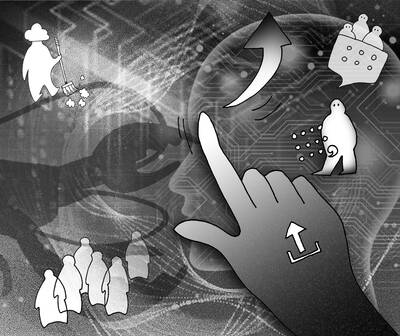
Weeks into the craze, nobody quite knows what to make of the OpenClaw mania sweeping China, marked by viral photos of retirees lining up for installation events and users gathering in red claw hats. The queues and cosplay inspired by the “raising a lobster” trend make for irresistible China clickbait. However, the West is fixating on the least important part of the story. As a consumer craze, OpenClaw — the AI agent designed to do tasks on a user’s behalf — would likely burn out. Without some developer background, it is too glitchy and technically awkward for true mainstream adoption,
On Monday, a group of bipartisan US senators arrived in Taiwan to support the nation’s special defense bill to counter Chinese threats. At the same time, Beijing announced that Chinese President Xi Jinping (習近平) had invited Chinese Nationalist Party (KMT) Chairwoman Cheng Li-wun (鄭麗文) to visit China, a move to make the KMT a pawn in its proxy warfare against Taiwan and the US. Since her inauguration as KMT chair last year, Cheng, widely seen as a pro-China figure, has made no secret of her desire to interact with the Chinese Communist Party (CCP) and meet with Xi, naming it a
A delegation of Chinese Nationalist Party (KMT) officials led by Chairwoman Cheng Li-wun (鄭麗文) is to travel to China tomorrow for a six-day visit to Jiangsu, Shanghai and Beijing, which might end with a meeting between Cheng and Chinese President Xi Jinping (習近平). The trip was announced by Xinhua news agency on Monday last week, which cited China’s Taiwan Affairs Office (TAO) Director Song Tao (宋濤) as saying that Cheng has repeatedly expressed willingness to visit China, and that the Chinese Communist Party (CCP) Central Committee and Xi have extended an invitation. Although some people have been speculating about a potential Xi-Cheng
The ongoing Iran conflict is putting Taiwan’s energy fragility on full display — the island of 23 million people, home to the world’s most advanced semiconductor manufacturing, is highly dependent on imported oil and gas, especially that from the Middle East. In 2025, 69.6 percent of Taiwan’s crude oil and 38.7 percent of liquified natural gas were sourced from the Middle East. In the same year, 62 percent of crude oil and 34 percent of LNG to Taiwan went through the Strait of Hormuz. Taiwan’s state-run oil company CPC Corp’s benchmark crude oil price (70 percent Dubai, 30 percent Brent)


 RSS
RSS