


Elon Musk often wields his Twitter account as a weapon — threatening to back out of his deal to buy Twitter or insulting US President Joe Biden as a damp sock puppet “in human form.”
More recently, the world’s richest person veered into more treacherous geopolitical territory by offering head-scratching proposals to end Russia’s invasion of Ukraine and settle questions about Taiwan’s sovereignty. His posts and other public comments have angered presidents and foreign ministers across Europe and, awkwardly, won praise from the US’ rivals.
Musk is escalating again, putting his money where his mouth is: On Friday, he threatened to cut financial support for SpaceX’s Starlink satellite Internet service in Ukraine, a move that would deny the country a key means of communication in the fight against Russian forces.
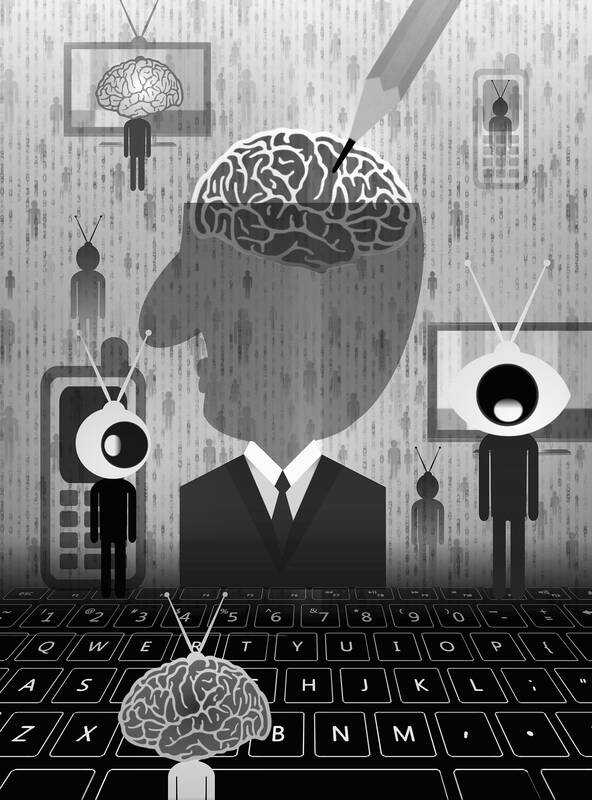
Illustration: Yusha
While Musk is hardly the first American business executive or celebrity to get tangled up in foreign policy, his wealth and penchant for mischief — not to mention his multibillion-dollar defense contracts — make him harder to ignore.
It is a phenomenon that is likely to become more pronounced if Musk’s US$44 billion bid to buy Twitter Inc outright goes through. Such a move would allow him to shape the debate in ways he has not had the power to do — by controlling the platform directly.
Asked in an e-mail about criticism that his comments touch on sensitive diplomatic and geopolitical matters, Musk answered: “When did Bloomberg News become worthless trash?”
American diplomats are well aware of Musk’s controversial comments, a US Department of State official said, discussing the situation on condition of anonymity, and they make clear to allies and close partners that the high-profile executive’s comments are those of a private citizen and do not reflect the Biden administration’s thinking.
“Starlink and Twitter are both small in global terms, but have outsized importance for key countries and constituencies,” said Jon Bateman, a senior fellow for technology and international affairs at the Carnegie Endowment for International Peace. “All this means that Musk’s pronouncements on international affairs, which have lately been naive at best, cannot simply be ignored.”
Regardless of whether he is acting in any official capacity, there is no question that Musk’s words carry weight.
With his high-level connections around the world and his vast economic influence, there have been lots of questions about his motives for getting involved, particularly after Eurasia Group president Ian Bremmer said in a widely disseminated newsletter that Russian President Vladimir Putin and the SpaceX founder had spoken.
Musk later wrote on Twitter that this claim was false, and that he had not spoken to Putin in 18 months — and even then, that it was about space. Bremmer later doubled down, writing on Twitter that Musk had “told me he had spoken with putin and the kremlin directly about ukraine.”
“He also told me what the kremlin’s red lines were,” Bremmer wrote — suggesting that Russian officials might have seen him as some sort of back channel.
“I’ll let Mr Musk speak for his conversations,” US National Security Council spokesman John Kirby said when asked about a possible call between the billionaire and Putin. “Obviously, he’s not representing the United States government in those conversations.”
Celebrities of all stripes have long waded into politics and foreign policy. Former basketball star Dennis Rodman partied in Pyongyang with North Korean leader Kim Jong-un.
However, Musk’s influence goes far beyond basketball infamy, with a sprawling digital reach fueled by his contrarianism and his vast wealth — a fortune of about US$209 billion, according to the Bloomberg Billionaires Index.
His company SpaceX has won Pentagon contracts for national security satellite launches, and his Tesla electric vehicle factory in Shanghai is the company’s biggest. Starlink has also been proposed as a way to help protesters in Iran — a notion Musk helped promote when he wrote on Twitter that SpaceX would seek an exemption to US sanctions to deploy there.
Most significant of all, he is pursuing his purchase of the social media site Twitter Inc after threatening — on Twitter — to back out in May.
“Billionaires often seek to influence public discourse on global affairs,” Bateman of the Carnegie Endowment said. “Elon Musk may be the only ultra-rich person, other than Donald Trump, who shapes conversations so directly through his personal cultural power.”
The latest back-and-forth over Starlink took on a threatening sheen after a previous Twitter spat with Ukraine. Last week, he proposed on Twitter that Ukraine cede territory that Russia claimed to have annexed to end the war.
Finland’s former prime minister said Musk’s intervention made him Putin’s “useful idiot.”
Ukrainian diplomat Andrij Melnyk was more blunt, writing: “Fuck off is my very diplomatic reply to you @elonmusk.”
On Friday, Musk wrote on Twitter that his company SpaceX could not keep carrying the cost of Starlink in Ukraine indefinitely, adding that the operation had cost SpaceX US$80 million so far. He later sent another post saying that Russia is “actively trying to kill Starlink” and that he has had to divert “massive resources” toward defending the service.
When Musk was asked what was behind the warning over Starlink, Musk wrote — in an apparent joke — that he was just following Melnyk’s recommendation.
Underscoring Ukraine’s reluctance to get into a Twitter flame war with Musk, the country’s leaders blinked on Friday.
“Let’s be honest. Like it or not, @elonmusk helped us survive the most critical moments of war,” adviser to President Volodymyr Zelenskiy Mykhailo Podolyak wrote on Twitter. Ukraine “will find a solution to keep Starlink working. We expect that the company will provide stable connection till the end of negotiations.”
Musk had also suggested, in comments to the Financial Times, that Taiwan should agree to become a special administrative zone of China, angering Taiwanese officials and leading the nation’s minister of defense to declare that the military would no longer purchase Tesla’s products.
Musk’s Tesla electric vehicle company derives about 25 percent of its revenue from China.
His suggestion certainly cheered the Chinese ambassador to Washington, who praised Musk in a series of posts, because they dovetailed with Beijing’s longstanding desire to “reunify” Taiwan with China.
“I would like to thank @elonmusk for his call for peace across the Taiwan Strait and his idea about establishing a special administrative zone for Taiwan,” Chinese Ambassador to the US Qin Gang (秦剛) wrote.
“Disentangling Musk’s economic interests from what he is saying is hard enough,” president of the Chicago Council on Global Affairs and former US ambassador to NATO Ivo Daalder said. “But the fact that basically he’s becoming a mouthpiece, at least in these two instances, of two governments whose behavior is diametrically against the interests of the United States is problematical.”
Taiwanese pragmatism has long been praised when it comes to addressing Chinese attempts to erase Taiwan from the international stage. “Taipei” and the even more inaccurate and degrading “Chinese Taipei,” imposed titles required to participate in international events, are loathed by Taiwanese. That is why there was huge applause in Taiwan when Japanese public broadcaster NHK referred to the Taiwanese Olympic team as “Taiwan,” instead of “Chinese Taipei” during the opening ceremony of the Tokyo Olympics. What is standard protocol for most nations — calling a national team by the name their country is commonly known by — is impossible for
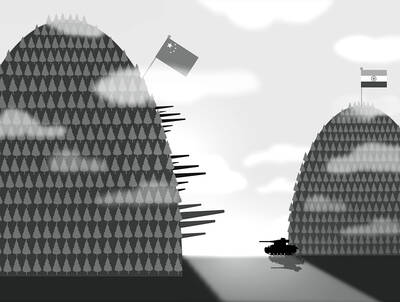
India is not China, and many of its residents fear it never will be. It is hard to imagine a future in which the subcontinent’s manufacturing dominates the world, its foreign investment shapes nations’ destinies, and the challenge of its economic system forces the West to reshape its own policies and principles. However, that is, apparently, what the US administration fears. Speaking in New Delhi last week, US Deputy Secretary of State Christopher Landau warned that “we will not make the same mistakes with India that we did with China 20 years ago.” Although he claimed the recently agreed framework
The Office of the US Trade Representative (USTR) on Wednesday last week announced it is launching investigations into 16 US trading partners, including Taiwan, under Section 301 of the Trade Act of 1974 to determine whether they have engaged in unfair trade practices, such as overproduction. A day later, the agency announced a separate Section 301 investigation into 60 economies based on the implementation of measures to prohibit the importation of goods produced with forced labor. Several of Taiwan’s main trading rivals — including China, Japan, South Korea and the EU — also made the US’ investigation list. The announcements come
Taiwan is not invited to the table. It never has been, but this year, with the Philippines holding the ASEAN chair, the question that matters is no longer who gets formally named, it is who becomes structurally indispensable. The “one China” formula continues to do its job. It sets the outer boundary of official diplomatic speech, and no one in the region has a serious interest in openly challenging it. However, beneath the surface, something is thickening. Trade corridors, digital infrastructure, artificial intelligence (AI) cooperation, supply chains, cross-border investment: The connective tissue between Taiwan and ASEAN is quietly and methodically growing


 RSS
RSS