


In just the past few weeks, at least 92 confirmed and 28 suspected cases of monkeypox have been reported across Europe, Canada, Israel, the US and Australia. That number stands to grow as surveillance expands, Maria Van Kerkhove of the WHO said on Monday last week.
This is concerning, but no reason for anyone to panic. The global response to these case clusters is so far working as it should. Scientists are sequencing and analyzing the genes of virus samples. Public health agencies are tracking down people who might have been exposed. Education efforts are underway to make healthcare workers and any vulnerable communities aware of the outbreak. Governments are preparing to deploy vaccines and antivirals as needed.
Nevertheless, the curious cases raise questions about why this transmission is happening now and who is at risk.
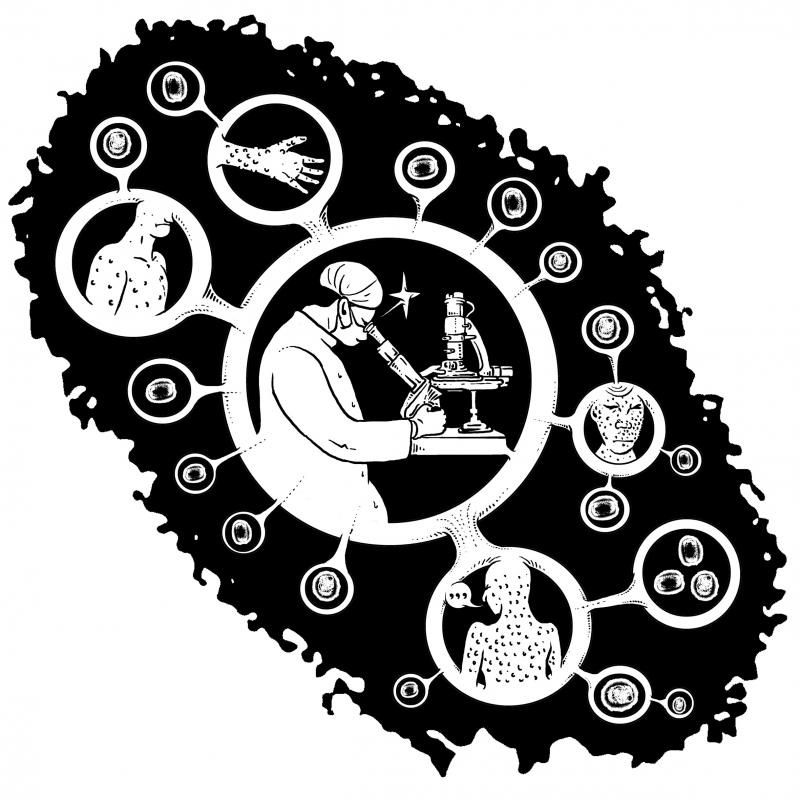
Illustration: Mountain People
Scientists are scrambling to answer a key question: Why now? Two strains, or clades, of monkeypox are known to exist, and the one currently circulating seems to be the milder West Africa one.
In the past, monkeypox cases have typically arisen via animal-to-human transmission in Central or West Africa, where the virus is endemic.
“It’s what we call a dead-end infection,” said Grant McFadden, director of Arizona State University’s Biodesign Center for Immunotherapy, Vaccines and Virotherapy. “It can spread from human to human by direct contact, but the chain tends to peter out pretty quickly.”
This makes the current degree of human-to-human transmission concerning.
One possible explanation is that the virus simply has had more opportunities to infect people. Routine administration of the smallpox vaccine, which also protects against monkeypox, was ended in the US and other countries in the 1970s — the world was declared free of smallpox in 1980. This means that a sizable chunk of the population has no existing immunity to monkeypox.
People born during the era of routine smallpox vaccinations might retain some protection, McFadden said.
Immune responses to the smallpox vaccine are known to be long-lived, but how well that correlates to monkeypox is an open question.
Several clusters of cases are concentrated in a community of men who have sex with men, suggesting that a gathering or event might have kicked off a chain of transmission.
Scientists are also asking: Is monkeypox becoming more contagious? Another theory for the rise in cases is that something in the virus itself has changed to make it more transmissible.
Scientists have several rough drafts of the viral genome taken from patients, including samples from Portugal, Belgium and the US, and are looking for any changes that might make it better at infecting people.
Such changes are unexpected, because monkeypox is a DNA virus and therefore has a genome more stable than that of an RNA virus such as SARS-CoV-2.
Nothing unusual has so far been detected in the monkeypox gene sequences, said Gustavo Palacios, a virologist at the Icahn School of Medicine at Mount Sinai in New York City — until last year, he was a biopreparedness expert at the US Army Medical Research Institute of Infectious Diseases.
However, researchers still need to do a deep dive into the more variable areas of the monkeypox genome before ruling out mutations that could change the virus’ behavior.
One challenge is that researchers lack a good baseline measure on the transmissibility of this clade of the virus.
Over the weekend, Maimuna Majumder, a computational epidemiologist at Harvard Medical School, provided an initial analysis of the monkeypox virus’ R0 (R-naught) — the number of people expected to be infected by a single case. These findings, which have yet to be peer reviewed and are based on limited data, suggest an R0 of 1.15 to 1.26 — low enough to imply that the virus can be kept in check by contact tracing, vaccination and isolation of infected people.
Members of the public are wondering if everyone needs the smallpox vaccine — probably not. Unlike a respiratory virus such as COVID-19 or the flu, monkeypox is primarily transmitted through close contact with an infected person. This means that public health officials will probably follow a strategy known as “ring vaccination.” Rather than try to vaccinate everyone, ring vaccination targets only people who have had close contact with someone who has been infected.
“When smallpox was eradicated, it wasn’t because the whole world was vaccinated. It was because they used ring vaccination,” said Amesh Adalja, a senior scholar at the Johns Hopkins Center for Health Security of the Bloomberg School of Public Health.
Some might be confused to hear that the US keeps a stockpile of smallpox vaccines, but this cache exists to address the threat that someone might one day weaponize smallpox.
One more thing worth remembering: Monkeypox, unlike COVID-19, has a long incubation period, so people can be vaccinated after they have been exposed, to lessen the severity of infection.
Unfortunately, that incubation period also provides a long window in which a monkeypox carrier can infect others. Just how long remains unknown. People with smallpox are typically contagious when symptoms appear, but it is not known whether monkeypox can be transmitted in the days or weeks before an infected person’s telltale pustules appear.
This is why nations are being cautious. For example, Belgium has guided the infected to isolate until their lesions have healed, and for close contacts to self-monitor and avoid contact with pregnant people, children and anyone who is immunocompromised for three weeks.
How worried should people be? After more than two years of COVID-19, people are primed to expect the worst, but the best advice is to be aware of monkeypox, not stressed.
“Don’t worry — at least about this,” said Geoffrey Smith, a University of Cambridge virologist.
While the present chain of monkeypox transmission differs from earlier patterns, this clade of the virus is generally mild for most infected people — albeit with a long period of isolation and recovery. Vaccines and antivirals are also available to address infections.
An assessment released on Monday by the European Centre for Disease Prevention and Control suggests that three groups should be the focus of education efforts: men who have sex with men, people who are immunocompromised and healthcare workers.
Raising awareness that the virus is circulating should help contain it.
Adalja said that some cases have been identified because an infected person sought help from a health clinic for a suspected sexually transmitted infection (STI).
Monkeypox is not an STI, but the symptoms might be confused with one. Until recently, most healthcare staff would not have had monkeypox on their diagnosis checklist when a patient walked in with an unusual rash, but now they do.
Yes, there are uncertainties about this outbreak to iron out, but all of the pieces are in place to study, treat and ultimately contain monkeypox infections.
Lisa Jarvis is a Bloomberg Opinion columnist covering biotech, healthcare and the pharmaceutical industry.
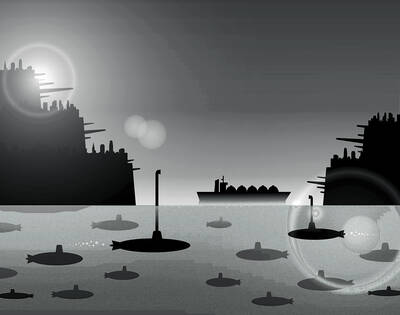
In the event of a war with China, Taiwan has some surprisingly tough defenses that could make it as difficult to tackle as a porcupine: A shoreline dotted with swamps, rocks and concrete barriers; conscription for all adult men; highways and airports that are built to double as hardened combat facilities. This porcupine has a soft underbelly, though, and the war in Iran is exposing it: energy. About 39,000 ships dock at Taiwan’s ports each year, more than the 30,000 that transit the Strait of Hormuz. About one-fifth of their inbound tonnage is coal, oil, refined fuels and liquefied natural gas (LNG),
On Monday, the day before Chinese Nationalist Party (KMT) Chairwoman Cheng Li-wun (鄭麗文) departed on her visit to China, the party released a promotional video titled “Only with peace can we ‘lie flat’” to highlight its desire to have peace across the Taiwan Strait. However, its use of the expression “lie flat” (tang ping, 躺平) drew sarcastic comments, with critics saying it sounded as if the party was “bowing down” to the Chinese Communist Party (CCP). Amid the controversy over the opposition parties blocking proposed defense budgets, Cheng departed for China after receiving an invitation from the CCP, with a meeting with
To counter the CCP’s escalating threats, Taiwan must build a national consensus and demonstrate the capability and the will to fight. The Chinese Communist Party (CCP) often leans on a seductive mantra to soften its threats, such as “Chinese do not kill Chinese.” The slogan is designed to frame territorial conquest (annexation) as a domestic family matter. A look at the historical ledger reveals a different truth. For the CCP, being labeled “family” has never been a guarantee of safety; it has been the primary prerequisite for state-sanctioned slaughter. From the forced starvation of 150,000 civilians at the Siege of Changchun
The two major opposition parties, the Chinese Nationalist Party (KMT) and the Taiwan People’s Party (TPP), jointly announced on Tuesday last week that former TPP lawmaker Chang Chi-kai (張啟楷) would be their joint candidate for Chiayi mayor, following polling conducted earlier this month. It is the first case of blue-white (KMT-TPP) cooperation in selecting a joint candidate under an agreement signed by their chairpersons last month. KMT and TPP supporters have blamed their 2024 presidential election loss on failing to decide on a joint candidate, which ended in a dramatic breakdown with participants pointing fingers, calling polls unfair, sobbing and walking


 RSS
RSS