

For more than a year, Antonio slept with a wasp nest humming above his head. Not in the open, but inside a small brick house on a farm a couple of hours from Brazil’s capital, Brasilia.
Outside, a dozen charcoal kilns burned wood day and night, filling the air with smoke, next to piles of logs illegally cut from the endangered Cerrado biome, South America’s largest savanna.
Antonio, who asked for his real name not to be disclosed, worked feeding native trees into the kilns to make charcoal.
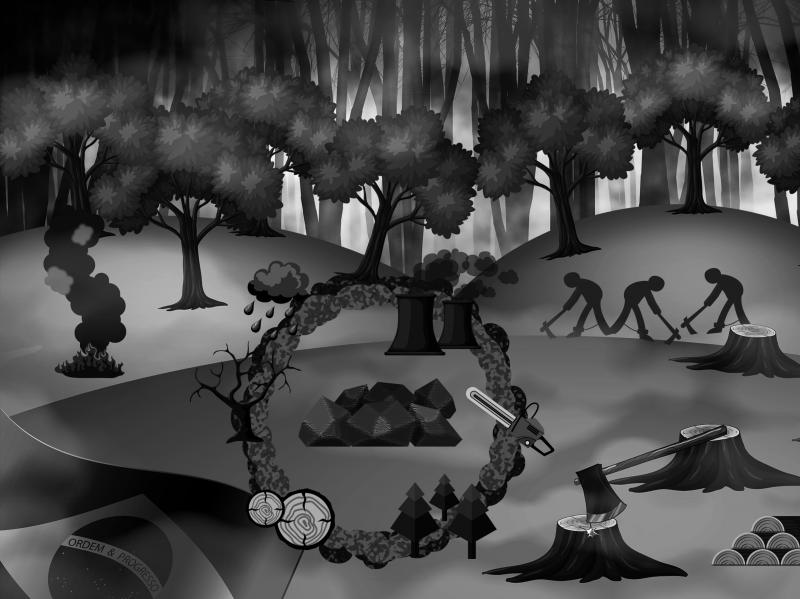
Illustration: Louise Ting
That fuel, used by steel mills and for the traditional Brazilian barbecue, has links to labor rights abuses and environmental contraventions.
Antonio and several other men were hired in the southeastern state of Minas Gerais for jobs in the center-west state of Goias, where they were forced to work in conditions that labor inspectors described as “slavery-like” after discovering the workers last month.
The two-bedroom house Antonio shared with five other men lacked electricity, clean water and a functioning bathroom. He worked from about 4am until 10pm, he said, while taking medication for depression.
The wasps were the least of his worries. “I suffered worse than this,” he said. The wasps “won’t sting you if you don’t mess with them.”
Globally, the wood fuel sector is a substantial source of the greenhouse gases heating up the planet, and is estimated to account for up to 7 percent of emissions from human activity, the UN Food and Agriculture Organization said.
In 2015, Brazil was the world’s top producer of charcoal, the most recent available data from the organization show.
Brazil’s steel mills rely on charcoal, much of which is made from native forests, said Roberto Kishinami, energy coordinator at the Rio de Janeiro-based Institute for Climate and Society.
“We do not consider charcoal as sustainable, because charcoal from reforestation and from native forests mix, and ... there is no control process in the steel industry for it,” he said.
Instituto Aco Brasil, a steel mill association, said that all the charcoal its members use comes from forests the mills grow for commercial purposes or from vetted third parties that are required to provide proof that the charcoal was produced sustainably.
The body said that these rules allow its members — which account for about 85 percent of Brazil’s steel — to make “carbon-neutral” steel, as the greenhouse gas emissions from their production are offset by the forests planted by the mills.
In addition to the climate costs of charcoal production and use, a human price is being paid, labor officials have said.
Since 1995, about 2,830 people have been found working in slavery-like conditions at charcoal production sites in Brazil, with 2,080 of them using wood from native forests, according to data supplied by Mauricio Krepsky, the head of Brazil’s anti-slavery department DETRAE.
Beyond being an environmental infraction, deforestation for the charcoal industry is often linked to slave labor, he said.
While there is no hard data, at least 1,324 workers have been rescued from slavery while felling wood from native forests since 1995, DETRAE data said.
Around 2004, Brazil’s steel sector tried to introduce self-regulation, as mills were increasingly concerned about buying charcoal produced with slave labor, said Mercia Silva of InPACTO, a Brazilian non-profit organization that monitors supply chains.
InPACTO started an initiative to track where charcoal was purchased and slavery cases fell, but a decade later, a crisis caused by tougher competition from Chinese-made steel put a stop to that effort, Silva said.
Meanwhile, the charcoal price increased, which led more farms to set up production sites. Some use eucalyptus wood they have planted or bought, while others burn native forests.
About 40 percent more workers were rescued from charcoal production sites last year than in 2020, Krepsky said, attributing the rise to the high price of charcoal.
This year, 66 workers were found in slavery-like conditions at just one site, something not seen for a decade, he added.
On Dec. 6, labor inspectors from Brazil’s anti-slavery mobile enforcement group rescued Antonio and 11 other workers from three locations, in an operation joined by reporters.
To reach the workers, officials spent hours traveling on muddy farm roads near the cities of Cristalina and Luziania in Goias. To access the first site, the inspectors had to take off their shoes and cross a stream.
They found workers living in a dilapidated brick building, where holes in the walls were covered with plastic bags to keep out scorpions. Workers burned firewood inside to drive out mosquitoes.
At the third site, they found a 16-year-old helping with charcoal production, which is prohibited under Brazilian law. It was his first job, and he had stopped going to school to do it.
“I have to work. I don’t like to rely on my mom and dad,” the teen said, the oldest of three siblings and who cannot not be named for legal reasons.
However, it was the second site — where inspectors found Antonio and the wasp nest — that shocked even those with decades of experience, like Marcelo Campos, who led the operation.
“I’ve never seen anything like it — it [shows] complete neglect... Everything was wrong in that place,” said Campos, who determined that the men were being made to work as slaves.
In Brazil, slavery is defined as forced labor, but also covers debt bondage, degrading work conditions, long hours that pose a risk to health, or other work that violates human dignity.
Finding illegally deforested wood being burned to produce charcoal is common, Campos said, adding that he notified local environmental authorities of the discovery.
He is still investigating whether the charcoal found on the raids was being sold to steel mills.
Whenever workers are rescued in Brazil, they receive three months of unemployment insurance — about 1,045 reals (US$185) per month. Labor prosecutors and public defenders also broker deals with employers to pay damages.
Antonio is expected to receive about 6,600 reals in compensation, public defender Marcos Teixeira said.
Campos has referred the laborer to social workers to get help for his depression.
Officials also aim to break the cycle of labor abuse. Inspector Shakti Prates Borela, who took a deposition from the 16-year-old youth, told him that he could find legal work elsewhere.
The Brazilian state funds apprenticeship programs for adolescents aged 16 and older, she said, adding she could not guarantee him a spot, but could sign him up.
For that, he would need to go back to school.
“Of course,” he replied with a smile.
In an article published on Tuesday in The Atlantic, titled “Will Taiwan Just Give Up?”, journalist Simon Shuster emphasizes the unpredictability of the US as an ally under US President Donald Trump and cites diminishing faith in the US as a contributor to what he sees as waning determination to resist China. As the title suggests, Shuster views a deal between Taiwan and China as an increasingly inevitable alternative to a costly war — one that Taiwan, lacking reliable allies and military capabilities, would eventually be destined to lose. He focuses on Chinese Nationalist Party (KMT) Chairwoman Cheng Li-wun (鄭麗文) — her
For more than a decade, Beijing has described its Belt and Road Initiative (BRI) as a benign program of ports, railways, factories and digital connectivity. That description was never true. The People’s Republic of China (PRC) has begun to stage military power behind the commercial geography it has constructed — and its recent air exercise in Egypt is the clearest warning yet. Last month, a Chinese flight of J-16 strike fighters, Y-9LG electronic warfare aircraft, KJ-500 AWACS aircraft, Y-20 transport aircraft, Z-20 utility helicopters and YY-20A in-flight refueling aircraft flew approximately 6,000km to Egypt for the “Eagles of Civilization” exercise with
Taiwan does not need a CIA deputy director to explain that Beijing treats commerce as a battlefield. It has been living that lesson for decades, watching its chip designers get poached, its retired officers get recruited for cash, and its companies get pressured to choose between the Chinese market and their own government’s security priorities. What changed this month is that Washington finally said the quiet part out loud. CIA Deputy Director Michael Ellis told a Washington audience that China’s threat to the US is now “fundamentally different,” because the competition is economic, not military, and that a Chinese company cannot
When the Shorter Oxford English Dictionary cataloged “Taiwanese,” it dated the word’s entry into written English to the mid-20th century, recording five distinct meanings: a native or inhabitant of Taiwan, the primary local language and the adjectives describing the place, its people and its speech. Equivalent multilayered entries appear in Random House Webster’s Unabridged Dictionary, The American Heritage Dictionary of the English Language and Wiktionary. Yet behind these orderly lexicographical entries lies a broader linguistic evolution — one in which the precise boundary between a “dialect” and a “language” reflects changing global perspectives on identity and regional culture. While


 RSS
RSS