


Listening to Taiwan
The National Taiwan Symphony Orchestra was invited to perform at the Tyzen Hsiao Memorial Concert at the Center for the Performing Arts in San Jose, California, on Aug. 4.
It was a day of music in the San Francisco Bay Area, where about 2,500 people were immersed in the powerful ending notes of Taiwan the Green.
Hsiao Tyzen (蕭泰然) was an old friend to the Bay Area Taiwanese community and the world premiere of his 1947 Overture was presented at the Calvin Simmons Theatre in Oakland, California, on June 3, 1995. Hsiao, known as Taiwan’s Rachmaninov and a neo-romantic pianist, was a composer with a remarkable gift.
He was born in 1938 in Kaohsiung and died in 2015 in the US. From 1988 to 1990, he composed the three greatest works of his life — Violin Concerto in D, opus 50, Cello Concerto in C, opus 52 and Piano Concerto in C minor, opus 53. The world premiere of Violin Concerto was given by Lin Chao-liang (林昭亮) with the San Diego Symphony Orchestra in 1992. Cello Concerto was premiered by Tang Zhongsheng (湯崇生) with the Vancouver Symphony Orchestra in 1994.
Twenty-three years later, the Taiwanese American Center of Northern California organized a chorus of 150 local Bay Area Taiwanese joined by the National Taiwan Symphony Orchestra (NTSO) at the Maestro Tyzen Hsiao Music Festival. The NTSO, founded in 1945, is the oldest symphony orchestra in Taiwan. The concert was its first performance in the US since its founding.
Conductor Chen Mei-annn (陳美安), who was born in Taiwan, first came to the US to study violin in 1989. She received master’s degrees in violin and conducting at the New England Conservatory and earned a Doctorate of Musical Arts degree in conducting at the University of Michigan.
Chen is not fluent in Taiwanese, but she gave the chorus clear instructions on when to lower their voice, cut their voice and raise their voice. She trained the chorus to sing like professionals.
Pianist Gwhyneth Chen (陳毓襄) was born in Taiwan and immigrated to the US in 1980. At the age of 12, she won the 50-state National Piano Competition staged by the Music Teacher National Association. In 1993 she won the biggest cash prize in the history of piano competitions. She played the major part in section 2 of the concert.
Soprano Karen Ho (何佳陵), who was born and grew up in Taiwan, received her Master’s in Music from the Eastman School of Music and Artist’s Diploma from the College-Conservatory of Music in Cincinnati, Ohio. Her high voice smoothly led the chorus into the suite.
The Taiwanese American Center of Northern California, David Chen (陳德輝), Maysing Chang (黃美星), Wei Chun (唯甄) and Li Shea (麗雪) provided great service, selling out all of the tickets at the 2,600-capacity venue. The program’s first section included March of Democracy and Angel From Formosa; the second was Piano Concerto; the third was the soprano’s performance of How Lovely is Thy Dwelling, The Fairest Flower and I Love Taiwan; then it was Love and Hope and Taiwan the Green, with an encore with Snack Peddler.
Thanks to the clear instructions from Chen, the choir’s performance was excellent and they earned a big round of applause, while the audience had tears in their eyes.
The concerts delivered a clear message to the community. The 1947 Overture tells us the history of the 228 Massacre, the terrible killing of 10,000 souls.
John Hsieh
Hayward, California
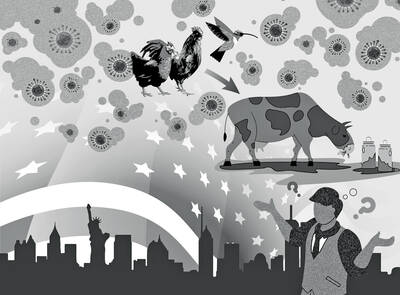
The bird flu outbreak at US dairy farms keeps finding alarming new ways to surprise scientists. Last week, the US Department of Agriculture (USDA) confirmed that H5N1 is spreading not just from birds to herds, but among cows. Meanwhile, media reports say that an unknown number of cows are asymptomatic. Although the risk to humans is still low, it is clear that far more work needs to be done to get a handle on the reach of the virus and how it is being transmitted. That would require the USDA and the Centers for Disease Control and Prevention (CDC) to get
For the incoming Administration of President-elect William Lai (賴清德), successfully deterring a Chinese Communist Party (CCP) attack or invasion of democratic Taiwan over his four-year term would be a clear victory. But it could also be a curse, because during those four years the CCP’s People’s Liberation Army (PLA) will grow far stronger. As such, increased vigilance in Washington and Taipei will be needed to ensure that already multiplying CCP threat trends don’t overwhelm Taiwan, the United States, and their democratic allies. One CCP attempt to overwhelm was announced on April 19, 2024, namely that the PLA had erred in combining major missions
As Maldivian President Mohamed Muizzu’s party won by a landslide in Sunday’s parliamentary election, it is a good time to take another look at recent developments in the Maldivian foreign policy. While Muizzu has been promoting his “Maldives First” policy, the agenda seems to have lost sight of a number of factors. Contemporary Maldivian policy serves as a stark illustration of how a blend of missteps in public posturing, populist agendas and inattentive leadership can lead to diplomatic setbacks and damage a country’s long-term foreign policy priorities. Over the past few months, Maldivian foreign policy has entangled itself in playing
The victory of Vice President William Lai (賴清德) in January’s presidential election raised questions about the future of China’s unification strategy toward Taiwan. A decade ago, the assumption in Bejing had been that deepening economic ties with Taiwan would bring about a political accommodation eventually leading to political integration. Not only has this not happened, but it hastened the opposite. Taiwanese are more concerned with safeguarding their political independence than they have ever been. China’s preferred party, the Chinese Nationalist Party (KMT), has not won a presidential election since 2012. Clearly, Beijing’s strategy is not working. Polling conducted by the Institute of European


 RSS
RSS