


To become a normal democracy, the nation has to build up its Taiwanese identity against Beijing’s threats from within and outside the nation, former president Lee Teng-hui (李登輝) said yesterday.
“The key to whether Taiwan can become a normal democracy and a leading international nation is based on whether improving the identity of ‘new Taiwanese’ succeeds,” Lee said at a convention of the Presbyterian Church in Tainan.
New Taiwanese are people who love the nation, prioritize its interests and support local democratic values, Lee said.
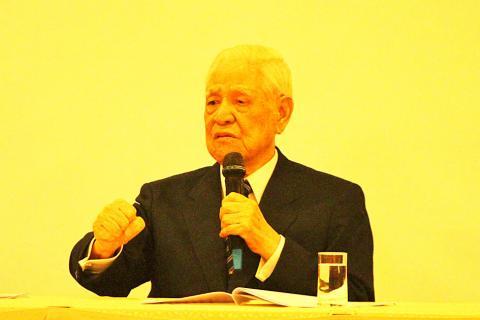
Photo: CNA
For the past five decades, China has been a constant threat to Taiwan, often seeking to infringe on or suppress Taiwanese sovereignty, Lee said.
Beijing is prepared to obstruct Taiwan’s democratization militarily, as it did during Lee’s term, when it launched a series of large-scale missile tests in the Taiwan Strait in the run-up to the 1996 presidential election, resulting in the Third Taiwan Strait Crisis, he said.
China has diversified its “united front” strategies by recruiting pro-unification supporters and sponsoring organized criminal activities in Taiwan to stir ethnic conflict and destabilize society, he said.
It also seeks to coerce Taiwan with economic manipulation, luring Taiwanese businesses from the nation to blunt the nation’s competitive edge, Lee said, adding that Taiwanese, while enjoying political freedom, are gradually losing economic autonomy to China.
“It is extremely irresponsible for any pro-Taiwanese leader not to take action against — or even to create — conflict between independence and unification groups,” Lee said.
“To overcome the challenge, the priority is to improve identification with Taiwan, where democracy is practiced. It is on such a basis that ethnic differences can be dissolved with democratization and anti-democracy politicians can no longer deceive the public with the fabricated ‘1992 consensus,’” he said.
The so-called “1992 consensus,” a term former Mainland Affairs Council chairman Su Chi (蘇起) in 2006 admitted making up in 2000, refers to a tacit understanding between the Chinese Nationalist Party (KMT) and the Chinese government that both sides of the Taiwan Strait acknowledge there is “one China,” with each side having its own interpretation of what “China” means.
The prosperity of a nation depends on a powerful leadership, a set of clearly defined goals and internal solidarity, Lee said.
The Democratic Progressive Party (DPP) for the first time won both the presidency and legislative majority in last year’s general elections, but its administration has been mired in growing public dissatisfaction, giving rise to the fear that a local administration might be replaced.
To prevent the “reinstatement of a Chinese administration,” such as the KMT regaining the government in 2008, the DPP government should ensure a properly functioning democracy and party system, prevent social division and proceed with reforms, Lee said.
He commended Premier William Lai (賴清德) for his insistence on Taiwanese independence, saying it is rare that a premier has the boldness to openly insist on independence.
Lai’s appointment has helped boost President Tsai Ing-wen’s (蔡英文) approval rating by 16 percentage points, and he is expected to lead economic development, Lee said.
He also called on Tsai to explain the DPP’s constitutional reform initiative to familiarize the public with the complicated issue, as DPP lawmakers have launched a proposal to amend the Constitution to pave the way for a pure presidential system.
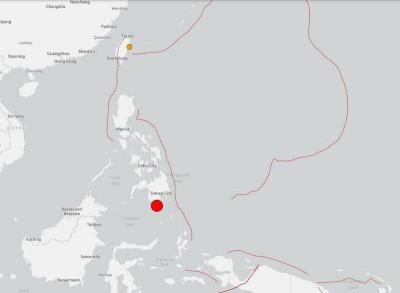
A magnitude 7.8 earthquake struck off the southern coast of Mindanao in the Philippines at 7:38am today, prompting the US Tsunami Warning System to issue an alert for neighboring countries, including Taiwan. The system issued a purple alert indicating a "tsunami threat." The potential threat zone includes Taiwan, the Philippines, Papua New Guinea, Yap and Palau. Philippine authorities were assessing the damage from the quake, with the office of civil defense seeking to verifying initial reports that 15 people had been killed and 129 injured in the region, mostly from falling debris. Arlene Hollero, disaster chief of Maasim town in the Philippines' Sarangani Province,
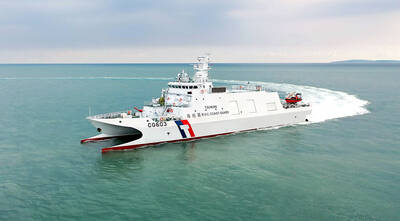
‘GRAY ZONE’ PRESSURE: Beijing’s activities are intended to create the deceitful impression that China has jurisdiction over the area around Taiwan, the CGA said Taiwan’s rights over its territorial waters and exclusive economic zone must not be violated by any country, the Mainland Affairs Council said yesterday, adding that it will not accept any unprovoked actions. The council issued the remarks in response to the China Coast Guard conducting maritime enforcement drills near eastern Taiwan and claiming to fully exercise China’s maritime administrative law enforcement authority. The Coast Guard Administration (CGA) has been closely monitoring the situation and is taking concrete steps to defend the nation’s sovereignty and secure its waters, the council said. China has no sovereign rights over the waters off eastern

RESILIENCE: Taiwan plays a key role in semiconductors, energy, information infrastructure and advanced manufacturing, AIT Director Raymond Greene said Taiwan’s continued investment in deterrence and resilience remains vital, especially in uncrewed systems and other emerging technologies, American Institute in Taiwan (AIT) Director Raymond Greene said yesterday. Greene made the remarks at the annual National Strategic Summit on Supply Chain Resilience held by the Research Institute for Democracy, Society and Emerging Technology (DSET), a government-backed think tank. As Taiwan last year became the US’ fourth-largest trading partner and supply chain security is becoming more important, cooperation in emerging technologies continues to deepen between the two countries, he said. The US is committed to accelerating innovation, building key infrastructure, strengthening cooperation

The National Chungshan Institute of Science and Technology yesterday showcased its locally developed variants of the Vision 60 robotic patrol dog, which it plans to deploy on the nation’s outlying territories in the South China Sea. The variants were produced under the Joint Lab project — created by the institute and domestic companies — and assembled with domestically produced motors, lenses and artificial intelligence (AI) systems alongside licensed tech from the US, Missile and Rocket Systems Research Division deputy director Jen Kuo-kang (任國光) told the media event at a military base in Taipei’s Dazhi (大直) area. Taiwan has built up its strengths


 RSS
RSS