

At a BP service station in downtown Manhattan, the British company’s green and yellow logo has been defaced with huge brown smears of mud. Protesters dressed as oil-soaked mermaids have occupied garage forecourts, anti-BP demonstrations are taking place from Los Angeles to Florida, and a boycott BP campaign is creating a buzz on the Internet.
BP’s name is, quite simply, mud. Americans are disgusted with the once proud London-based energy company.
As political leaders threaten criminal prosecutions and possible seizure of the company’s assets, and environmentalists bay for blood, BP’s stock is plummeting: It has fallen by a third since the Deepwater Horizon rig caught fire on April 20, causing the worst oil slick in US history. In financial circles, questions are growing about whether BP can salvage its reputation in the US and whether the company can survive as an independent entity at all.
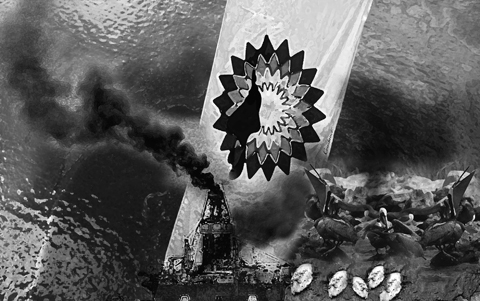
“Ultimately, we’ve got no idea how much this accident is going to cost,” said Dougie Youngson, an energy analyst at Arbuthnot Securities. “People have been throwing around numbers like US$10 billion, US$15 billion, US$20 billion, but the reality is we just don’t know. They’ve made five attempts to plug this leaking well and they’ve all failed.”
Youngson believes there is a real possibility the Deepwater disaster could destroy BP, leading to a break-up of the 101-year-old company, which employs 80,000 people, operates 22,400 gas stations and generated US$239 billion of revenue last year.
“The longer this situation goes on, the more realistic that becomes,” he said.
US Interior Secretary Ken Salazar has warned that BP’s “life is very much on the line.”
The company’s market value has dropped from US$122 billion to barely US$80 billion.
John Kilduff, an energy analyst turned hedge-fund manager at Round Earth Capital, told CNBC television: “It’s questionable whether they can continue to do business in the United States.”
Seemingly aware of its rock-bottom public image, BP this week hired Anne Womack-Kolton, once press secretary to former US vice president Dick Cheney, to bolster its public relations effort in the US. A CBS poll found that 70 percent of Americans disapprove of the way BP has handled the oil spill and the worst has yet to come. So far relatively little oil has washed up on the US coast; in the weeks ahead, images of stricken birdlife, clogged marshland and blackened beaches are likely to be ubiquitous.
James Hoopes, a professor of business ethics at Babson College, in Massachusetts, said it was hard to imagine a worse public relations fiasco.
“This has to be one of the all-time disasters for corporate reputation. The most graceful course of action for BP would be to hang its head for a very long time and admit it has some deep issues to deal with,” Hoopes said.
The company’s predicament is far worse than Exxon’s battering in 1989 when the Exxon Valdez tanker hit a reef off Alaska. Not only is BP a foreign company with little claim to US loyalty, but it is a repeat offender: Memories are raw of BP’s Texas City refinery blast in 2005, which killed 15 workers after serious safety lapses, and of the damage caused to the Alaskan wilderness in 2006 by leaking BP pipelines which, the firm admitted, had not been maintained adequately.
“Is BP dishonest, is it ill-intentioned?” Hoopes asked. “I don’t think there’s any evidence to suggest those things, but the ethical lapse concerns a lack of caution and lack of responsibility in handling what is an inherently risky business. Accidents happen, but there is evidence to suggest that BP is unusually accident prone.”
As of Tuesday, 257,000 people had signed up to a Facebook page advocating a boycott of BP. Additionally, a consumer advocacy group, Public Citizen, is calling for Americans to avoid filling up at BP gas stations for three months to punish the company.
Tyson Slocum, director of the Public Citizen’s Energy Program, said that BP had pleaded guilty to two environmental charges arising from its Texas City and Alaskan difficulties, before the Deepwater spill took place.
With valuable, tangible property around the world, BP is not in danger of simply evaporating like Enron, Arthur Andersen or Lehman Brothers — all asset-poor business that had little left after they lost their reputations. Theoretically, the collapse in BP’s share price could make the firm cheap. Exxon Mobil and Royal Dutch Shell have been mooted as possible eventual purchasers.
The administration of US President Barack Obama, which wants to cut US dependence on foreign oil money, would have a significant say; it hands out exploration licenses and is unlikely to be keen on Russian, Chinese or Middle Eastern control of strategically important American resources.
Not everybody thinks BP is doomed. Charles Maxwell, an energy analyst at the US broker Weeden & Co, says he does not consider Deepwater Horizon fatal for BP.
“While you’re right in the melee, the battle rages harsh and hot and fierce around you, but there will come an end to it. They’ll drill a relief well and it will work, I’m sure,” Maxwell said.
Maxwell said reputational damage would fade since consumers barely distinguished between brands. He said that BP’s chief executive, Tony Hayward, who succeeded Lord Browne of Madingley as chief executive in 2007, had not had enough time to repair the damage wreaked by his predecessor.
To start regaining consumer trust, BP needs to show a more human face to the US, said Dan McGinn, a communications expert at TMG Strategies, who said Hayward and his colleagues should “emote” more freely.
“Don’t make it so technical, so mechanical. Give us a sense of passion, that you feel people’s suffering,” McGinn said.
Corporate giants have rebounded from catastrophes before. The tire maker Firestone, which seemed terminally tarnished in 2000 when it was accused of covering up flaws in products linked to hundreds of deadly accidents, turned around its reputation, and General Motors, which filed for bankruptcy just a year ago, is back on its feet, winning market share and praise for new models.
“What we do know ... is that you can suffer extraordinary damage in a short period of time, but you can also recover,” McGinn said.
He said that the worst sins, in the eyes of the public, were not accidents themselves, but a sense of gross incompetence, a perception of cruelty or veneer of sheer arrogance.
“If it comes across that you not only don’t understand, but don’t care about the consequences of your actions, that’s unforgivable to Americans,” McGinn said.

Taiwan’s domestic political situation is following recognizable political rhythms, while the international environment surrounding Taiwan is undergoing a major transformation. Within Taiwan, there are ongoing battles between the legislative and executive branches over the budget, and between cities and the central government over resources. Tensions between political parties dominate headlines and consume much of the attention of party leaders. Jockeying is underway for local elections this November and national elections in 2028. And the longstanding philosophical debate inside Taiwan over how best to protect Taiwan and promote the good life remains unresolved. Amidst all of this, Taiwan continues to function well. It
In an article published on Tuesday in The Atlantic, titled “Will Taiwan Just Give Up?”, journalist Simon Shuster emphasizes the unpredictability of the US as an ally under US President Donald Trump and cites diminishing faith in the US as a contributor to what he sees as waning determination to resist China. As the title suggests, Shuster views a deal between Taiwan and China as an increasingly inevitable alternative to a costly war — one that Taiwan, lacking reliable allies and military capabilities, would eventually be destined to lose. He focuses on Chinese Nationalist Party (KMT) Chairwoman Cheng Li-wun (鄭麗文) — her
With candidate registration for this year’s local elections closed on Sept. 4 and the elections less than 80 days away, Democratic Progressive Party (DPP) Legislator and Taipei mayoral candidate Puma Shen’s (沈伯洋) rapidly growing popularity has become the focus of political talk shows and online discussions over the past week, heating up the mayoral election race in Taipei. Local media headlines and political pundits have picked up his supporters’ slogan “ocean current” (洋流) — a play on the last character of Shen’s name, which literally means “ocean” (洋), and the character (流), which can mean “current,” “flow” or “trend” — to
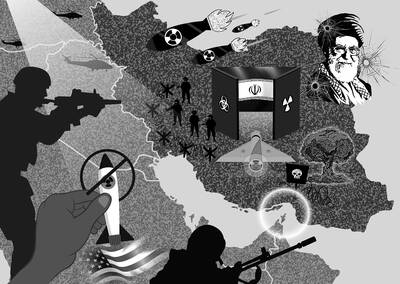
When was the last time you heard a meaningful proposal to prevent Iran from developing a nuclear arsenal? There has been nothing on the subject since the June Memorandum of Understanding between the US and Iran; the promised 60 days of talks to settle questions around Tehran’s uranium-enrichment program never began and have long since expired. When the war was launched, on Feb. 28, a resolution of the nuclear dispute was prominent among the dizzying array of US and Israeli aims to explain the attack. But as should be clear by now, the attempt was entirely reliant on achieving regime change. That


 RSS
RSS