


While China grapples with its latest tainted food crisis, the political elite are served the choicest, safest delicacies. They get hormone-free beef from the grasslands of Inner Mongolia, organic tea from the foothills of Tibet and rice watered by melted mountain snow.
And it’s all supplied by a special government outfit that provides all-organic goods from farms working under the strictest guidelines.
That secure food supply stands in stark contrast to the frustrations of ordinary citizens who have faced recurring food scandals — vegetables with harmful pesticide residue, fish tainted with a cancer-causing chemical, eggs colored with industrial dye, fake liquor causing blindness or death, holiday pastries with bacteria-laden filling.
Now that the country’s most reputable dairies have been found selling baby formula and other milk products tainted with an industrial chemical that can cause kidney stones and kidney failure, many Chinese don’t know what to buy. Tens of thousands of children have been sickened and four babies have died.
Knowing that their leaders do not face these problems has made some people angry.
“Food safety is a high priority for children and families of government officials, so are normal citizens less entitled to safe food?” asked Zhong Lixun, feeding her seven-month-old grandson baby formula after he got checked for kidney stones at Beijing Children’s Hospital.
The State Council Central Government Offices Special Food Supply Center was specifically designed to avoid the problems troubling the general population.
“We all know that average production facilities use large quantities of chemical fertilizers and pesticides. Antibiotics and hormones are commonly used in raising livestock and poultry. Farmed aquatic products are contaminated by various kinds of water pollution,” center director Zhu Yonglan said in a speech earlier this year.
“It goes without saying that these are harmful when consumed by humans,” Zhu told executives at supplier Shandong Ke’er Biological Medical Technology Development Co, which posted it on its Web site.
Zhu’s speech has been widely circulated by Chinese Internet users on blogs and forums in recent days, with many expressing outrage that top government officials have a separate — and safer — food supply than the public.
The special food center enforces strict standards on suppliers like Shandong Ke’er, which makes health supplements designed to boost immunity and energy. Foods must be organic, not genetically modified and meet international food standards, said a manager in the center’s product department, who only gave her surname, Zhang.
The reason: its A-list clientele of government officials and retirees of vice minister rank or higher.
It’s not unusual for China’s leadership to have a special food supply; the practice stretches back thousands of years to farms providing ingredients for lavish imperial meals or the greasy, spicy dishes favored by former leader Mao Zedong (毛澤東).
The former Soviet Union’s ruling classes also ate food that was unavailable to the masses. In North Korea, where withering famines have seen tens of thousands starve over the past 13 years, leader Kim Jong-il is a gourmet known for his love of lobster, shark’s fin soup and sushi.
Set up in 2004, China’s Special Food Supply Center is almost as secretive as its high-end clientele, whose precise number is unclear, but includes hundreds of top political leaders, their families and retired cadres. Much of the information on its Web site was removed after media inquiries and interview requests this week.
Goods deemed to meet the highest standards are stamped with the label “Nation A,” which stands for “top end, irreplaceable, the best,” the Web site says.
Those products are for senior politicians or government offices and not released to the general consumer market, a customer service agent surnamed Dong said.
Since the latest tainted food scandal broke earlier this month, Chinese looking for reassurance have turned to one company not named in any recalls — Sanyuan Foods Ltd.
It proudly advertises that its milk is used for state banquets at the Great Hall of the People. And despite its higher price, sales have tripled in Beijing, while demand has outstripped supply in at least one province.


Through the noise of rushing papers and whirring belts at a print factory in Kyoto, two creators watch their photo essay come to life in broadsheet form — part of an effort to win new audiences in the age of artificial intelligence (AI). Despite the decline of the publishing industry, self-publication and handmade “zine” magazines are growing in popularity in Japan, reflecting the nation’s enduring love of paper in the digital era. While speaking to Agence France-Presse at the plant, his hands black with ink, one of the creators, Kazuma Obara, said: “I think [paper] is a medium that engages all five
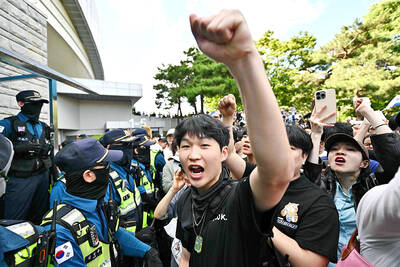
‘ABSURD MISTAKE’: The election commission said that there had been a failure to anticipate turnout after 14 polling stations ran short of ballot papers South Korean riot police yesterday cleared protesters from a Seoul polling station after a 35-hour blockade sparked by a shortage of ballot papers during local elections earlier this week. Wednesday’s election was the first nationwide vote since South Korean President Lee Jae-myung took office following the ouster of Yoon Suk-yeol over his short-lived martial law declaration. Lee’s ruling Democratic Party swept most races, but failed to flip the crucial Seoul mayoral seat. The South Korean National Election Commission apologized, blaming a failure to anticipate turnout after 14 polling stations in Seoul ran short of ballot papers. Some polling stations stayed open until 10pm to

France experienced its hottest spring on record, the French weather service said on Tuesday, after an exceptional early heat wave that also broke highs for the season in England and Wales. Meteo-France said the average nationwide temperature over March to May was 13.8°C — about 1.7°C above the norm, and surpassing records set in 2011 and 2020. “The warmest spring since records began in 1900,” it said in a bulletin. All three months were warmer than average, but the onset of an “unprecedented heatwave” late last month pushed the mercury to highs typically seen at the height of the summer. “Our country had never

A Sherpa guide was found crawling to base camp on Mount Everest a week after he went missing and was reunited with his family, who had given up hope he would return. Dawa Sherpa was last seen on Friday last week descending the mountain, but he did not reach base camp even though his client did. The pair were among the last climbers on the mountain as the climbing season came to an end and the route was dismantled. Dawa was located by a cleaning crew on Thursday morning as he was crawling down the snowy slopes around the Khumbu Icefall, just above


 RSS
RSS