


he realization in the US that the war in Iraq has been lost is perhaps the most momentous fact of international politics this year. The time of US unilateralism is objectively over. Whether US foreign policy will come to reflect this fact, only the future will tell.
Unfortunately, this also means that a unique opportunity has been lost. For only the US -- with all its power and sense of mission -- had the ability to establish a new world order at the beginning of the twenty-first century. To achieve this, the US would have had to subordinate its power to the goal of shaping the new order, much as it did at the close of World War II in 1945. Instead, the US succumbed to the temptation of unilateralism.
National greatness for a world power always arises from its ability to shape the world. If a great power forgets this, or loses the ability to act accordingly, it begins to decline. It is almost tempting to think that the US' great Cold War opponent, the Soviet Union, with its sudden disappearance 15 years ago this month, left its own Trojan horse for the US -- the poisoned gift of unilateralism.
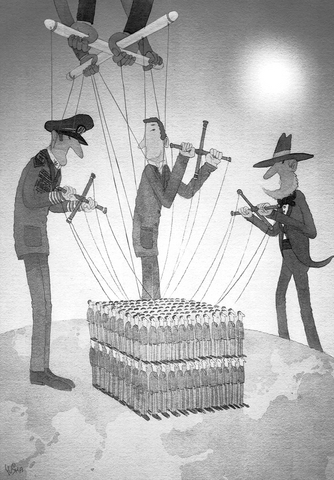
Without a fundamental turnaround in the US political consciousness, the unilateralist amnesia of US foreign policy will have far-reaching consequences and leave a huge vacuum in the global system. No other nation -- not China, Europe, India or Russia -- has the power and the sense of mission to take on the US' role. Only the US was (and potentially still is) able to fuse realism and idealism, self-interest and ethics, in its foreign policy.
Only the US pursued a foreign policy that conceived freedom and democracy as its mission. This was not always and everywhere the case -- certainly not in Latin America. But where it did apply, the US' strength and willingness to seek international cooperation created an order whose institutions still hold the world together.
The UN, NATO, the IMF and the World Bank, the law of nations and international criminal law, even today's free and united Europe -- all are crowning achievements of US foreign policy. They mark the moments in history when the US' power was used to further a global order, while also pursuing its own interests in the most effective and sustainable manner.
The US' departure from this great tradition did not begin with the terrorist attacks of Sept. 11, 2001. Indeed, as early as the final years of the Cold War, the US began to view the whole system of international treaties and institutions as an obstacle to enforcing its own interests. The US' foreign policy elite increasingly came to perceive the US as a Gulliver tied down and oppressed by political midgets, with their laws of nations, treaties, and multilateral institutions. The existing world order -- created by the US itself -- was first devalued in American eyes, then weakened and finally consciously attacked.
Thus, the current debate in the US about the consequences of defeat in Iraq still falls short -- because, despite all the critiques of US policy, that debate is still premised on the unilateral use of US power. This applies to the views of the Democratic opposition as well as to the Baker-Hamilton report.
What is needed is a conscious, deliberate return of US foreign policy to multilateralism. This mental turnaround is, indeed, essential if things are to improve, because the situation in Iraq represents, above all, a defeat of the US' unilateralist orientation.
The Middle East, North Korea, Darfur, Central and East Africa, the Caucasus -- in none of these places can the US still act successfully on its own. And yet, without the US and its power, the prospects in all these places are still bleaker -- more dangers and more chaos.
The situation is the same with respect to global growth, energy, resource management, climate change, environment, nuclear proliferation, arms control and terrorism. None of these problems can be resolved or even contained unilaterally. Yet no attempted solution will get very far without the US and its decisive leadership.
This also applies to the future of the law of nations, the newly created international criminal law, and the UN. Unless these rules and institutions are further developed, globalization, too, will take an ever more chaotic shape.
Former US secretary of state Madeleine Albright once called the US the "indispensable nation." She was right then, and she is still right today. Only one power can rob the US of its unique position -- the US itself. The question today is whether the current crisis of US consciousness marks the beginning of the US' decline or, let us hope, the beginning of a return to multilateralism. Will the US hark back to the spirit of 1945 or, despite being sobered and disappointed, decide to stick to its lone and lonely path?
No other power will be able to assume the US' role in the world for the foreseeable future. The alternative to US leadership is a vacuum and increasing chaos. But within one or two decades maybe China will define the rules, if the US continues to reject its multilateral responsibilities. For all these reasons not only the US' friends have a vital interest in a US return to multilateralism. Given the dangers of unilateralism for the current world order, so do the US' enemies.
Joschka Fischer was Germany's foreign minister and vice chancellor from 1998 to last year. A leader in the Green Party for nearly 20 years, he is now a visiting professor at Princeton University's Woodrow Wilson School.
Copyright: Project Syndicate/Institute of Human Sciences
In late January, Taiwan’s first indigenous submarine, the Hai Kun (海鯤, or Narwhal), completed its first submerged dive, reaching a depth of roughly 50m during trials in the waters off Kaohsiung. By March, it had managed a fifth dive, still well short of the deep-water and endurance tests required before the navy could accept the vessel. The original delivery deadline of November last year passed months ago. CSBC Corp, Taiwan, the lead contractor, now targets June and the Ministry of National Defense is levying daily penalties for every day the submarine remains unfinished. The Hai Kun was supposed to be
Reports about Elon Musk planning his own semiconductor fab have sparked anxiety, with some warning that Taiwan Semiconductor Manufacturing Co (TSMC) could lose key customers to vertical integration. A closer reading suggests a more measured conclusion: Musk is advancing a strategic vision of in-house chip manufacturing, but remains far from replacing the existing foundry ecosystem. For TSMC, the short-term impact is limited; the medium-term challenge lies in supply diversification and pricing pressure, only in the long term could it evolve into a structural threat. The clearest signal is Musk’s announcement that Tesla and SpaceX plan to develop a fab project dubbed “Terafab”

Most schoolchildren learn that the circumference of the Earth is about 40,000km. They do not learn that the global economy depends on just 160 of those kilometers. Blocking two narrow waterways — the Strait of Hormuz and the Taiwan Strait — could send the economy back in time, if not to the Stone Age that US President Donald Trump has been threatening to bomb Iran back to, then at least to the mid-20th century, before the Rolling Stones first hit the airwaves. Over the past month and a half, Iran has turned the Strait of Hormuz, which is about 39km wide at
The ongoing Middle East crisis has reinforced an uncomfortable truth for Taiwan: In an increasingly interconnected and volatile world, distant wars rarely remain distant. What began as a regional confrontation between the US, Israel and Iran has evolved into a strategic shock wave reverberating far beyond the Persian Gulf. For Taiwan, the consequences are immediate, material and deeply unsettling. From Taipei’s perspective, the conflict has exposed two vulnerabilities — Taiwan’s dependence on imported energy and the risks created when Washington’s military attention is diverted. Together, they offer a preview of the pressures Taiwan might increasingly face in an era of overlapping geopolitical


 RSS
RSS