


It's like flying, or floating, or waking up and finding someone you thought was dead is really there. It's what you like doing best, and then some more." This is Ted Burgess making a right old hash of explaining the facts of life to Leo in The Go-Between: a novel that documents the dire consequences of getting hold of the wrong end of the stick.
When and how to educate children about sex has not always been a thorny issue for parents: until 40 years ago, it was entirely acceptable to ignore the subject altogether, leaving the kids to assemble the puzzle by themselves with information gleaned from the playground, the behavior of pet hamsters and the much-thumbed "P" page in the local library's copy of the Shorter Oxford. With the sexual revolution, everyone agreed that it was important to get the facts across, but no one could quite decide who should be responsible. Parents? Teachers? Or could you just hand over a book, leave the room and hope for the best?
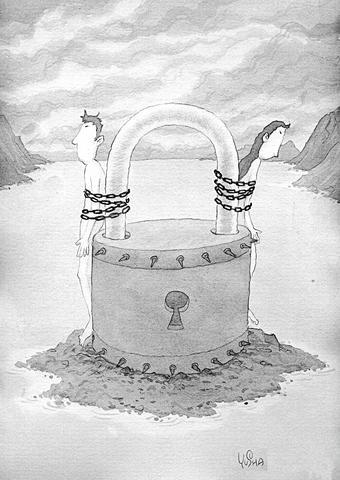
ILLUSTRATION: YU SHA
Since parents still find it so difficult to discuss the subject (and the statistical evidence is that most are leaving it up to schools to deliver the news to their children, despite the prevalence of sexual imagery on TV and in advertising), it's not surprising that the media finds it even harder. Following the Independent Advisory Group on Teenage Pregnancy's recommendation that very basic facts should be explained at key stage one (ages five to seven), possibly in the context of the arrival of a classmate's new sibling, the Mail on Sunday ran the headline: "This poison isn't sex education, it's more like child abuse."
Misinformation aside, the furore has left some parents more confused than ever.
"It has given me the impression that children should be told certain facts at certain times," says Lucy, a solicitor, "but my son seems younger at five than his sister was, and I'd much rather answer his questions as they come up than have the school set the pace."
The idea of making sex education compulsory in primary schools is also a source of anxiety to Suzi Godson, mother of three children under 12, and the author of The Sex Book, a guide to contemporary sex, health and relationships. But she approaches the subject from a very different angle.
"It's all very well making a fuss about sex education in schools, but the reality is that it's a parental responsibility, and parents are failing their children by not addressing these issues as they come up. I think it's a real cop-out for people to get outraged about sex education in primary schools when we live in a society which exposes children to sex the minute they open their eyes. And yet we, as a society, are so inhibited that we cling to the idea that it's OK to tell a child that a stork brought them until the age of eight. Where do parents get off on dumping responsibility for their own children's education? I think it's a real reflection on British society that the Government has to be so instrumental in trying to educate the nation's children about something that their parents should be telling them about."
Passing the buck to schools, says Godson, does a disservice to both children and to teachers.
"Parents can't talk to their children about sex, but they expect some teacher to be able to explain it to a class of 30." There is an absolute parental obligation, she believes, to answer questions truthfully, sensitively and as they start to arise, which will probably be when the child is around three.
"If you deal with all that stuff when they're young, by the time they get to the stage where this kind of stuff gets embarrassing, around 11, they know all the fundamentals anyway, and they're confident enough then to have more intellectual conversations about relationships and how to say no, which is really much more critical than knowing how a fallopian tube works."
But other parents are only too happy to hand over responsibility. Mark has two boys aged 14 and 11. So far, neither has taken him up on his offer to answer any questions they may have about sex, puberty -- the works. Secretly, he's relieved about this, just as he is about the pamphlets about STDs and contraception, handed out by teachers, that litter his older son's bedroom floor.
"There comes a point with your first one when you ask them if they need to know anything, and they don't, because they already get it from school. I'm not sure how systematic it is, but yes, I'm happy to leave it to the teachers. They seem to be drip-feeding him information as he needs it." Mark and his wife did lots of swotting up in the pre-adolescent years, reading up on how best to communicate the facts, but all the books seemed to indicate that the child should be the one to cue the discussion. The fact that this discussion has yet to happen does leave Mark occasionally wondering whether he and his wife are doing the right thing.
It's likely, he thinks, that they will "start panicking" when their first son becomes sexually active.
"I don't think he's having sex, because if he was I'm sure he'd tell us. He doesn't seem to have any hang-ups." But there's a double standard at work here.
"I'd probably feel differently if I had daughters," Mark admits.
"There is that thing about your sons being attractive to girls ... you do get a kind of surrogate pleasure from it. But if we had a daughter, I might be more proactive, wanting to make absolutely sure that she had all the information." He corrects himself. "Well, I'd get her mum to tell her, in fact." This begs the question: But will she tell her?
Genevieve, a company director, has three children under 10. Sex was not a subject her parents ever raised with her -- the news broke in the playground when she was nine -- and she was keen to do things differently with her own children. As a joke, a friend gave her Babette Cole's Mummy Laid An Egg! just after her first son was born, but it was treated like another picture book: its message was never taken on board.
Recently, when the house was full of nine-year-old boys running around tussling with pillows, Genevieve asked them what they were doing.
"They said, `We're sexing the pillows.' So I asked them what `sexing' was, and they said it was lots of kissing with no clothes on. I said, `Ri-ight, and what happens then?' They said they didn't know, and then they got bored and had a pillow fight.
"Shortly after this, the big discussion was sparked by the EastEnders episode when Alfie Moon went on an epic hunt for a late-night chemist. When Oscar asked her what a condom was, Genevieve asked him what he thought it was, and he said: `Drugs?' So I thought, right, now I really am going to have to tell him. Maybe if he'd said sweeties or something, I might have just left it.
So I said, `Do you know what sex is?' And he said, `Yes, snogging with no clothes on.' So I said, `It's a bit more than that.' He went, `What?' And I said, `Do you really want to know?' And he said he really did. So, after I'd made him promise not to tell everyone at school, I told him where the man's willy goes, and I said that though it sounded disgusting, it's not, actually. And then I said that a condom is something you put over a willy so the seed doesn't get to the egg. Because for years he's known that the man has seeds and the lady has eggs. We were next to each other, rather than face to face, looking at Shane Ritchie looking for a condom, so he wasn't at all embarrassed."
It all went more smoothly than she could have hoped -- though it looks rather as if it might have been a more significant moment for her than for Oscar.
"I did say to him later on, `Have you told Daddy your hot news? You know, what have you found out today?' And he went, `Umm, Michael Owen's having a baby?'"
Babette Cole's Mummy Laid an Egg! may not have been much help in this instance, but for many families it has been a reassuring ally, making the business of explaining biology both simpler and more fun.
A picture book in which children talk their blushing, clueless parents through the details of human reproduction, it is aimed at the under-fives with the idea of explaining the facts in unambiguous terms long before they're old enough to be embarrassed. Ten years after its first publication, it still leads the field, and its madcap tone has influenced an entire genre, though Nicholas Allan's forthcomingWhere Willy Went owes just as much to the final sketch in Woody Allen's Everything You Ever Wanted to Know About Sex. Babette only wrote it, she says, as a dare. But on publication, readers fell on it. The Sunday Telegraph hailed it as "a brilliantly funny picture book about sex education," while the Guardian said its author had "revolutionised the way small children can learn about the facts of life."
"If children ask questions, it's anybody's responsibility to answer them, whether it's the parents or the school," says Babette.
"[Mummy] was the first of its kind. It actually did show mummies and daddies fitting together -- and it still is the only one. That is the taboo, the rubicon," says Cole, giggling.
"And nobody has done it since. It is the most useful book I've ever written."
In late January, Taiwan’s first indigenous submarine, the Hai Kun (海鯤, or Narwhal), completed its first submerged dive, reaching a depth of roughly 50m during trials in the waters off Kaohsiung. By March, it had managed a fifth dive, still well short of the deep-water and endurance tests required before the navy could accept the vessel. The original delivery deadline of November last year passed months ago. CSBC Corp, Taiwan, the lead contractor, now targets June and the Ministry of National Defense is levying daily penalties for every day the submarine remains unfinished. The Hai Kun was supposed to be
Reports about Elon Musk planning his own semiconductor fab have sparked anxiety, with some warning that Taiwan Semiconductor Manufacturing Co (TSMC) could lose key customers to vertical integration. A closer reading suggests a more measured conclusion: Musk is advancing a strategic vision of in-house chip manufacturing, but remains far from replacing the existing foundry ecosystem. For TSMC, the short-term impact is limited; the medium-term challenge lies in supply diversification and pricing pressure, only in the long term could it evolve into a structural threat. The clearest signal is Musk’s announcement that Tesla and SpaceX plan to develop a fab project dubbed “Terafab”
Most schoolchildren learn that the circumference of the Earth is about 40,000km. They do not learn that the global economy depends on just 160 of those kilometers. Blocking two narrow waterways — the Strait of Hormuz and the Taiwan Strait — could send the economy back in time, if not to the Stone Age that US President Donald Trump has been threatening to bomb Iran back to, then at least to the mid-20th century, before the Rolling Stones first hit the airwaves. Over the past month and a half, Iran has turned the Strait of Hormuz, which is about 39km wide at
The ongoing Middle East crisis has reinforced an uncomfortable truth for Taiwan: In an increasingly interconnected and volatile world, distant wars rarely remain distant. What began as a regional confrontation between the US, Israel and Iran has evolved into a strategic shock wave reverberating far beyond the Persian Gulf. For Taiwan, the consequences are immediate, material and deeply unsettling. From Taipei’s perspective, the conflict has exposed two vulnerabilities — Taiwan’s dependence on imported energy and the risks created when Washington’s military attention is diverted. Together, they offer a preview of the pressures Taiwan might increasingly face in an era of overlapping geopolitical


 RSS
RSS