


Until recently, your average record company executive probably reacted to the sound of a mobile phone blaring out its ringtone with the same weary resignation as the rest of us. Like reality TV or clipboard-clutching charity muggers, they were one of modern life's petty irritants. This year, however, your average record company executive is more likely to stifle a cheer every time he hears a tinny version of a chart hit bleeping from a nearby Nokia. According to some sources, the mobile phone ringtone has come to save the music industry.
Three years ago, personalised ringtones were given away free on websites run by amateurs, who dedicated their spare time to programming mobiles to play Eminem songs instead of merely ringing -- a hobby that seemed to rank alongside translating the Bible into Klingon for pointlessness. Nobody would call r pointless today. Last year, mobile phone users spent US$3 billion on them.
They account for 10 percent of the world's music market. Over the next 12 months, more and more new phones will play "mastertones" -- not bleepy electronic facsimiles of chart hits, but the hits themselves. Unlike the current monophonic and polyphonic ringtones, their sales will generate money for record companies.
There is talk of mastertones ultimately replacing the ailing single format. While James Gillespie of the Official UK Chart Company, is cautious about rumors that sales of ringtones will soon be included in the singles chart -- "It's something we'll possibly look at in the next few years, but it's a big `possibly'" -- others are more bullish: after all, the British singles chart is soon to include legal downloads, and their sales are barely a fraction of ringtones.
"It's only a matter of time before someone comes up with a mastertone chart," says Rob Wells, new media director of Universal Music UK, "and before that starts to carry more weight than the singles chart. I absolutely, definitely, believe 100 percent that ringtones should be included in the charts."
Wells adds that "the speed with which ringtones took off surprised pretty much everyone," but with the benefit of hindsight, it is easy to see why they became so popular. Constantly changing your ringtone combines several pubescent obsessions at once: pop music, computer technology and playground one-upmanship. According to Paul Reilly, technical adviser on a terrifying-sounding publication called Ringtone Magazine, their appeal has spread far beyond schoolchildren.
"We started putting pages in the magazine about classic ringtones and we discovered that a lot of people's parents, who saw the magazine lying around the house, bought them. People also change their ringtone depending on where they are. I'm a Celtic fan, so when I'm at a football match, I have a Celtic ringtone, but I live near the Ibrox stadium, so when I go home at night, I have to change it."
The rise of the ringtone throws up some puzzling questions for the music industry.
"One of the things we have to look at is why kids are perfectly happy to spend ?3.99 on a ringtone, but they think a similar amount is too much to pay for a single," says Gillespie. One theory is that ringtones are simply easier to buy.
There is no need to go to a shop or access a Web site, simply send a text message and the cost is added to your phone bill. Another is that the onslaught of reality TV has devalued the singles chart in the eyes of its traditional target market.
Certainly a ringtone reduces pop songs down to their barest essentials and in doing so sorts the wheat from the chaff. It gives short shrift to bland songwriting. Unless a song has an instantly recognisable melody, it won't work, which may explain why R&B and hip-hop, with their emphasis on sonic novelty and infectious hooklines, vastly outsell the work of Westlife or Gareth Gates in ringtone format. Gillepsie says ringtones are the millennial equivalent of dressing like a punk or a mod. They tap into the youthful desire to define yourself via the music you like.
"Their popularity demonstrates that kids still care about music in a very definite way. They're taking the song they like and using it as a way of manifesting their identity. When a ringtone blares out on the bus or in the middle of a film, it says `I'm here, and this is what I like.' It's like wearing a badge with your favourite band's name on."
Nevertheless, for anyone brought up on the old-fashioned notion of a single as a tangible object, something you buy, keep and pull out decades later, playing the B-side and poring over the sleeve in a fit of nostalgia, buying a new ringtone every fortnight is a difficult concept to grasp.
It is fair to say that Wells has not lost much sleep worrying about whether the ever-increasing popularity of ringtones suggests that pop music has become an inherently transient medium.
"The disposability of music?" he frowns, "I don't know about that. The issue is that there are consumers spending considerable volumes of cash on the products. If they're going to be spending more money on music, as opposed to spending small amounts of money and keeping the music for a long time? The more money they spend on music, the better."

FIREPOWER: On top of the torpedoes, the military would procure Kestrel II anti-tank weapons systems to replace aging license-produced M72 LAW launchers Taiwan is to receive US-made Mark 48 torpedoes and training simulators over the next three years, following delays that hampered the navy’s operational readiness, the Ministry of National Defense’s latest budget proposal showed. The navy next year would acquire four training simulator systems for the torpedoes and take receipt of 14 torpedoes in 2027 and 10 torpedoes in 2028, the ministry said in its budget for the next fiscal year. The torpedoes would almost certainly be utilized in the navy’s two upgraded Chien Lung-class submarines and the indigenously developed Hai Kun, should the attack sub successfully reach operational status. US President Donald Trump
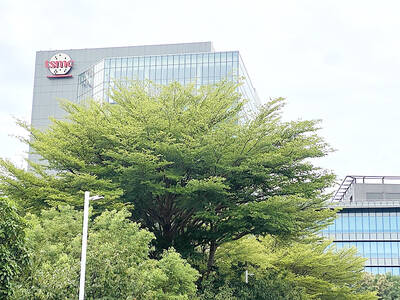
Taiwan Semiconductor Manufacturing Co (TSMC, 台積電) is expected to start construction of its 1.4-nanometer chip manufacturing facilities at the Central Taiwan Science Park (CTSP, 中部科學園區) as early as October, the Chinese-language Liberty Times (the Taipei Times’ sister newspaper) reported yesterday, citing the park administration. TSMC acquired land for the second phase of the park’s expansion in Taichung in June. Large cement, construction and facility engineering companies in central Taiwan have reportedly been receiving bids for TSMC-related projects, the report said. Supply-chain firms estimated that the business opportunities for engineering, equipment and materials supply, and back-end packaging and testing could reach as high as

ALL QUIET: The Philippine foreign secretary told senators she would not respond to questions about whether Lin Chia-lung was in the country The Ministry of Foreign Affairs on Wednesday confirmed that a business delegation is visiting the Philippines, but declined to say whether Minister of Foreign Affairs Lin Chia-lung (林佳龍) is part of the group, as Philippine lawmakers raised questions over Lin’s reported visit. The group is being led by Deputy Minister of Agriculture Huang Chao-chin (黃昭欽), Chinese International Economic Cooperation Association (CIECA) chairman Joseph Lyu (呂桔誠) and US-Taiwan Business Council (USTBC) vice president Lotta Danielsson, the ministry said in a statement. However, sources speaking on condition of anonymity said that Lin is leading the delegation of 70 people. Filinvest New Clark City Innovation Park
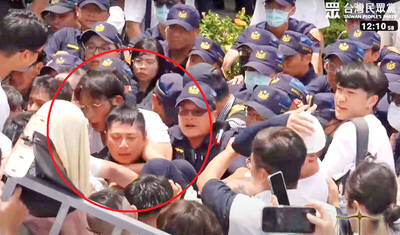
TPP RALLY: The clashes occurred near the Chiang Kai-shek Memorial Hall on Saturday at a rally to mark the anniversary of a raid on former TPP chairman Ko Wen-je People who clashed with police at a Taiwan People’s Party (TPP) rally in Taipei on Saturday would be referred to prosecutors for investigation, said the Ministry of the Interior, which oversees the National Police Agency. Taipei police had collected evidence of obstruction of public officials and coercion by “disorderly” demonstrators, as well as contraventions of the Assembly and Parade Act (集會遊行法), the ministry said in a statement on Sunday. It added that amid the “severe pushing and jostling” by some demonstrators, eight police officers were injured, including one who was sent to hospital after losing consciousness, allegedly due to heat stroke. The Taipei


 RSS
RSS