


The Boeing Co said Friday that it was scrapping plans to build a futuristic, high-speed plane called the Sonic Cruiser in favor of designing a fuel-efficient aircraft.
Boeing's announcement brings to an end one of the most imaginative -- and some say quixotic -- projects in recent aerospace engineering. Over the course of almost two years, Boeing executives said the company was putting together a new jet that would fly 15 percent to 20 percent faster than today's commercial planes.
But what really ignited the public's interest was the proposed design of the Sonic Cruiser. Looking like something from George Lucas' drawing board, it was pitched as a sleek bullet-shaped tube with two large wings in the rear and two smaller wings behind the cockpit.
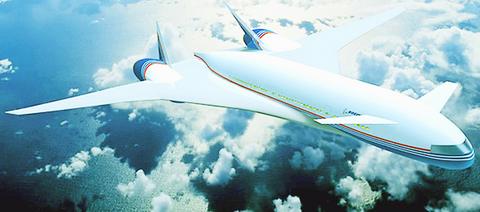
PHOTO: NY TIMES
What Boeing discovered was that there was little demand for the plane. With the airline industry mired in the worst downturn in its history and losing billions of dollars each year, no airline wanted to purchase an expensive jet geared toward business travelers. Such passengers were no longer paying for high-priced tickets, and many airline executives raised doubts about whether extra speed could really pry open travelers' wallets.
Alan Mulally, the chief executive of Boeing Commercial Airplanes, said Friday at a news conference in Seattle that Boeing would turn its attention to building a plane that would be 17 percent to 20 percent more fuel efficient than the 767. The company plans to introduce the plane in 2004, with a first delivery in 2008. There are no orders for the new plane yet.
"We will move the vast majority of our resources and energy to the super-efficient airplane," Mulally said. "I feel probably the future and what we can do and our direction is more clear now than ever before."
He said the new plane would look like the popular narrow-body 777 rather than Flash Gordon's planet-hopping rocket. He declined to give a cost estimate for research and development. The construction of the plane will not necessarily take place in the Seattle area, where Boeing has its commercial airplane operations.
Shares of Boeing rose US$0.46 on Friday, to close at US$32.71.
Mulally said Boeing might be able to sell upward of 3,000 of the new jets, and that it would have broad market appeal because it could be used as a replacement for various planes made by both Boeing and Airbus.
Airbus, which is based in Toulouse, France, has been gnawing away at Boeing's market share over the past several years. Airbus plans to deliver 300 planes next year, and it has already begun building the A-380, a 555-seat behemoth that will enter service in 2006. In October, Airbus dealt a big blow to Boeing when it won a 120-jet order from EasyJet, the low-cost carrier based outside London.
Boeing said Friday it believed it was making a smarter gamble than Airbus by betting that the increasing popularity of point-to-point service would mean that airlines in the future would want smaller, more efficient planes rather than large ones built for big hub transfers.
"The average number of passengers per airplane has continued to go down," Mulally said. "I feel more confident than ever over the last three or four years that this is the next airplane Boeing needs to make."
This is the second time in the past several years that Boeing has shelved plans for a high-profile commercial jet project; it decided not to build a larger version of its 747 in favor of pursuing the Sonic Cruiser.

LEVERAGE: China did not ‘need to fire a shot’ to deny Taiwan airspace over Africa when it owns ‘half the continent’s debt,’ a US official said, calling it economic warfare The EU has raised concerns about overflight rights following the delay of President William Lai’s (賴清德) planned state visit to the Kingdom of Eswatini after three African nations denied overflight clearance for his charter at the last minute. Taiwanese allies Paraguay and Saint Kitts and Nevis, as well as several US lawmakers and the Inter-Parliamentary Alliance on China (IPAC) condemned China for allegedly pressuring the countries. Lai was scheduled to fly directly to Taiwan’s only African ally from yesterday to Sunday to celebrate the 40th anniversary of King Mswati III’s accession and his 58th birthday, but Seychelles, Mauritius and Madagascar suddenly revoked
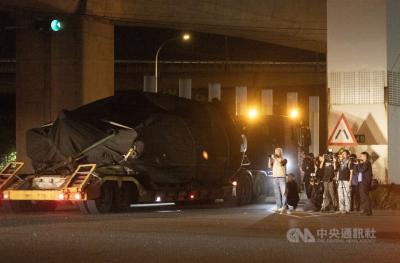
The final batch of 28 M1A2T Abrams tanks purchased from the US arrived at Taipei Port last night and were transported to the Armor Training Command in Hsinchu County’s Hukou Township (湖口), completing the military’s multi-year procurement of 108 of the tanks. Starting at 12:10am today, reporters observed more than a dozen civilian flatbed trailers departing from Taipei Port, each carrying an M1A2T tank covered with black waterproof tarps. Escorted by military vehicles, the convoy traveled via the West Coast Expressway to the Armor Training Command, with police implementing traffic control. The army operates about 1,000 tanks, including CM-11 Brave Tiger
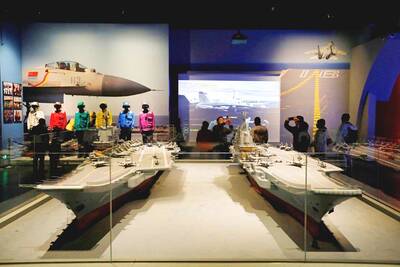
China on Wednesday teased in a video an aircraft carrier that could be its fourth, and the first using nuclear power, while making an allusion to Taiwan and vowing to further build up its islands, as it looks to boost maritime power, secure resources and bolster territorial claims. The video, issued on the eve of the 77th founding anniversary of the Chinese People’s Liberation Army Navy, featured fictional officers with names that are homophones of three commissioned aircraft carriers, the Liaoning (遼寧), Shandong (山東) and Fujian (福建). Titled Into the Deep, it showed a 19-year-old named “Hejian” (何劍) joining the group, sparking
BIG YEAR: The company said it would also release its A12 chip the same year to keep a ‘reliable stream of new silicon technologies’ flowing to its customers Taiwan Semiconductor Manufacturing Co (TSMC, 台積電) yesterday said its newest A13 chip is to enter volume production in 2029 as the chipmaker seeks to hold onto its tech leadership and demand for next-generation chips used in artificial intelligence (AI), high-performance-computing (HPC) and mobile applications. TSMC, the world’s biggest contract chipmaker, also unveiled its A12 chip at its annual technology symposium in Santa Clara, California. The A12 chip, which features TSMC’s super-power-rail technology to provide backside power delivery for AI and HPC applications, is also to enter volume production in 2029, a year after the scheduled release of the A14 chip. The technology moves


 RSS
RSS