


Atlanta subway passengers who looked through the dark windows of their moving train on Thursday saw glowing, full-motion ads for Dasani, the new bottled water from Coca-Cola. Thursday's launch of the unusual advertisement, originally scheduled for Sept. 11, the day of the terror attacks, was a low-key affair, but it may herald a new age in outdoor advertising.
City transit systems are emblazoning the dirt and graffiti-covered walls of subway tunnels with illuminated signs that, when seen from a speeding train, appear to be animated. The effect, similar to that of a flip book, is not unlike watching a 30-second television commercial.
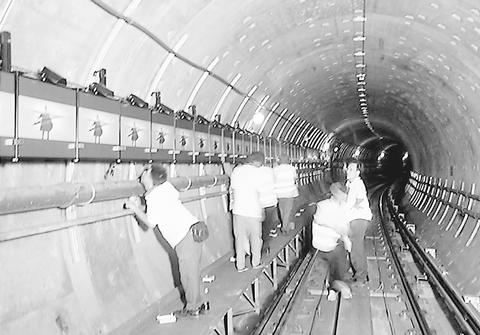
PHOTO: NY TIMES
"As you pass by at high speed, you see a full-fledged motion picture," said Matthew Gross, president of Submedia, the New York-based outdoor advertising company, which has installed 1,000 feet of light boxes between the Dunwoody and Sandy Springs stations on Atlanta's North Line. "We use a series of compressed images and are able to get an extremely high frame rate -- about 200 to 300 frames per second."
An offbeat and fast-growing phenomenon, "in-tunnel" systems began showing up this summer in Europe. Adidas and Coca-Cola, the first to experiment with them, bought space in the Budapest, Hungary and Athens transit systems through MotionPoster, a small company based in Oxfordshire, England. MotionPoster has recently announced contracts to install systems in Munich, Frankfurt and Seoul.
Many of the world's mass-transit systems are considering similar proposals. Surprisingly, interest remains high even after the attacks on the World Trade Center and Pentagon. "We really have not had any letup in interest from advertisers," said Gross. "No matter what happens, companies are still looking for a way to differentiate themselves."
In August, Submedia signed a contract with the Port Authority of New York and New Jersey to install a system on the PATH commuter rail line in Manhattan. Sidetrack Technologies, in Winnipeg, Manitoba, is setting up tunnel ads in the Kuala Lumpur, Malaysia, subway and has plans to bring at least two more systems to North America next year. All three companies are meeting with big-city transit representatives.
"Advertisers are using every opportunity they can find to communicate their marketing messages, to fight the clutter of advertising that surrounds us," said Sid Holt, editor-in-chief of Adweek magazine in an e-mail interview. "And outside of prison, I can't think of a more captive audience than subway riders."
Indeed, if in-tunnel media companies have anything in common, it's the belief that marketers must delve into previously unexplored territory to get consumers' attention.
Gross said advertisers could expect to pay US$35,000 to US$250,000 a month for in-tunnel media, depending on location and passenger traffic. The cost of Dasani's three-month run in Atlanta, he said, "is on the lower half of that scale."
Coca-Cola's subway ad is made up of saturated color images of cascading water. "It's a neat way to communicate in a targeted, closed environment," said Kellam Graitcer, Dasani's brand manager at Coca-Cola. Phactory Productions Inc, a New York design firm, created the advertisement itself.
"When you've got a brand new medium, people don't have anything that's been designed specifically for it," said Rob Walker, president of Sidetrack Technologies. "We can put images on both sides of the train so that the images can interact through the train."
Still, some wonder how effective such ephemeral imagery can be. Diane Cimine, executive vice-president for marketing at the Outdoor Advertising Association of America, who has never seen the ads, said in-tunnel promotion sounds "wild and fun" but wonders whether "there's going to be a limitation on the communicability of these mediums."
Even if the market is relatively small, some critics say this idea will inevitably backfire, particularly given a newly skittish population of subway riders. "There have been so-called breakthroughs like this for years -- like ads at the bottom of golf holes or in public toilets," said Kalle Lasn, the editor of Adbusters, a magazine published by the Media Foundation in Vancouver, British Columbia, that satirizes consumerism.
"The real story, the way I see it, is that we are at the beginning of a huge backlash against the encroachment of our mental environment."
Some point out the technology's similarity to one employed by marketers in Ray Bradbury's dystopian vision Fahrenheit 451.
MotionPoster maintains there has been no adverse response in Europe. "None at all," said Michael Pelham, chairman of MotionPoster. "The passenger reaction is absolutely fascinating. They are saying, `Gosh, this makes our journeys much more cheerful,' and they are looking out for more."
The ads "don't block any beautiful views of city architecture or mountains," Gross said. "This isn't a pristine environment. This is an industrial environment. It's just dark outside the window." He also points out that advertising revenues help the cities where these ads appear. "This is providing revenue to the subway system. It's actually directly helping the communities where these signs will be in place."
The economics of in-tunnel deals vary by city, but few transit authorities have the luxury of turning a blind eye to the revenue potential. Atlanta's in-tunnel advertisements are projected to bring the city several million dollars over the next few years.
"I think people will ride the train just to see the ad," said Tony Griffin, marketing business manager of the Metropolitan Atlanta Rapid Transit Authority. "Obviously if this thing is a success, we want to look at it as a way of expanding."

‘NO SECURITY RISK’: The Railway Bureau reassured the public that the technicians’ activities were limited to technical guidance and did not involve sensitive systems The Railway Bureau yesterday said it had invited eight Chinese technicians to assist with an airport MRT construction project. The bureau issued the confirmation after an Internet user said Chinese nationals had entered the construction zone of Taiwan Taoyuan International Airport’s Terminal 3 project. They asked why “individuals from an enemy state” were allowed access to such a major national infrastructure project, which raised serious concerns over Taiwan’s industrial safety, sensitive systems and information security. The bureau’s Northern Region Engineering Branch Office said subcontractor Taiwan Handle Industrial Co (台灣手把工業) of the Taoyuan airport MRT’s “Contract No. CU05 Project A14 Station Civil, MEP &

A US uncrewed surface vessel (USV) encountered multiple Chinese warships during an autonomous transit of the Taiwan Strait, US defense company Seasats said in a statement on Wednesday. Seasats announced that a Lightfish USV had completed the first autonomous transit of the Taiwan Strait. Over five days, the USV traversed the entire length of the Strait while constantly monitoring surface vessel traffic, the company said. The Lightfish encountered multiple Chinese warships, one of which was a Chinese People’s Liberation Army Navy (PLAN) Type 056 corvette, it said. The Chinese vessels were operating “well within Taiwan’s exclusive economic zone without transmitting their identity via the
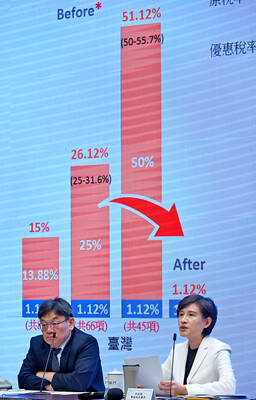
GREATER REACH? Auto parts and wood products would face tariffs of up to 15%, matching those targeting the EU, Japan and South Korea, Vice Premier said The US has announced that preferential tariff treatment for Taiwan’s non-semiconductor Section 232 goods would take effect retroactively from May 1, the Executive Yuan said yesterday. The US government yesterday posted a notice on the Federal Register’s public inspection Web site previewing tariff concessions for Taiwan under a memorandum of understanding (MOU) on Taiwan-US investment after two months of negotiations. The MOU signed on Jan. 15 stipulated three major preferential tariff arrangements: a 15 percent “reciprocal” tariff rate for Taiwan without stacking most-favored nation (MFN) rates; preferential Section 232 treatment for semiconductors and related products; and preferential Section 232 treatment for non-semiconductor

TIT-FOR-TAT: The US allegedly revoked the visa of a Chinese national working at Xinhua News Agency in the US in response to Beijing’s expulsion of Vivian Wang The Presidential Office yesterday condemned China for expelling a New York Times correspondent from Beijing following the newspaper’s interview with President William Lai (賴清德), saying the move highlighted Beijing’s suppression of press freedom and its threat to international news media. Taiwan has noted a series of recent incidents in which Beijing used similar tactics to “threaten and pressure international media outlets and journalists,” Presidential Office spokeswoman Karen Kuo (郭雅慧) said in a statement. “This concerns not only press freedom and freedom of expression, but also the safety of journalists, and Taiwan and relevant partners are paying close attention to the situation,” she


 RSS
RSS