

IMF managing director Kristalina Georgieva yesterday said that this year’s Annual Meetings with global policymakers were marked by “optimism and worry” about the global economic outlook as the event wound down in Bangkok.
Georgieva also said her organization had a “responsibility” to help low-income countries struggling with price shocks stemming from the US-Israel war on Iran.
Meetings in the Thai capital this week brought together finance ministers, central bank chiefs and other top officials from around the world, with surging inflation, spiking bond yields and economic growth driven by artificial intelligence (AI) at the top of the agenda.
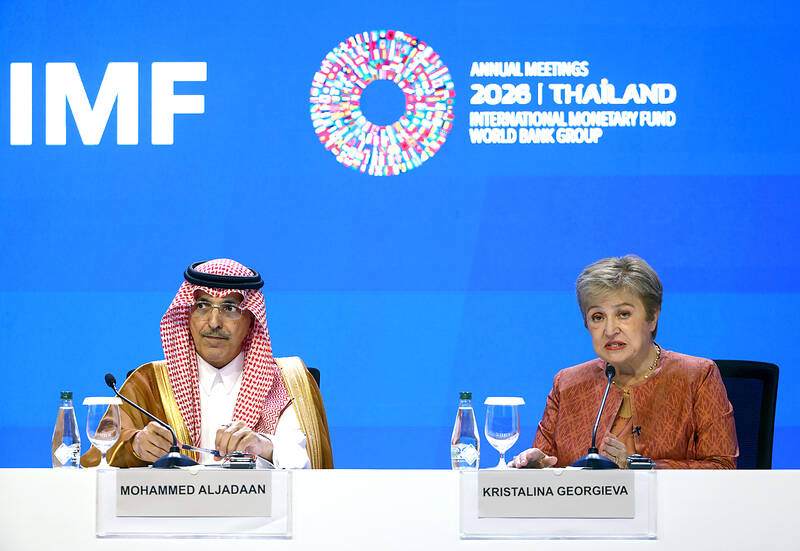
Photo: EPA
The meetings “were marked by both optimism and worry,” said Georgieva, who was speaking at a press briefing alongside Saudi Arabian Minister of Finance Mohammed al-Jadaan.
“Optimism from the resilience of the global economy, the promise of AI, the dynamism of Asia. But AI is also recognized to be a source of worry, and so are inflation, high levels of debt, wars, climate risks,” she said.
All week, the IMF has warned that high levels of debt and rising bond yields in advanced economies are tightening financial conditions just as central banks need to focus on bringing inflation down, likely by increasing interest rates.
Global energy prices have spiked since late February, when the US and Israel launched the war on Iran, with Tehran’s retaliatory actions targeting Washington’s Gulf allies and curtailing oil and gas supplies.
The price increases have rippled across the globe, fueling inflation in economies across a range of income groups.
The most vulnerable to the shock, the IMF has said, are low-income oil-importing countries that are not exposed to the boom in AI investment that has propped up growth in many advanced economies.
“I can tell you that people everywhere, but especially in poorer countries, they don’t like inflation. Inflation is like a tax on the poor,” Georgieva said.
Such countries needed to set spending targets such that they prioritized growth and protecting the most vulnerable people, she said, adding that the IMF had a “relentless pursuit of more resources for low-income countries.”
However, higher global interest rates and bond yields are driving up debt repayments for low-income countries, she said.
The share of debt repayments as a percentage of government revenue had gone up to 14 percent from 8 percent for low-income countries in the past few years, she said.
Her organization had a responsibility to help countries to restructure debt if needed, to assist with domestic resource mobilization, to bring in international finance and to create conditions for private investment, she said.
“When we do our best, it translates into better lives for people,” Georgieva said.
On the AI investment boom, she said that member countries had recognized its value in propping up growth, but “when we are dependent on one particular driver of growth, it is like we stand on one leg.”
A key debate at this year’s meetings has been on whether the technology’s most advanced frontier models require regulation and guardrails.
The question has grown more urgent after recent revelations of security incidents involving autonomous AI agents.
Georgieva said she was “impressed” by the spirit of cooperation between AI companies, governments and other stakeholders that she witnessed in Bangkok on the issue.

INFRINGEMENT: The investigation comes after a complaint from Vicor Corp, with the company seeking a limited exclusion order as well as cease-and-desist orders, the ITA said The US International Trade Commission (USITC) has launched a Section 337 investigation naming Taiwanese technology companies, including Hon Hai Precision Industry Co (鴻海), Delta Electronics Inc (台達電) and Quanta Computer Inc (廣達), as respondents. The Ministry of Economic Affairs (MOEA) pledged assistance if needed. The USITC said on Friday in a statement that it had voted to institute an investigation under Section 337 of the US Tariff Act of 1930 into certain vertical power delivery systems, related components and computing devices incorporating such systems. The investigation covers 20 companies from Taiwan, China, Germany and the US, the commission said, adding that it

IN GOOD FAITH: Lai said he appreciates Micron’s commitment to Taiwan and that it would continue expanding its investment in the country, while also working with labor President William Lai (賴清德) yesterday called for US memory maker Micron Technology Inc and its workers to negotiate “sincerely” ahead of a possible strike by the company’s union in Taiwan. Last week, a Taiwanese union representing workers at Micron said it had secured authorization from its members to strike over a dispute concerning the company’s bonus scheme, escalating a labor conflict at the chipmaker’s largest manufacturing hub. Micron employs about 15,000 people in Taiwan and has said it invested more than NT$1.6 trillion (US$49.6 billion) in the country. Speaking in Taichung at the opening of a new Micron advanced assembly and testing facility,

A man charged along with Super Micro Computer Inc co-founder Yih-Shyan “Wally” Liaw (廖益賢) of conspiring to send cutting-edge chips to China in violation of US export controls pleaded guilty, court documents said. Ting-Wei “Willy” Sun (孫廷瑋), a former outside contractor described by US authorities as a “fixer” who allegedly aided in the sales, pleaded guilty on Thursday at a hearing in federal court in New York as part of an agreement with prosecutors, court filings showed. Prosecutors claimed the men were part of a scheme to send Nvidia Corp-powered servers to an unnamed Southeast Asian company and then divert them to
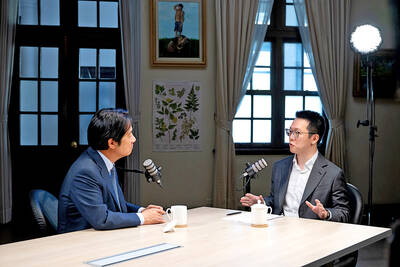
Taiwan should not rule out any energy source or abandon environmental sustainability in favor of ideology and short-term benefits, President William Lai (賴清德) said in an interview, calling for a “professional assessment” of whether nuclear power should be reintroduced into Taiwan’s energy mix. In an online interview with influencer Yu Ting-hao (游庭皓) that aired yesterday, Lai reiterated his position on nuclear power. SHIFT Lai’s remarks marked a shift from the Democratic Progressive Party’s (DPP’s) longstanding opposition to nuclear power. As premier from 2017 to 2019, Lai pushed for more gas-fired power capacity while sticking to the DPP’s nuclear free homeland ideology and rejected the


 RSS
RSS