

From his yard, Chibang Kasump sees the comings and goings of the miners who dig for copper and cobalt, day and night, deep below his small, brick home in the southern Democratic Republic of the Congo (DR Congo).
The 47-year-old has lived for more than a decade in the Musonoi area of Kolwezi, the country’s mining capital, which sits atop coveted deposits at the center of a global race for critical minerals.
“I bought this house because it was quiet, close to the city center and near the lake,” he told reporters. “I didn’t know there were minerals beneath my feet. Now I live with a well in my yard.”
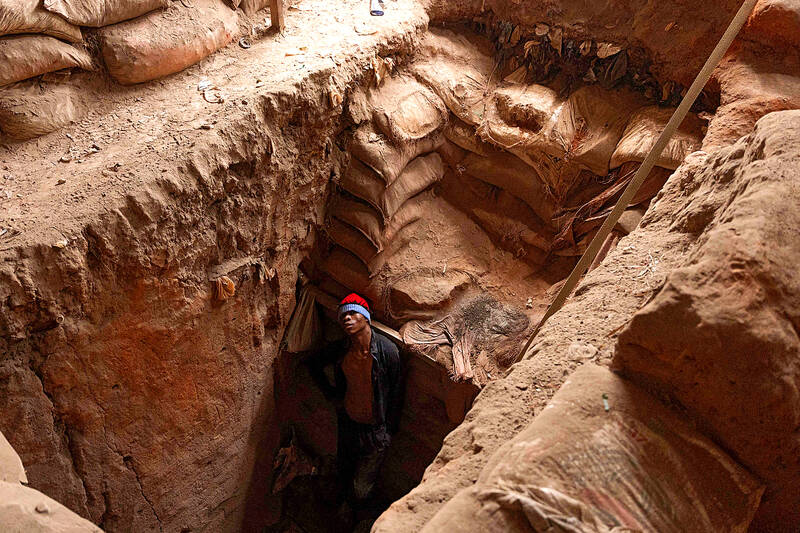
Photo: AFP
The vast central African nation produces about 70 percent of global cobalt output — key for making electric batteries and in defense technology — and holds some of the world’s richest deposits of copper, a metal in growing demand as countries expand electrical networks to harness renewable energies.
Mining companies and foreign investors have stepped up their expansion efforts, explorations and asset acquisitions. The next few years are expected to bring exponential growth in demand for critical metals that are indispensable to global industry.
China has been investing in the DR Congo for two decades.
The US signed a strategic partnership deal with the Congolese government in December last year, hoping to shore up supplies for its high-tech industry.
Kasump’s plot lies within Tondo Mining Co’s concession.
The Congolese firm holds the operating license for the site, which is next to the vast copper and cobalt deposit of Commus, a company controlled by Longyan, China-based Zijin Mining Group (紫金礦業集團).
Ahead of an industrial mining operation being set up, artisanal miners, known as diggers, have moved into the area — right up to Kasump’s yard.
The boundary between urban space and mining land is fading in Kolwezi, in the heart of the African copper belt.
Open-pit mines are gradually eating away at neighborhoods, while concessions are piling up on top of one another.
In Musonoi, the houses have numbers spray-painted on them.
“All the houses are identified for relocation,” said Kazadi Roger, a local administrative official. “The mining company is going to provide compensation, but people still don’t know when they’ll be leaving.”
Under Congolese mining law, a land title does not confer any rights over the minerals present in the subsoil, but a mining title also does not cancel out the rights of the occupants of a plot, who must be compensated in the event of expropriation.
Kasump initially refused, but said “with the pollution, the explosions linked to the extraction, I ended up saying yes.”
He does not know how much he will receive or where he will move to, though.
Behind him, dumper trucks rolled by, nonstop, along the road carved out by the neighboring Chinese industrial mine.
The dust settles on the rooftops and rainwater seeps into houses that have cracked as a result of the mining.
Under a white tarpaulin adjoining his house, a yawning chasm appeared in the ground into which a young digger disappeared.
A pump hummed softly, sending oxygen to those who had descended into the darkness.
At a depth of about 100m, some 30 men hacked away at the rock with pickaxes, filling sacks.
Using a rope, a human chain carried the ore — mostly copper — to the surface.
“We follow the vein,” one of the diggers said. “When we see the grade is good, we stop.”
The timber lining the walls acts as a support, but even the slightest collapse can prove fatal.
Some diggers earn about US$500 a month, others much less, depending on how much ore they have recovered and its quality.
All the artisanal stakeholders interviewed complained that the artisanal mining zones, which are provided for by law, were insufficient.
“Everywhere, concessions have already been granted,” said Sylvestre Petit-Petit, the artisanal miners’ local representative. “The state has not given enough space to the diggers.”
As a result, they work in private concessions, often without authorization.
Some break into large industrial mines, risking their lives.
“Over there, they’re shooting at us,” one of them said, adding that he had lost “several friends” that way.
The extracted ore is washed, sold to traders who are often Chinese, and then undergoes initial processing before being exported.
“The mines advance; the city retreats,” said Aaron Niumbi, a young resident of another Kolwezi neighborhood.
He, too, faces having to move out due to the expansion plans of Commus.

INFRINGEMENT: The investigation comes after a complaint from Vicor Corp, with the company seeking a limited exclusion order as well as cease-and-desist orders, the ITA said The US International Trade Commission (USITC) has launched a Section 337 investigation naming Taiwanese technology companies, including Hon Hai Precision Industry Co (鴻海), Delta Electronics Inc (台達電) and Quanta Computer Inc (廣達), as respondents. The Ministry of Economic Affairs (MOEA) pledged assistance if needed. The USITC said on Friday in a statement that it had voted to institute an investigation under Section 337 of the US Tariff Act of 1930 into certain vertical power delivery systems, related components and computing devices incorporating such systems. The investigation covers 20 companies from Taiwan, China, Germany and the US, the commission said, adding that it

IN GOOD FAITH: Lai said he appreciates Micron’s commitment to Taiwan and that it would continue expanding its investment in the country, while also working with labor President William Lai (賴清德) yesterday called for US memory maker Micron Technology Inc and its workers to negotiate “sincerely” ahead of a possible strike by the company’s union in Taiwan. Last week, a Taiwanese union representing workers at Micron said it had secured authorization from its members to strike over a dispute concerning the company’s bonus scheme, escalating a labor conflict at the chipmaker’s largest manufacturing hub. Micron employs about 15,000 people in Taiwan and has said it invested more than NT$1.6 trillion (US$49.6 billion) in the country. Speaking in Taichung at the opening of a new Micron advanced assembly and testing facility,
A man charged along with Super Micro Computer Inc co-founder Yih-Shyan “Wally” Liaw (廖益賢) of conspiring to send cutting-edge chips to China in violation of US export controls pleaded guilty, court documents said. Ting-Wei “Willy” Sun (孫廷瑋), a former outside contractor described by US authorities as a “fixer” who allegedly aided in the sales, pleaded guilty on Thursday at a hearing in federal court in New York as part of an agreement with prosecutors, court filings showed. Prosecutors claimed the men were part of a scheme to send Nvidia Corp-powered servers to an unnamed Southeast Asian company and then divert them to
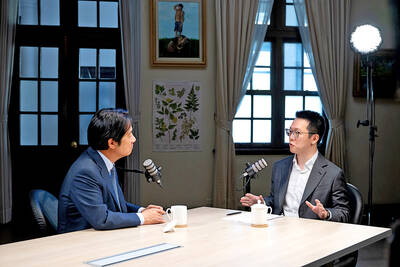
Taiwan should not rule out any energy source or abandon environmental sustainability in favor of ideology and short-term benefits, President William Lai (賴清德) said in an interview, calling for a “professional assessment” of whether nuclear power should be reintroduced into Taiwan’s energy mix. In an online interview with influencer Yu Ting-hao (游庭皓) that aired yesterday, Lai reiterated his position on nuclear power. SHIFT Lai’s remarks marked a shift from the Democratic Progressive Party’s (DPP’s) longstanding opposition to nuclear power. As premier from 2017 to 2019, Lai pushed for more gas-fired power capacity while sticking to the DPP’s nuclear free homeland ideology and rejected the


 RSS
RSS