

State-run Taiwan Power Co (Taipower, 台電) plans to build 43 substations over the next 15 years to meet growing electricity demand, chairman Tseng Wen-sheng (曾文生) said yesterday.
The expansion also includes about 1,922km of new power lines, Tseng said at a forum during the Energy Taiwan exhibition in Taipei.
Growing demand from semiconductor manufacturing and artificial intelligence (AI) is making the timely delivery of electricity a key challenge for the utility, he said.
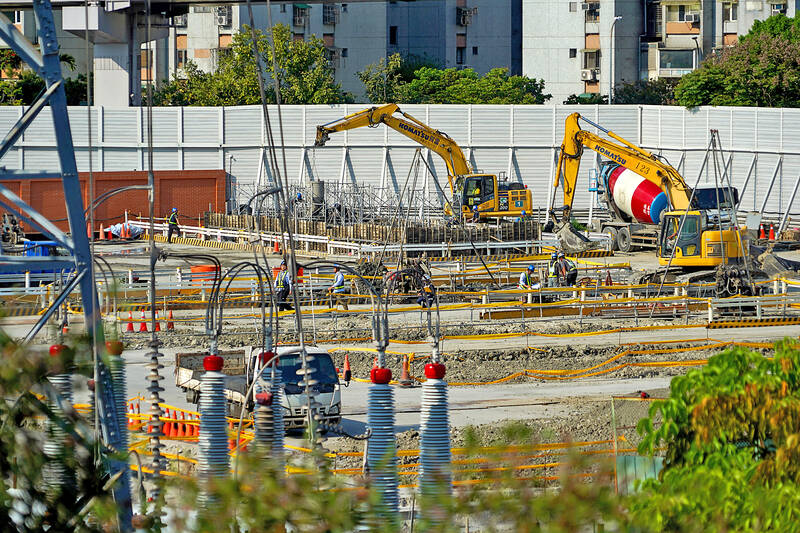
Photo: CNA
“We need to build 43 substations in 15 years, averaging about three a year. This is unprecedented,” he said.
Tseng cited the Songhu ultra-high voltage substation project in Taipei’s Neihu District (內湖) as an example of the difficulties facing grid construction.
The project broke ground last month after 26 years of planning and administrative procedures and is scheduled for completion in 2029, Taipower said.
The limited availability of land means shorter transmission distances, but also densely packed infrastructure that makes new lines difficult to build, he said.
Tseng cited growing power demand at the Southern Taiwan Science Park (南部科學園區) as an example of why additional substations were needed.
Grid planning would also need to account for AI equipment spreading beyond large data centers to businesses and potentially homes.
Such equipment could shift evening peak demand between 8pm and 10pm, prompting Taipower to adjust its load forecasts and assess upgrades to older urban grids, he said.
For companies planning new facilities, access to electricity on schedule has become an early investment consideration because power infrastructure could take longer to build than factories, Tseng added.
He urged large data centers to build near power plants, saying shorter dedicated power lines could reduce construction time, engineering difficulties and costs.
Speaking to reporters afterward, Tseng said Taipower is coordinating locations and investment schedules with major users and hopes to work directly with companies committed to investing in computing infrastructure.
Allocating supply capacity to a site developer before an actual investor is secured could leave less capacity available for other projects, he said, adding that Taipower is considering fair rules to address that issue.
The utility’s fastest-growing AI-related electricity demand comes from manufacturing, including chip fabrication, memory production, packaging and server production, rather than computing service providers, Tseng said.
Planning with those industries is beginning earlier, including during industrial park development, to align electricity infrastructure with their expansion schedules, he added.


INFRINGEMENT: The investigation comes after a complaint from Vicor Corp, with the company seeking a limited exclusion order as well as cease-and-desist orders, the ITA said The US International Trade Commission (USITC) has launched a Section 337 investigation naming Taiwanese technology companies, including Hon Hai Precision Industry Co (鴻海), Delta Electronics Inc (台達電) and Quanta Computer Inc (廣達), as respondents. The Ministry of Economic Affairs (MOEA) pledged assistance if needed. The USITC said on Friday in a statement that it had voted to institute an investigation under Section 337 of the US Tariff Act of 1930 into certain vertical power delivery systems, related components and computing devices incorporating such systems. The investigation covers 20 companies from Taiwan, China, Germany and the US, the commission said, adding that it
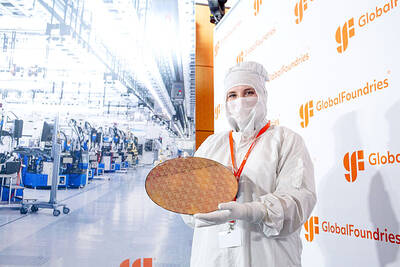
PACKAGING PUSH: The chipmaker said that it would begin ramping up silicon interposer production in New York in the first half of 2028 to support AI systems GlobalFoundries Inc shares gained as much as 7 percent after the chip manufacturer announced a five-year, US$2 billion deal to provide US production capacity to Taiwan Semiconductor Manufacturing Co (TSMC, 台積電). Under the agreement, announced on Thursday, GlobalFoundries is to help supply components known as silicon interposers. The US company is to rely on manufacturing at its facility in Malta, New York, and said it has the option to expand capacity “as customer demand grows.” An interposer is a small layer of silicon that sits between a chip and its packaging. It is home to the wires that carry electronic signals and
A man charged along with Super Micro Computer Inc co-founder Yih-Shyan “Wally” Liaw (廖益賢) of conspiring to send cutting-edge chips to China in violation of US export controls pleaded guilty, court documents said. Ting-Wei “Willy” Sun (孫廷瑋), a former outside contractor described by US authorities as a “fixer” who allegedly aided in the sales, pleaded guilty on Thursday at a hearing in federal court in New York as part of an agreement with prosecutors, court filings showed. Prosecutors claimed the men were part of a scheme to send Nvidia Corp-powered servers to an unnamed Southeast Asian company and then divert them to
SECOND-TOP MONTH: September revenue was 0.6 percent lower month-on-month, but despite the drop, it was the firm’s highest-ever sales report for the month Taiwan Semiconductor Manufacturing Co (TSMC, 台積電) yesterday reported record quarterly revenue for last quarter, after sales last month hit the second-highest monthly level in the company’s history. Revenue in the quarter ended last month was NT$1.49 trillion (US$46.75 billion), up 17 percent from NT$1.27 trillion in the second quarter and exceeding the combined prediction of 19 LSEG SmartEstimate analysts of NT$1.46 trillion. Last quarter’s figure — which was up 12 percent from the midpoint of last year — also surpassed the company’s July estimates of US$44.6 billion to US$45.8 billion amid surging demand for the ramp-up of its advanced 2-nanometer technology, artificial


 RSS
RSS