

Lightmatter Inc, a US-based optical interconnect solution start-up, yesterday said it plans to ship its first near-packaged optics (NPO) engines and high-density laser network-interface cards (NICs) next year, adding that this would pave the way for full-scale copackaged optics (CPO) engine production in 2028 and 2029.
The company’s liquid-cooling and high-density laser NIC, called Guide NR, is light-source engineered to power next-generation CPO and NPO architectures in artificial intelligence (AI) data centers.
One of the CPO engines with detachable fiber array units is assembled in Taiwan by ASE Technology Holding Co (日月光投控), Lightmatter chief executive officer Nick Harris told a virtual media conference yesterday.

Photo courtesy of Lightmatter Inc
Lightmatter also counts Taiwan Semiconductor Manufacturing Co (TSMC, 台積電), chip designer Global Unichip Corp (GUC, 創意電子) and passive fiber optic components maker Browave Corp (波若威) as its silicon photonics ecosystem partners in Taiwan.
Asked about the company’s commercial launches of new products, Harris said NPO and Guide DR could be launched next year and CPO in 2028.
“On the CPO side, we work with GUC, and there are others in Taiwan and elsewhere,” he said.
Initial, low-volume shipments of CPO are scheduled for next year, while high-volume deployment is expected start in 2028, Harris said.
The company’s photonic interposer technology, which is considered the most advanced and ultimate stage of CPO, will roll out on a very similar timeline, he said.
Silicon photonics is the next big breakthrough in artificial intelligence scalability, as it enables huge speedups for inference and training workloads, while traditional copper transmission reaches its physical scaling limits, he said.
The transition to photonics would coincide with the arrival of 224Gbps and 448Gbps copper-based SerDes technologies, he said.
Some Taiwanese companies have developed their first 400Gbps designs, but it remains highly unlikely that a standalone 896Gbps SerDes technology would ever materialize, Harris said.
Lightmatter already has technology capable of handling 1,600Gbps per optical fiber, which provides a scalable roadmap spanning from 400Gbps to 10Tbps per optical fiber, doubling the speed offered by traditional Ethernet technology, he said.
As the optical industry is facing acute laser and optical fiber shortages, Lightmatter uses bidirectional technology to halve optical fiber consumption, Harris said.
The company also uses a diversified supply chain and its proprietary Guide platform to mitigate laser shortages, he said.
The Guide platform relies on silicon-level integration known as Very Large Scale Photonics to drastically reduce laser usage, he added.
In the face of semiconductor capacity tightness, Lightmatter works with multiple foundries such as Intel Corp and Tower Semiconductor Ltd and packaging houses including Amkor Technology Inc to provide flexible options for customers ordering standard products such as Passage L20 and Guide, Harris said.
For custom product orders, clients secure their own semiconductor capacity, and Lightmatter builds on top of their allocated supply, he said.
Those clients are mostly industry giants, including hyperscalers and major semiconductor firms, he added.

INFRINGEMENT: The investigation comes after a complaint from Vicor Corp, with the company seeking a limited exclusion order as well as cease-and-desist orders, the ITA said The US International Trade Commission (USITC) has launched a Section 337 investigation naming Taiwanese technology companies, including Hon Hai Precision Industry Co (鴻海), Delta Electronics Inc (台達電) and Quanta Computer Inc (廣達), as respondents. The Ministry of Economic Affairs (MOEA) pledged assistance if needed. The USITC said on Friday in a statement that it had voted to institute an investigation under Section 337 of the US Tariff Act of 1930 into certain vertical power delivery systems, related components and computing devices incorporating such systems. The investigation covers 20 companies from Taiwan, China, Germany and the US, the commission said, adding that it

INDUSTRY STANDARD: Most global semiconductor companies have tied employee bonuses directly to corporate profits, the union said, urging Micron to do the same Micron Memory Taiwan Co’s (台灣美光) Taoyuan union secured strike authorization yesterday after a six-day vote, ramping up pressure on management to build a reasonable profit-sharing mechanism. Before the strike, the Taoyuan union “encourages” members to join a protest in Taipei on Oct. 19, union chairman Jerry Lin (林哲瑞) told a news conference in Taipei. The union did not rule out staging a snap strike, Lin said. The union has 2,258 registered members, with 88.3 percent backing the strike, he said. The vote comes as Micron’s board of directors is meeting today and tomorrow in the US. The union expects the board to respond

Elon Musk said his business empire would build and operate Terafab independently, quashing speculation about industry leader Taiwan Semiconductor Manufacturing Co (TSMC, 台積電) swooping in to run his ambitious chipmaking venture. Based in Texas, the Terafab project is Musk’s effort to break into the business of fabricating chips, in service of his companies Tesla Inc and SpaceXAI. While Musk had said that he was in discussions with TSMC, the trillionaire clarified in an X post yesterday that the only matter under consideration is for TSMC potentially leasing some part of the planned site and would not involve any operational role. “Maybe TSMC
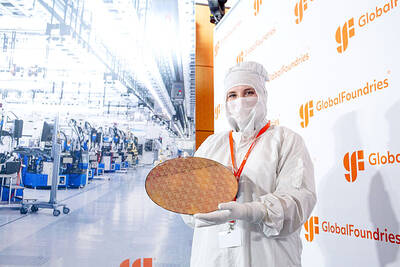
PACKAGING PUSH: The chipmaker said that it would begin ramping up silicon interposer production in New York in the first half of 2028 to support AI systems GlobalFoundries Inc shares gained as much as 7 percent after the chip manufacturer announced a five-year, US$2 billion deal to provide US production capacity to Taiwan Semiconductor Manufacturing Co (TSMC, 台積電). Under the agreement, announced on Thursday, GlobalFoundries is to help supply components known as silicon interposers. The US company is to rely on manufacturing at its facility in Malta, New York, and said it has the option to expand capacity “as customer demand grows.” An interposer is a small layer of silicon that sits between a chip and its packaging. It is home to the wires that carry electronic signals and


 RSS
RSS