

Federal Reserve Bank of Philadelphia President Anna Paulson on Thursday joined the chorus of policymakers saying additional interest-rate increases may be needed to ensure inflation returns to the central bank’s 2 percent goal.
“Looking ahead, if conditions evolve as I expect, some modest further tightening may be warranted,” Paulson said on Thursday at an event in Philadelphia.
Earlier on Thursday, New York Fed President John Williams said he and his colleagues “still have a lot of work to do” in dealing with lingering inflation risks.
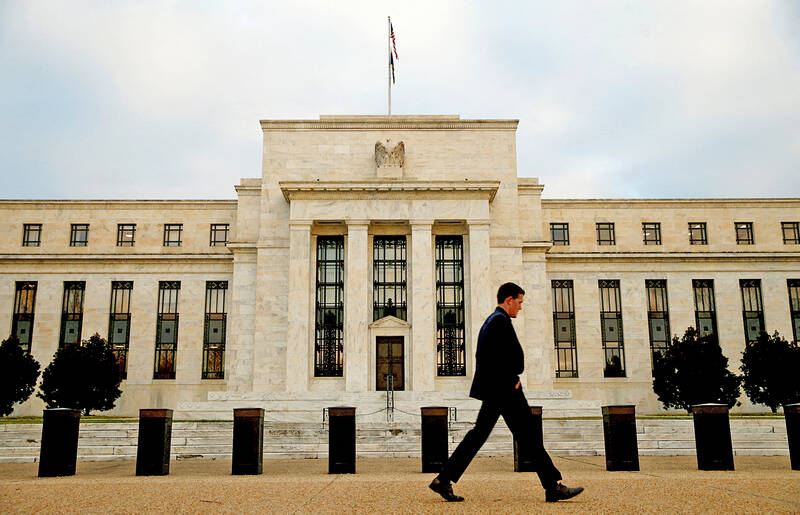
Photo: Reuters
Several other officials have aired similar comments, in line with the signal given last week when policymakers voted unanimously to raise their benchmark rate by a quarter percentage point and issued projections pointing to at least one more rate hike this year.
Investors, reacting to solid economic data and policymaker remarks, have lifted expectations for a rate increase next month to about 65 percent from 53 percent at the end of last week. The Fed’s next policy meeting concludes on Oct. 28, six days before congressional mid-term elections.
The comments are likely to increase tensions developing between the Fed and the White House. On Wednesday National Economic Council Director Kevin Hassett criticized policymakers for their views.
“A lot of the people who weren’t appointed by President Trump are giving speeches over the last couple of days, saying we need a lot more hikes,” Hassett said.
Paulson, who votes on policy decisions this year, said the move was needed because underlying measures of inflation, which strip out energy and food prices, remain “stubbornly elevated.”
“This recalibration brings policy closer to what I believe is needed to return inflation to 2 percent at a pace that balances inflation with risks to the labor market,” she said.
Paulson said the US economy has been resilient to shocks, with output growth solid and the labor market near full employment. She said she sees signs of “increased momentum.”
While tariff-related effects on consumer prices have eased, price pressures grew from the conflict in the Middle East and the build-out of data centers related to artificial intelligence. Wage growth, on the other hand, remains modest and signals that labor costs are not adding inflationary pressures, she added.
“The best I can say about underlying inflation this year is that it hasn’t gotten worse,” Paulson said.
The Philadelphia Fed chief said underlying inflation has shown little to no progress. She said measures are running in a range of 2.5 to 3 percent, showing little signs of easing to the Fed’s target.
Also speaking on Thursday, Cleveland Fed President Beth Hammack said the US economy is facing a series of supply shocks, increasing the risk that an inflationary mindset takes hold.
Richmond Fed President Tom Barkin, in Washington, said a broad range of persistent cost pressures this summer — from tariffs and tech price increases, to rising fuel and healthcare expenses — raised the risk that inflation in the US could become entrenched, making tighter policy necessary.
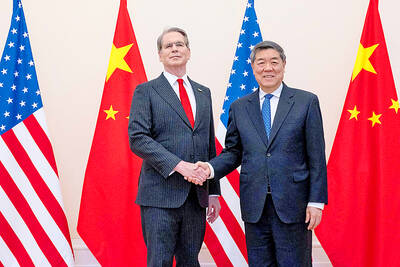
MINIMAL EXPECTATIONS: Analysts think that the two sides are likely to aim for ‘status quo’-level agreements, maintaining civility, without major trade breakthroughs US Secretary of the Treasury Scott Bessent and Chinese Vice Premier He Lifeng (何立峰) were set to meet yesterday to try to set up potential agreements on artificial intelligence (AI), tariffs and critical minerals for a summit in Washington this week between US President Donald Trump and Chinese President Xi Jinping (習近平). The meetings at JPMorgan Chase & Co’s headquarters in Manhattan, which included US Trade Representative Jamieson Greer, were due to start at about 10:30am on Sunday morning and were expected to run all day. Key topics would be the status of a US-China trade truce that is set to expire

GlobalFoundries Inc yesterday said it plans to accelerate global capacity optimization and expansion to accommodate exponential growth in radio frequency (RF) and other chips driven by the artificial intelligence (AI) boom. Singapore will pay a vital role in the company’s capacity expansion, alongside production line optimizations across its manufacturing sites, GlobalFoundries Asia Pacific head Vincent Feng (范曾文) told a news conference in Hsinchu City. “Many might be surprised to hear that the RF market is thriving now. We are gearing up for a massive capacity expansion, and it is all being driven by AI,” Feng said. He declined to disclose details of the

MORE DATA CENTERS: Microsoft’s Taiwan-area general manager said the corporation is looking to add two more data centers in northern Taiwan over the next few years Microsoft Corp plans to double its data centers in Taiwan from two facilities to four, Microsoft Taiwan general manager Sean Pien (卞志祥) said yesterday. “Over the past two to three years, we have consistently seen demand outstrip supply, and we expect that situation to continue over the next two to three years,” Pien said on the sidelines of a news conference in Taipei. The data center sites would mainly be in northern Taiwan to meet customer demand and reduce the risk of operational disruptions caused by a single event, he said, without saying their exact locations. Microsoft enabled the first phase of
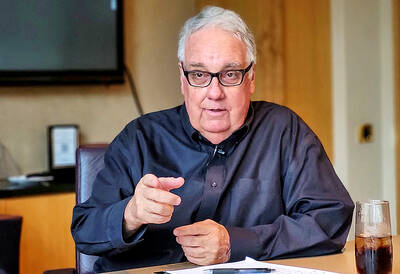
Berkshire Hathaway Inc has been synonymous with Warren Buffett. It falls to his oldest son, Howard Buffett, to keep the conglomerate’s “culture” alive. Friday’s announcement that Warren Buffett, 96, stepped down as chairman means the longtime investor would no longer have a management role at the company he took over in 1965, or be a regular sounding board for Greg Abel, who succeeded him as chief executive officer in January. Howard Buffett, 71, is assuming a different role as non-executive chairman, focused on preserving Berkshire’s culture and values. It is the latest move in a years-long leadership transition. “This one is really about


 RSS
RSS