

Microsoft Corp plans to double its data centers in Taiwan from two facilities to four, Microsoft Taiwan general manager Sean Pien (卞志祥) said yesterday.
“Over the past two to three years, we have consistently seen demand outstrip supply, and we expect that situation to continue over the next two to three years,” Pien said on the sidelines of a news conference in Taipei.
The data center sites would mainly be in northern Taiwan to meet customer demand and reduce the risk of operational disruptions caused by a single event, he said, without saying their exact locations.
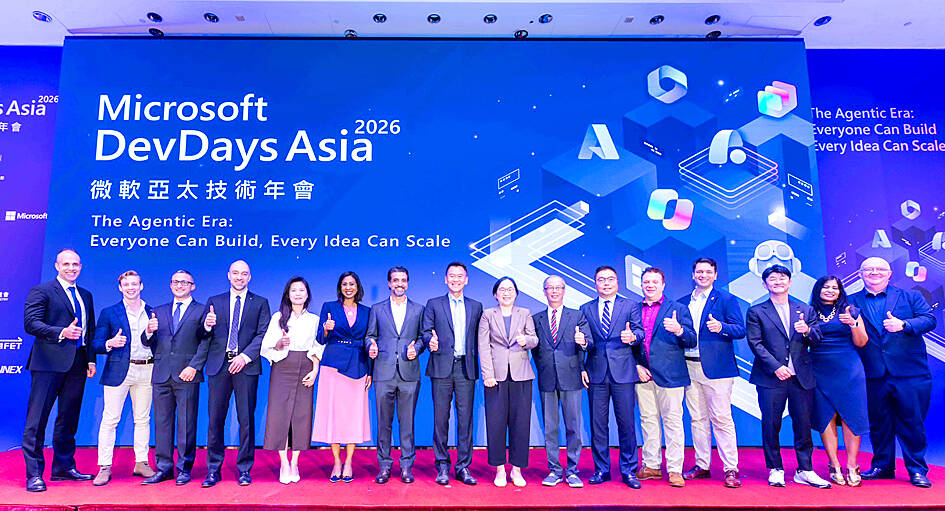
Photo courtesy of Microsoft Taiwan
Microsoft enabled the first phase of its Azure data center in Taoyuan in 2024.
The computing capacity shortage extends beyond graphics processing units and central processing units to power supply and space allocation for additional server racks, Pien said.
Addressing the shortage requires building new data centers and reconfiguring facilities to accommodate additional capacity, he said.
Microsoft aims to balance revenue growth, profitability and customer demand going forward, making continued expansion of its global computing capacity a clear priority, he said.
Taiwan’s supply chain would “undoubtedly” remain a key beneficiary and play a critical role in the global race to expand computing capacity, Pien said.
The nation is central to global computing infrastructure across artificial intelligence (AI) servers, computing, storage and networking, and there are no signs in the near term of a major shift in that role, he said.
To ease computing capacity constraints and meet local regulatory requirements, Microsoft has expanded the number of services available through its Taiwan data centers to more than 200 items from more than 70 initially, Pien said.
For corporate customers, connecting to Microsoft’s Taiwan data centers provides immediate access to its global network and customers worldwide, he said.
The company’s data center customers are concentrated in highly regulated industries with data sovereignty requirements, including government agencies, healthcare providers and financial institutions, he said.
Regarding the company’s custom chip development, Pien said Microsoft’s development, production capacity and future deployment of application-specific integrated circuits (ASICs) are all progressing smoothly.
As Microsoft expands AI services such as Copilot and Microsoft 365, it requires massive front-end inference capacity, he said.
Such workloads are highly predictable and controllable, making them well suited to ASICs, which can improve efficiency and lower computing costs, he added.
Microsoft’s own computing demand remains substantial, so its ASIC capacity is expected to be prioritized for internal use in the near term, Pien said.
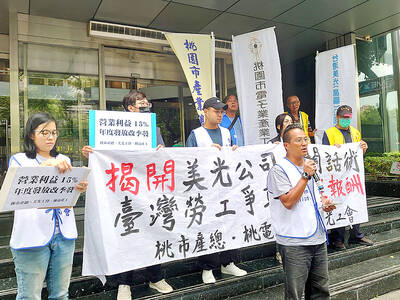
UNION DETERMINATION: Rejecting an offer for a one-time payout as an attempt to influence opinion, the union said a strike at the memory chip manufacturer is possible The Micron Taiwan workers’ union yesterday rejected a one-time payout unveiled by US-based Micron Technology Inc last week, saying it wants a long-term mechanism under which employees would share 15 percent of the company’s operating profits. While the union and the company are still in talks over the dispute, the reward package was proposed unilaterally by the employer without reaching an agreement with the union, union head Jerry Lin (林哲瑞) told reporters. Lin said he suspected the company was seeking to influence public opinion with the move. On Friday last week, Micron announced a reward package under which employees in Taiwan would receive
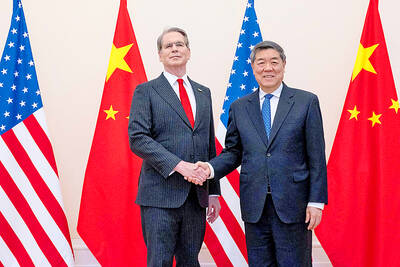
MINIMAL EXPECTATIONS: Analysts think that the two sides are likely to aim for ‘status quo’-level agreements, maintaining civility, without major trade breakthroughs US Secretary of the Treasury Scott Bessent and Chinese Vice Premier He Lifeng (何立峰) were set to meet yesterday to try to set up potential agreements on artificial intelligence (AI), tariffs and critical minerals for a summit in Washington this week between US President Donald Trump and Chinese President Xi Jinping (習近平). The meetings at JPMorgan Chase & Co’s headquarters in Manhattan, which included US Trade Representative Jamieson Greer, were due to start at about 10:30am on Sunday morning and were expected to run all day. Key topics would be the status of a US-China trade truce that is set to expire
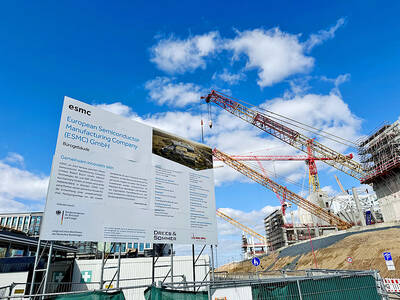
BUILDER’s RITES: The topping out ceremony is held when a project being built has its highest point laid out, a sure sign that TSMC’s European project is making solid progress A “topping out” ceremony was held on Monday at a plant under construction in Germany by Taiwan Semiconductor Manufacturing Co (TSMC, 台積電), indicating that the fab is progressing as planned and within budget, the head of a joint-venture company in charge of the project said. A topping out ceremony is the construction milestone of laying the final beam or structural piece at the highest point of a building, and it honors the construction crew, architects and engineers. European Semiconductor Manufacturing Co (ESMC) president Christian Koitzsch said that about 2,000 workers from 106 countries are working around the clock at the site in
APPEAL: Any agreement to produce advanced memory such as HBM or DRAM could run into opposition from Seoul as those technologies are sensitive, sources said South Korea’s SK Hynix Inc is in talks with Intel Corp about a deal that would see it manufacture memory chips on US soil for the first time, three people familiar with the discussions said. Under one potential scenario, SK Hynix would lease part of Intel’s long-planned chipmaking facility in Ohio, they said. Under another scenario, it could form a venture with Intel and major cloud firms that are keen to lock in memory supplies, two of the people said. A deal would relieve pressure on Intel, which has been struggling, and mark a big win for US President Donald


 RSS
RSS