

Export orders surpassed US$100 billion for the first time last month, driven by strong demand for artificial intelligence (AI), high-performance computing and cloud service applications, as well as rising international raw material prices, the Ministry of Economic Affairs said yesterday.
The strong order performance reflects better-than-expected demand for custom chips — known as application-specific integrated circuits (ASICs) — from major cloud service providers, the ministry said.
Last month’s orders rose 71.4 percent year-on-year to a record US$102.96 billion, the 19th consecutive month of increases and surpassing the ministry’s forecast of 61.4 to 64.8 percent growth.
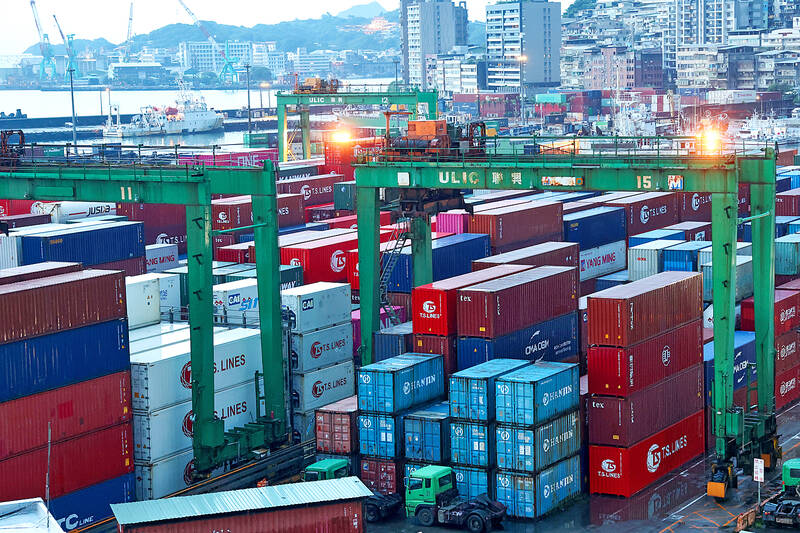
Photo: CNA
Cumulative orders in the first eight months of the year grew 55 percent to US$704.99 billion, a new record for the period, the ministry said in a report.
Export orders — including those received by Taiwanese firms and produced domestically or abroad — indicate product and component shipments to overseas markets one to three months before customs clearance.
Last month, firms produced 45.7 percent of all orders overseas, up 2.3 percentage points from a year earlier, as makers of information and communications technology (ICT) products boosted production abroad, the ministry said.
Orders for ICT products (including servers, networking products and industrial PCs) increased 100.5 percent, and electronic products (including ICs and thermal components) grew 83.9 percent year-on-year last month, driven by the rapid development of emerging technology applications, the ministry said.
Conversely, orders for optoelectronic products fell 5 percent due to weak demand for flat panels, it said.
In traditional industries, semiconductor firms’ continued capacity expansion and rising copper demand amid the AI boom boosted orders for machinery and base metals by 28.3 percent and 26.8 percent respectively, the ministry said.
Orders for chemicals grew 15.4 percent due to high pharmaceutical and industrial demand, and those for plastic and rubber products rose 6.7 percent on higher raw material costs, it said.
By destination, orders last month from the US registered the largest annual increase of 88.9 percent, followed by increases of 70.5 percent from ASEAN and 58.2 percent from Europe, the ministry said.
Orders from China (including Hong Kong) grew 47.7 percent, and those from Japan were up 41.1 percent, it said.
The ministry said the booming development of AI and emerging technology applications, the promotion of AI infrastructure by various countries and increased capital expenditure by cloud service providers, coupled with the Taiwanese semiconductor and server supply chains’ key position in the world, could support growth in export orders this month, despite geopolitical risks and trade policy uncertainties.
The ministry-compiled diffusion index of export orders — a gauge of manufacturers’ order expectations for the following month — climbed above the neutral level to 52.1, suggesting that firms remain confident in their outlook.
Orders for this month are forecast to increase 50.7 to 55.1 percent year-on-year to between US$106 billion and US$109.1 billion, and the full-year figure could top US$1.1 trillion if monthly orders stay above US$100 billion from this month to December, it said.
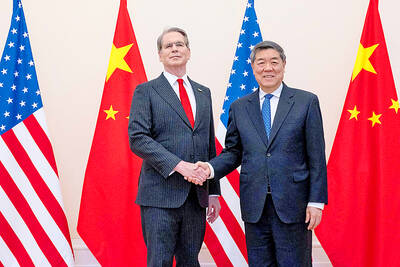
MINIMAL EXPECTATIONS: Analysts think that the two sides are likely to aim for ‘status quo’-level agreements, maintaining civility, without major trade breakthroughs US Secretary of the Treasury Scott Bessent and Chinese Vice Premier He Lifeng (何立峰) were set to meet yesterday to try to set up potential agreements on artificial intelligence (AI), tariffs and critical minerals for a summit in Washington this week between US President Donald Trump and Chinese President Xi Jinping (習近平). The meetings at JPMorgan Chase & Co’s headquarters in Manhattan, which included US Trade Representative Jamieson Greer, were due to start at about 10:30am on Sunday morning and were expected to run all day. Key topics would be the status of a US-China trade truce that is set to expire
APPEAL: Any agreement to produce advanced memory such as HBM or DRAM could run into opposition from Seoul as those technologies are sensitive, sources said South Korea’s SK Hynix Inc is in talks with Intel Corp about a deal that would see it manufacture memory chips on US soil for the first time, three people familiar with the discussions said. Under one potential scenario, SK Hynix would lease part of Intel’s long-planned chipmaking facility in Ohio, they said. Under another scenario, it could form a venture with Intel and major cloud firms that are keen to lock in memory supplies, two of the people said. A deal would relieve pressure on Intel, which has been struggling, and mark a big win for US President Donald
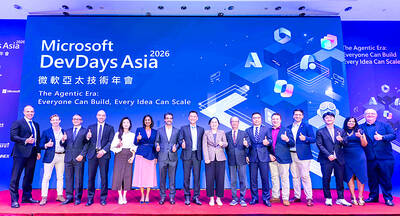
MORE DATA CENTERS: Microsoft’s Taiwan-area general manager said the corporation is looking to add two more data centers in northern Taiwan over the next few years Microsoft Corp plans to double its data centers in Taiwan from two facilities to four, Microsoft Taiwan general manager Sean Pien (卞志祥) said yesterday. “Over the past two to three years, we have consistently seen demand outstrip supply, and we expect that situation to continue over the next two to three years,” Pien said on the sidelines of a news conference in Taipei. The data center sites would mainly be in northern Taiwan to meet customer demand and reduce the risk of operational disruptions caused by a single event, he said, without saying their exact locations. Microsoft enabled the first phase of

Anthropic PBC CEO Dario Amodei and Salesforce Inc CEO Marc Benioff said companies have just begun taking advantage of artificial intelligence (AI) tools and need more help to gain the greatest benefits for their businesses. The power of AI is barely diffused through the economy, with only 5 to 10 percent of the value of the technology being used, Amodei said on Tuesday during an appearance with Benioff at Salesforce’s annual Dreamforce conference in San Francisco. Implementation of AI at large businesses — like the kind Salesforce mostly serves — remains far away from the futuristic vision professed by executives such as


 RSS
RSS