

Steady attention is crucial when keeping watch over hundreds of data centers worldwide, facilities essential to online banking, messaging and artificial intelligence (AI) services that society uses.
Analysts are surrounded by digital maps and dashboards at the Singapore operations center of US firm Digital Realty Trust Inc, a global operator of the warehouse-like sites filled with whirring servers.
The goal is not simply to react when something breaks, but to detect warning signs, such as a sudden rise in temperature, early enough to prevent disruption.
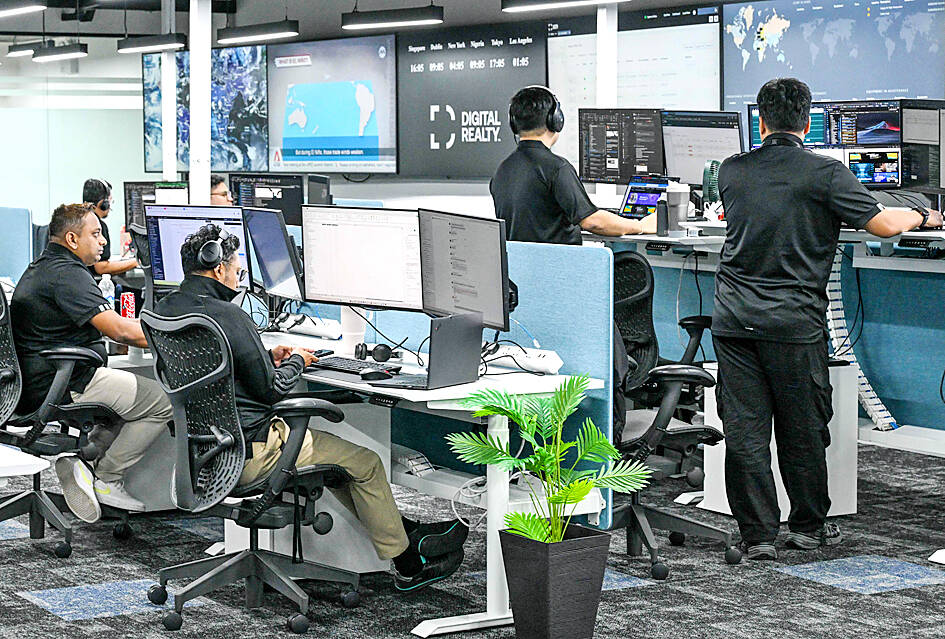
Photo: AFP
Daniel Naing, 37, and his colleagues at the center in Singapore handle thousands of system alerts flagging signs of trouble each week.
The operations center and its two sister hubs, in Europe and the US, provide round-the-clock oversight of more than 300 data centers across six continents.
Digital Realty rents its server space to about 6,000 companies, with power loss and equipment failure the most common issues.
There are procedures for earthquakes and typhoons, and an approaching storm thousands of kilometers away is enough to put the team on standby.
Demand for data centers is a political hot potato in many places, as tech companies race to develop AI tools that require massive amounts of computing power.
Without them “nothing works” in our high-tech world, Digital Realty managing director and Asia Pacific head Serene Nah said.
Data centers are essential infrastructure — a matter “almost like national security,” she said.
“We need to be up running all the time.”
However, Nah said that “our business is very misunderstood” and has little support from the public, who believe data centers emit “a lot of carbon or heat” or “use up a lot of water.”
“Yet everyone’s scrolling their phones every day,” and for each swipe “the data needs to go somewhere.”
The company is prioritizing renewable energy such as solar panels and closed-loop server cooling systems that continuously recycle water, Nah said.
Data centers operate 24 hours a day, so the Singapore center takes the 7am to 7pm shift before hand-off to Europe.
Engineers must respond to an alert within minutes. The teams liaise with on-site staff and call on a global network of experts to help, while keeping clients updated.
The company’s operations center in Singapore is housed inside one of three data centers that the company runs in the city-state.
Most areas of the data center, whose roof is lined with solar panels, are off-limits for security reasons.
AFP was shown a room where rows of black server cabinets formed long, narrow corridors, with bundles of yellow cables running overhead and the computer servers’ high-velocity fans emitting a soft hum.
AI is accelerating the growth and complexity of data centers, but for the operations center, humans remain indispensable, said Terence Tang, head of the Asia Pacific global command center.
“We still need human intervention to really look at whether or not those are genuine outages, genuine alerts and alarms, because sometimes AI or automation can give you false positives,” Tang said.
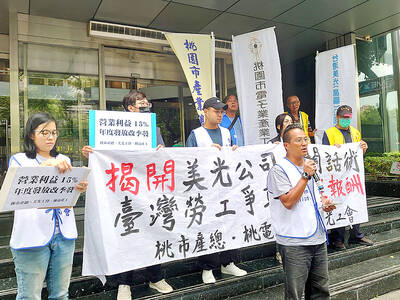
UNION DETERMINATION: Rejecting an offer for a one-time payout as an attempt to influence opinion, the union said a strike at the memory chip manufacturer is possible The Micron Taiwan workers’ union yesterday rejected a one-time payout unveiled by US-based Micron Technology Inc last week, saying it wants a long-term mechanism under which employees would share 15 percent of the company’s operating profits. While the union and the company are still in talks over the dispute, the reward package was proposed unilaterally by the employer without reaching an agreement with the union, union head Jerry Lin (林哲瑞) told reporters. Lin said he suspected the company was seeking to influence public opinion with the move. On Friday last week, Micron announced a reward package under which employees in Taiwan would receive

BUILDER’s RITES: The topping out ceremony is held when a project being built has its highest point laid out, a sure sign that TSMC’s European project is making solid progress A “topping out” ceremony was held on Monday at a plant under construction in Germany by Taiwan Semiconductor Manufacturing Co (TSMC, 台積電), indicating that the fab is progressing as planned and within budget, the head of a joint-venture company in charge of the project said. A topping out ceremony is the construction milestone of laying the final beam or structural piece at the highest point of a building, and it honors the construction crew, architects and engineers. European Semiconductor Manufacturing Co (ESMC) president Christian Koitzsch said that about 2,000 workers from 106 countries are working around the clock at the site in
APPEAL: Any agreement to produce advanced memory such as HBM or DRAM could run into opposition from Seoul as those technologies are sensitive, sources said South Korea’s SK Hynix Inc is in talks with Intel Corp about a deal that would see it manufacture memory chips on US soil for the first time, three people familiar with the discussions said. Under one potential scenario, SK Hynix would lease part of Intel’s long-planned chipmaking facility in Ohio, they said. Under another scenario, it could form a venture with Intel and major cloud firms that are keen to lock in memory supplies, two of the people said. A deal would relieve pressure on Intel, which has been struggling, and mark a big win for US President Donald
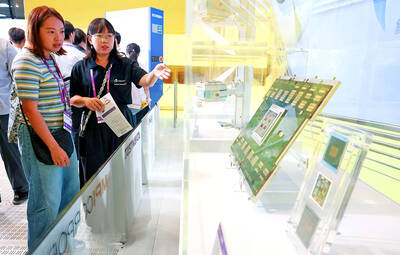
Prices of high-capacity NOR flash memory chips are projected to increase 90 to 110 percent in the second half of this year amid growing demand and slower capacity expansion, after jumping 100 to 120 percent on average in the first half, TrendForce Corp (集邦科技) said yesterday. “Emerging applications such as AI servers and aerospace communications are propelling demand in 2026, aside from existing applications such as advanced driver assistance, digital cockpit systems and industrial devices,” the Taipei-based research group said in a report. Demand from AI servers is exceptionally strong as each AI server requires three to five times more NOR flash


 RSS
RSS