

NexCOBOT Co (創博) expects robust growth in its artificial intelligence (AI) controller business this year and next year, as partnerships across a range of robotics applications begin to bear fruit, chairman Clement Lin (林茂昌) said in an interview with the Taipei Times on Monday last week.
NexCOBOT is a robotics subsidiary of industrial PC maker Nexcom International Co (新漢), where Lin also serves as chairman.
AI controller shipments are expected to exceed 1,000 units and account for about 20 percent of NexCOBOT’s controller sales next year, as the company has received orders for AI controllers for wheeled robots with humanoid upper bodies, he said, adding that the company plans to ship hundreds of units from the second half of this year through early next year.
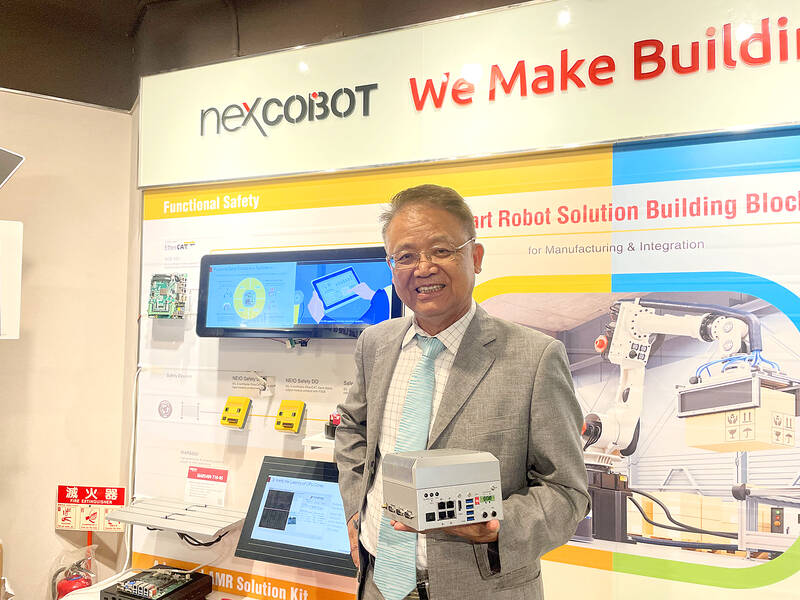
Photo: Meryl Kao, Taipei Times
Controller sales — including those for computer numerical control equipment, industrial robotic arms, collaborative robots and AI robotics — are expected to account for more than 20 percent of NexCOBOT’s total revenue next year, he said.
The company’s AI controllers made with higher-end Nvidia Corp computing modules could cost US$5,000 to US$8,000 per unit, significantly higher than standard controllers, which are priced at about US$1,000 each, Lin said.
NexCOBOT expects to ship about 500 advanced AI controllers based on Nvidia’s IGX Thor platform next year, up from several hundred units this year, he said.
Quadruped robot dogs and wheeled robots with humanoid upper bodies are likely to begin volume production earlier than fully bipedal humanoid robots, Lin said.
Nexcom, the Industrial Technology Research Institute and Compal Electronics Inc (仁寶) demonstrated a robot dog solution in July, drawing the interest of firefighting agencies, while wheeled robots are generally more practical than bipedal humanoids in factories, he said.
Fully bipedal humanoid robots still require major advances in vision-language-action models and multimodal AI, Lin said, adding that meaningful progress was unlikely for at least another three years.
To address the complexity of humanoid robots’ more than 20 joints, as well as the demands that heat dissipation, wiring and real-time synchronization place on AI controllers, NexCOBOT earlier this year introduced a “four-in-one” AI control platform that combines motion control, functional safety, AI computing and cybersecurity, Lin said.
With the four-in-one platform, NexCOBOT adds its own I/O baseboards, communications, and control hardware and software to computing modules from Nvidia and Intel Corp, enabling components such as joints, vision modules, dexterous hands, thermal-imaging systems and predictive maintenance tools to be directly integrated and operated together, he said.
“While industrial PC suppliers typically provide only graphics cards or hardware baseboards, NexCOBOT aims to offer a more complete ‘last-mile’ solution to help system makers develop and deploy robots faster,” Lin said.
Last month, NexCOBOT unveiled its “RoboWIZ AI Robot Open Platform” to bring together dozens of robotics ecosystem partners and support the development of humanoid, quadruped and dual-arm robots, while allowing customers to focus on robot design, dynamic balancing, application development and commercialization, thereby shrinking the time to market, Lin said.
Taiwanese robotics partners mainly supply cameras, thermal-imaging and predictive maintenance technologies, while functional safety joints, complete 3D vision modules and advanced dexterous hands still require the support of European and US partners, he said.
NexCOBOT works with motion control supplier Synapticon GmbH on developing functional safety joints, he added.
Nexcom plans to establish RoboWiz hubs in Taipei, Taichung and at the Curiosity Lab in Atlanta, Georgia, to serve robot system makers and engage with local ecosystem partners, Lin said.
The company also aims to leverage Taiwan’s information and communications technology integration capabilities to expand AI robotics supply chain cooperation and position the country as a key partner for US robotics development and non-China supply chains, he said.
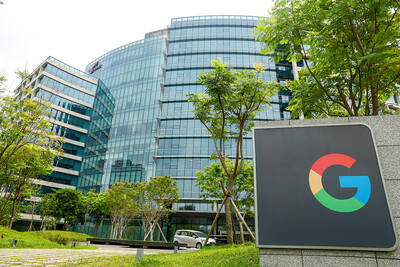
READJUSTMENT? Despite the rumors, a senior Google official said that the company plans to expand its AI research center in Taipei’s Shilin District Google Taiwan is reducing its workforce as the company continues to adjust operations to improve efficiency and focus resources on core goals, the Chinese-language Liberty Times (sister paper of the Taipei Times) reported yesterday. The Alphabet Inc unit said the organizational adjustments have begun and would continue, even though it did not put a figure on the number of potential job cuts or specify the affected departments in its Taiwan operations. The company’s response came after rumors circulated on social media about major job cuts at Google Taiwan. Some posts said the downsizing would target the company’s consumer electronics-related departments
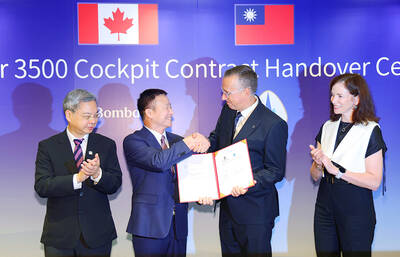
Taiwanese aircraft maker Aerospace Industrial Development Corp (AIDC, 漢翔航空) yesterday announced that it has secured a 20-year partnership agreement with Canada-based Bombardier Inc. The two companies held a ceremony in Taipei yesterday to exchange signed copies of the agreement, launching the 20-year partnership under which AIDC would supply cockpit and forward fuselage structural components for Bombardier’s super-midsize Challenger 3500 business jets, the Taiwanese company said. The agreement represents a new milestone in cooperation between the two companies, which dates back to 1999, with the Taiwanese supplier having provided rear fuselage structural components for more than 1,000 Challenger 3500 aircraft, it
FOUNDRY DATA: Demand pushed production on some TSMC lines to full utilization, while Samsung’s market share of 5.9 percent dropped, TrendForce said Taiwan Semiconductor Manufacturing Co’s (TSMC, 台積電) foundry market share edged up to 72.5 percent in the second quarter from 72.3 percent in the previous quarter, propelled by robust artificial intelligence (AI) and smartphone chip revenue, data compiled by market researcher TrendForce Corp (集邦科技) showed yesterday. TSMC’s revenue last quarter grew 12 percent sequentially to US$40.2 billion, outpacing the 11.5 percent average growth among the world’s top 10 foundry companies, the researcher said. Combined revenue of the top 10 is expected to grow further this quarter from US$53.49 billion last quarter, supported by strong demand and price hikes, it said. The increased demand has

Global notebook computer shipments are expected to fall 8 percent year-on-year to 167.9 million units this year, dragged by weak demand, high component prices and supply constraints, the Market Intelligence and Consulting Institute (MIC) said on Tuesday. Next year, shipments are expected to decline by a further 4.7 percent to 160 million units as higher retail prices weigh on consumption, MIC deputy director-general Edward Lin (林柏齊) told a news conference in Taipei. The downtrend is expected to extend into 2028, with replacement demand unlikely to recover before supplies of key components rebound and costs decline, Lin said. Surging demand for artificial intelligence (AI)


 RSS
RSS