

The global semiconductor market is expected to be worth more than US$2 trillion by 2030 because of growth driven by demand for artificial intelligence (AI) infrastructure, SEMI senior director of market intelligence Clark Tseng (曾瑞榆) said yesterday.
Earlier projections had put the market at about US$1 trillion by 2030 based on demand for traditional applications such as personal computers, smartphones and consumer electronics, Tseng said at a news conference in Taipei ahead of the opening of Semicon Taiwan trade show today.
Those forecasts have since changed significantly, as AI data centers drive demand for advanced logic chips, high-bandwidth memory (HBM) and enterprise solid-state drives (SSDs), he said.
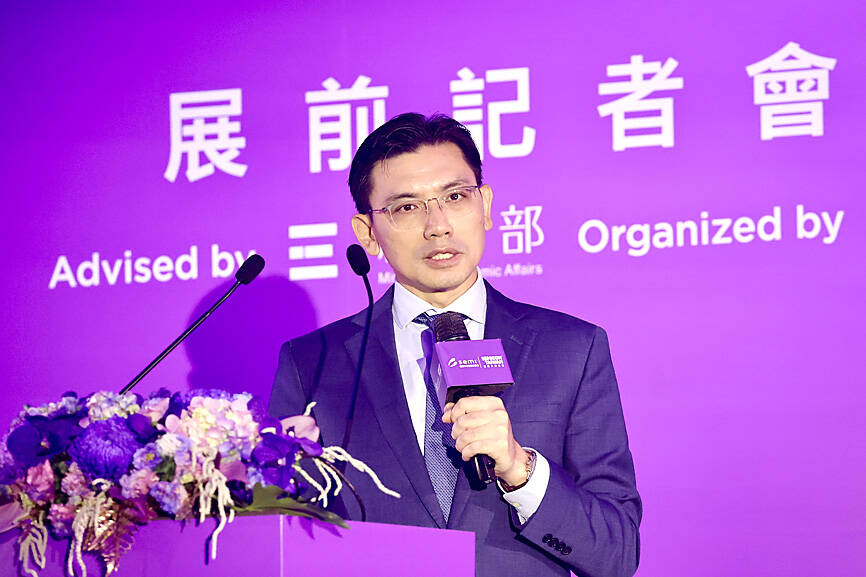
Photo: CNA
The market is expected to surpass US$1.5 trillion this year, but the growth is not broad-based, with PC and smartphone shipments remaining under pressure despite semiconductor demand outpacing overall economic and investment growth, he added.
“AI is reshaping semiconductor growth, driving sustained demand for advanced logic, HBM and DRAM, high-layer-count NAND, testing and advanced packaging equipment,” Tseng said.
SEMI expects the global wafer fab equipment market to grow to US$220 billion in 2028 from US$117 billion last year, up from its previous forecast of US$200 billion.
The association has also raised its 2028 forecasts for testing equipment to US$23.5 billion from US$20.8 billion and for packaging equipment to US$10 billion from US$8.6 billion, Tseng said.
The revisions reflect stronger investment in 2-nanometer and 3-nanometer production capacity, as well as rising demand for HBM, enterprise SSDs, and more complex chip testing and packaging, he said.
The global semiconductor materials market is expected to post double-digit growth this year and next year, reaching US$83 billion and US$92 billion respectively, Tseng said.
Taiwan is expected to account for about 30 percent of the market next year, reflecting its importance in advanced manufacturing and packaging, he said.
On the same occasion, Tien Wu (吳田玉), chair of the SEMI international board of directors and chief executive officer of ASE Technology Holding Co (日月光投控), said the rapid expansion of AI is creating stress on Taiwan’s resources.
The ecosystem required to meet strong AI demand is creating short-term pressure on land, talent, capital and electricity in the nation, while also raising concerns in other countries about the concentration of semiconductor production in Taiwan, Wu said.
However, AI’s long-term value would not come from replacing existing human knowledge, but from enabling cross-disciplinary innovation and replicating successful applications on a much larger scale, he said.
Taiwan should therefore accelerate investment in AI infrastructure while strengthening ties with international partners and explaining the purpose of that investment more clearly, he added.
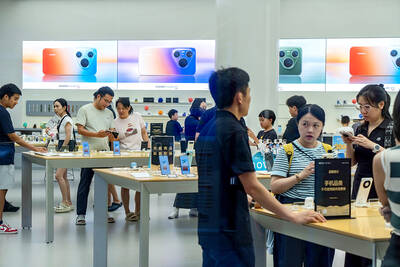
In China’s hilly Guizhou Province, a cluster of European-style buildings complete with clock tower and multi-arched bridge emits a low, permanent hum — a clue to its unexpected identity as tech giant Huawei’s largest data center. The town-like complex is unique in design, but not in its placement. Dozens of data centers have been constructed in the southwestern province in the past few years. They are part of a government strategy that has seen much of the digital infrastructure for breakneck artificial intelligence (AI) development across China’s eastern seaboard established in the country’s less populated, rural west. The build-out is ongoing. China
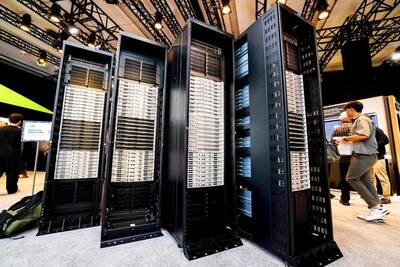
AM Intelligence, an Indian artificial intelligence (AI) infrastructure company, has ordered 9,000 Nvidia Corp Vera Rubin systems, seeking to become one of the first adopters of the advanced computing platform in Asia. Servers equipped with the rack-scale systems are slated to come online next year in southern India, the Hyderabad-based company said in a statement yesterday. Customers include major cloud service providers, AI labs and organizations aiming to develop homegrown Indian AI models, it said. Supplies of high-end Nvidia compute clusters remain tight. Demand from data centers and companies such as Microsoft Corp, Alphabet Inc’s Google and Amazon.com Inc to train AI models
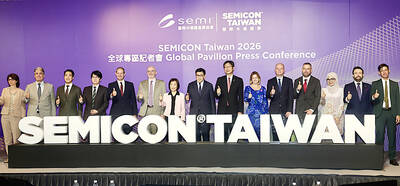
EXPANDING: Firms are accelerating commercialization of the technologies as the industry moves beyond chip-level speeds to upgrading rack-to-rack links, SEMI said Silicon photonics and copackaged optics (CPO), technologies seen as critical to meeting the surging bandwidth demands of artificial intelligence (AI) infrastructure, would be among the main themes at the Semicon Taiwan trade show, which opens on Wednesday, event organizer SEMI said yesterday. The forum runs until Friday at the Taipei Nangang Exhibition Center, with technical forums beginning today. The event is expected to set a record in terms of the number of participants, SEMI said, projecting more than 1,300 exhibitors from 65 countries across 4,300 booths and more than 100,000 attendees. Optical interconnects underpinning AI infrastructure would be one of the highlights, with
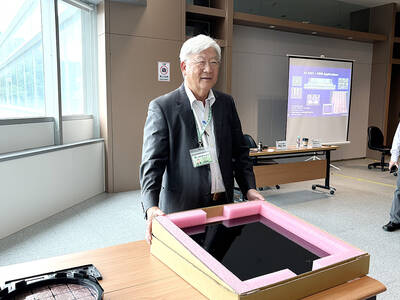
STRATEGIC GAMBLE: After developing FOPLP for six years, the chip packager has secured a 100 percent utilization rate for the new technology, its chairman said Chip packaging service provider Powertech Technology Inc (力成科技) yesterday said that its advanced fan-out panel-level packaging (FOPLP) production line has secured a 100 percent utilization rate through 2030 ahead of its scheduled volume production next year. Powertech made the remarks during the first public unveiling of its FOPLP production capabilities. The company expressed strong confidence in its long-term order pipeline, saying that robust market traction has mitigated any client acquisition concerns. “Our capacity has been fully booked by two major customers. Customers are not an issue through 2030,” Powertech chairman Tsai Du-kung (蔡篤恭) told reporters at the company’s plant in the Hsinchu


 RSS
RSS