

An onerous mock trading course is becoming an effective tool for South Korea to cool investor fervor over risky products that have turned the country’s US$4.3 trillion stock market extremely volatile.
Leveraged exchange-traded funds (ETFs) targeting twice the daily returns of chipmakers Samsung Electronics Co and SK Hynix Inc have seen their trading value collapse to 4 percent of its June peak and are set for their first monthly outflow.
Key to sapping demand has been a series of regulatory tightening moves, most recently a rule to complete five-day simulated trading. Investors must download a Windows-only program on PCs and spend at least one hour a day learning the ropes — and the risks — of leveraged trading with virtual cash.
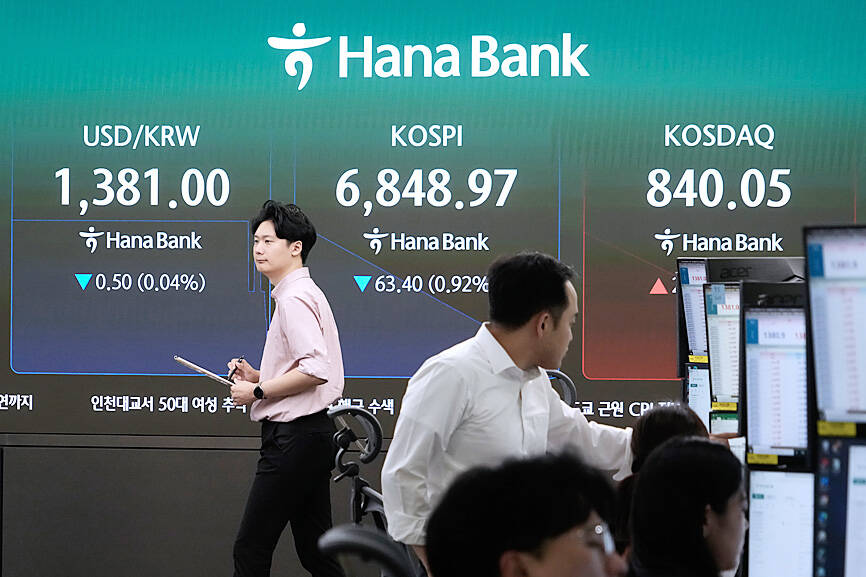
Photo: AP
Interviews with several South Korean retail investors suggested that the requirement, effective on Aug. 19, is too cumbersome to meet.
Gyeonggi Province resident Kim Jung-hoon said his first reaction to the mandatory mock trading was that he would not attempt it, as it was “too much of a hassle.”
“The hours sound long and you can only download the program on PCs,” Kim said. “My work computer can’t download external programs. It doesn’t sound easy to bring an extra laptop with me to work.”
The exercises add to a slew of regulatory curbs since last month to deter investors from trading the leveraged ETFs tied to Samsung and SK Hynix. Earlier measures included a higher minimum deposit.
The system gives investors a virtual cash deposit of 100 million won (US$72,560), offering a first-hand lesson on the perils of trading risky instruments. It lets them witness the so-called “volatility decay” — how returns can erode over time for leveraged products.
Another retail investor, Lee, who asked to be identified by his surname only, said he satisfied all the other prerequisites including the 30 million won minimum cash deposit, but stumbled over the mock trading course.
“You have to download a program and there were minimum time requirements,” Lee said, adding that he also had to create a new membership account. “So I didn’t proceed. I just turned off there.”
The single-stock ETFs tied to Samsung Electronics and SK Hynix have seen combined outflows of about US$1 billion so far this month, poised to experience their first monthly fund exodus, Bloomberg Intelligence data showed.
The ETFs’ combined assets under management shrank to US$5 billion as of Thursday, down from US$11.4 billion at their peak in late June.
While the rapid contraction in trading might frustrate investors hoping to cash out at higher levels, it has helped stabilize the market. The KOSPI’s volatility gauge has slid to a four month low of about 50, down from a peak of 97 in late June. The stock benchmark is up 61 percent so far this year, but remains 25 percent below its record high reached two months ago.
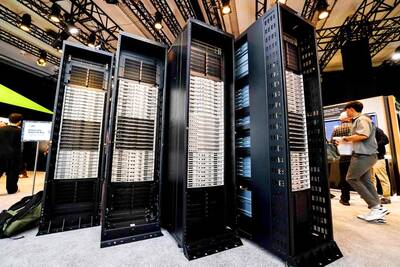
AM Intelligence, an Indian artificial intelligence (AI) infrastructure company, has ordered 9,000 Nvidia Corp Vera Rubin systems, seeking to become one of the first adopters of the advanced computing platform in Asia. Servers equipped with the rack-scale systems are slated to come online next year in southern India, the Hyderabad-based company said in a statement yesterday. Customers include major cloud service providers, AI labs and organizations aiming to develop homegrown Indian AI models, it said. Supplies of high-end Nvidia compute clusters remain tight. Demand from data centers and companies such as Microsoft Corp, Alphabet Inc’s Google and Amazon.com Inc to train AI models

In China’s hilly Guizhou Province, a cluster of European-style buildings complete with clock tower and multi-arched bridge emits a low, permanent hum — a clue to its unexpected identity as tech giant Huawei’s largest data center. The town-like complex is unique in design, but not in its placement. Dozens of data centers have been constructed in the southwestern province in the past few years. They are part of a government strategy that has seen much of the digital infrastructure for breakneck artificial intelligence (AI) development across China’s eastern seaboard established in the country’s less populated, rural west. The build-out is ongoing. China

Xiaomi Corp (小米) has launched a mobile processor for its marquee devices, putting pressure on Qualcomm Inc and MediaTek Inc (聯發科), which for years supplied the key component to the Chinese company. The Xring O3 system-on-a-chip advances Xiaomi’s in-house semiconductor design efforts with more power-efficient image processing and better artificial intelligence capabilities, the Beijing-based company said in a post on Sina Weibo yesterday. The company’s new silicon is made using a 3-nanometer fabrication process, Xiaomi founder Lei Jun (雷軍) said in a WeChat post . That is closer to the node used for Apple Inc’s most recent A19 Pro chips and well ahead
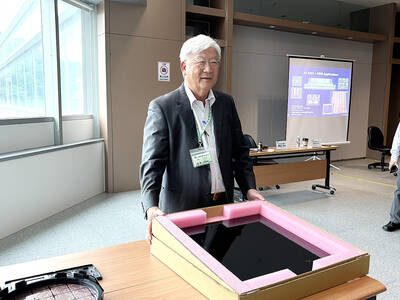
STRATEGIC GAMBLE: After developing FOPLP for six years, the chip packager has secured a 100 percent utilization rate for the new technology, its chairman said Chip packaging service provider Powertech Technology Inc (力成科技) yesterday said that its advanced fan-out panel-level packaging (FOPLP) production line has secured a 100 percent utilization rate through 2030 ahead of its scheduled volume production next year. Powertech made the remarks during the first public unveiling of its FOPLP production capabilities. The company expressed strong confidence in its long-term order pipeline, saying that robust market traction has mitigated any client acquisition concerns. “Our capacity has been fully booked by two major customers. Customers are not an issue through 2030,” Powertech chairman Tsai Du-kung (蔡篤恭) told reporters at the company’s plant in the Hsinchu


 RSS